
Free Safe Operating Procedure (Metal Pickling) Template
Develop a structured Safe Operating Procedure for metal pickling processes to manage chemical and operational risks effectively.
Free Safe Operating Procedure (Metal Pickling) Template
DOCX • 126 KB + PDF
Updated Oct 2026
No signup required
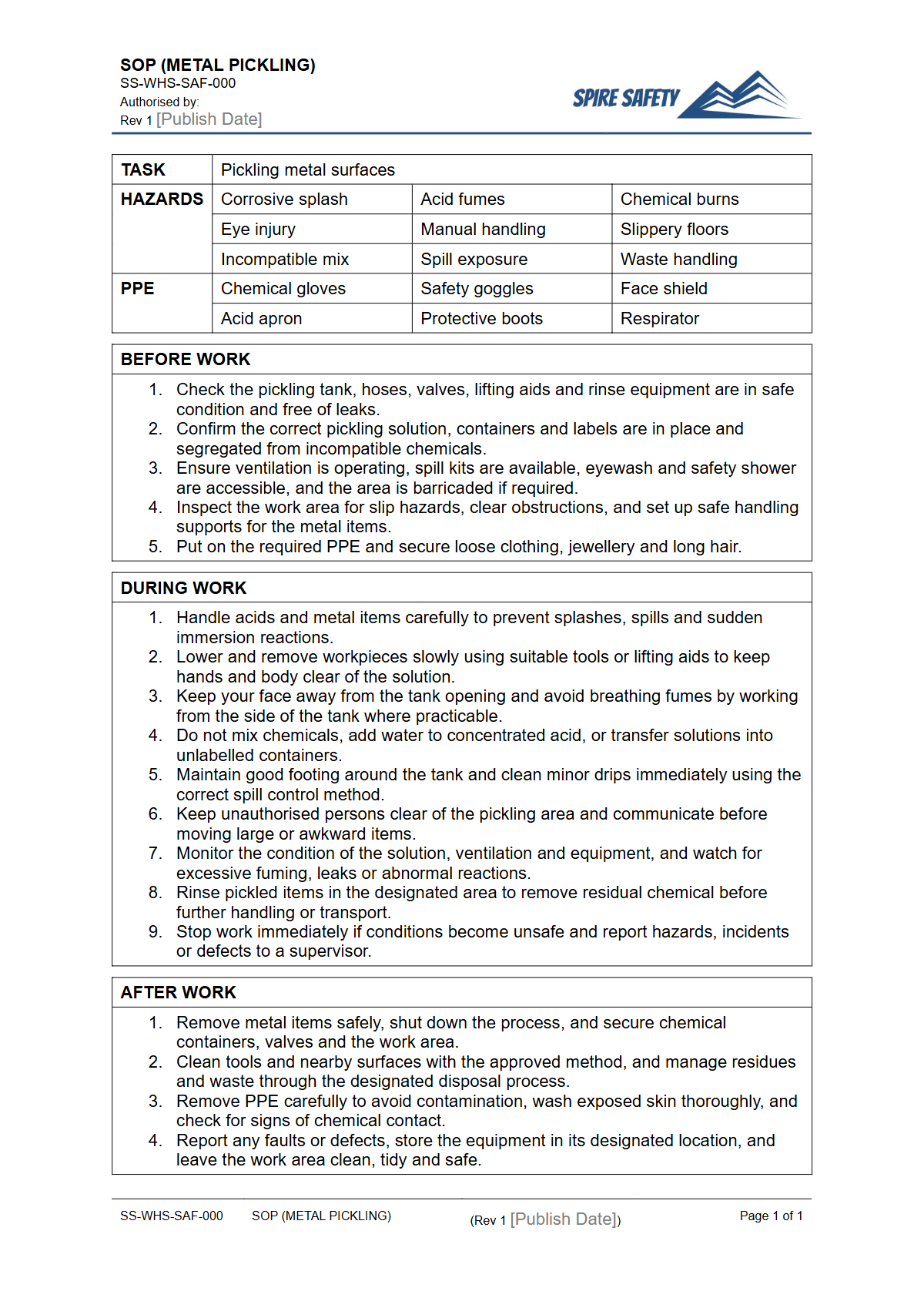
Purpose of the Free Safe Operating Procedure (Metal Pickling) Template
This Free Safe Operating Procedure (Metal Pickling) Template provides a structured starting point for documenting the step-by-step process for safely performing metal pickling tasks. Metal pickling involves the use of highly corrosive acids to remove impurities, scale, and rust from metal surfaces.
Due to the significant risks posed by hazardous chemicals and associated processes, a formal SOP is a critical tool for any organisation conducting this work.
A well-developed SOP helps to standardise safe work practices, minimise the risk of chemical burns, toxic fume inhalation, and other injuries, and provides a clear guide for worker training. Documenting your procedures is a key part of demonstrating how your organisation is meeting its duties under Australian WHS laws.
It serves as a foundational component within broader WHS management systems, ensuring consistent and safe operational behaviour.
Video walkthrough
How to use the Free Safe Operating Procedure (Metal Pickling) Template
This resource is available as a fully editable DOCX file and a print-ready PDF. The DOCX version allows you to tailor the content to the unique requirements of your workplace.
Important: This is a template only. You must customise this document to reflect your specific site conditions, the types of acids and other chemicals used, the equipment in operation, and your established emergency procedures.
We are not responsible for the outcomes of any documentation you produce using this template. To properly customise it, you should:
- Consult with workers who perform the task, as they have direct knowledge of the risks involved.
- Thoroughly review the Safety Data Sheets (SDS) for every chemical used in your pickling process.
- Incorporate the make and model of your specific plant and equipment, including tanks, hoists, and ventilation systems.
- Detail your workplace's specific emergency response, first aid, and spill containment procedures.
If you are uncertain about any aspect of managing hazardous chemical risks, seeking professional WHS consulting is highly recommended to ensure your procedures are robust and effective.
Key Hazards in Metal Pickling
A comprehensive SOP must identify and control all foreseeable hazards. For metal pickling, these primarily include:
- Chemical Exposure: Direct contact with pickling acids (such as hydrochloric or sulfuric acid) can cause severe chemical burns to the skin and eyes. Inhalation of acid mists or vapours can cause serious respiratory damage.
- Hazardous Atmospheres: Pickling processes can release toxic gases (e.g., hydrogen gas, which is flammable) and vapours, requiring robust mechanical ventilation and atmospheric monitoring to prevent worker exposure and potential fire or explosion.
- Plant and Equipment: Hazards may arise from manual handling of parts, or from the failure of equipment like tanks, cranes, or heating elements. Larger automated lines may introduce further risks, similar to those managed by a Conveyer System SOP. Ancillary equipment used in the workshop must also have its own procedures, like our Air Compressor SOP.
- Reactive Chemical Hazards: Improper mixing or contamination of chemicals can lead to violent reactions, explosions, or the release of highly toxic gases.
When to use a Safe Operating Procedure
An SOP for metal pickling should be developed before the work is carried out for the first time. It is a critical document that should be used consistently during:
- Worker Training and Induction: To ensure all operators understand the correct, safe method for performing the task.
- Pre-start Checks: As a reference for workers to confirm that all safety controls, including PPE and ventilation, are in place and functional.
- Ongoing Operations: As a guide for completing the task safely and consistently every time.
- Risk Assessments and Reviews: To inform the risk assessment process and to be reviewed and updated whenever a process changes or an incident occurs.
Who should use this template
This Safe Operating Procedure template is designed for use by Persons Conducting a Business or Undertaking (PCBUs), as well as their nominated managers and supervisors. Specifically, it is for:
- WHS Managers and Safety Officers: To draft, implement, and manage safety documentation as part of the overall safety management system.
- Workshop and Production Supervisors: To train workers, enforce safe work practices, and ensure procedures are followed on the floor.
- Workers: Operators performing metal pickling must be trained in the SOP and use it as their primary guide for safe task execution.
- Auditors and Safety Committees: To review and verify that safe systems of work are documented and implemented effectively, often as part of regular WHS compliance auditing.
By establishing and following a clear SOP, your organisation can significantly reduce the likelihood of serious incidents. Explore our free WHS resources library for more templates to support your safety management system.
Common mistakes
Common mistakes to avoid
- Using a generic SOP template without customising it for specific workplace chemicals and equipment.
- Neglecting to provide and maintain adequate mechanical ventilation, leading to the build-up of hazardous fumes.
- Failing to provide task-specific training to workers on the procedures and emergency responses outlined in the SOP.
- Storing acids and other chemicals incorrectly, increasing the risk of spills, degradation, or dangerous reactive incidents.
Legal references
Legal considerations
The following legal requirements may be relevant to this type of work.
- Work Health and Safety Act (Harmonised) — Provides the primary duties for protecting workers and other people from work health and safety risks.
- Work Health and Safety Regulations (Harmonised) — Sets out requirements supporting the management of workplace hazards and risks.
The following codes may be relevant to this type of work.
- Managing WHS Risks Code of Practice — Provides practical guidance on identifying hazards, assessing risks and applying effective controls.
- Work Health and Safety Consultation, Cooperation and Coordination Code of Practice — Provides practical guidance on consulting workers and coordinating with other duty holders.
- Managing the Work Environment and Facilities Code of Practice — Provides practical guidance on safe work environments, workplace facilities and related controls.
Did you know
A Change in Acids
Historically, sulfuric acid was the most common pickling agent for steel. Today, hydrochloric acid is often preferred because it pickles faster at ambient temperatures and provides a cleaner surface finish.
Splash Risk
Acid splash is one of the most frequent injuries in metal pickling, with eyes and skin being most at risk. This is why appropriate PPE, splash guarding, and accessible emergency eyewash stations are non-negotiable safety controls.
FAQ
Frequently asked questions
01What acids are commonly used in metal pickling and what are their main hazards?
02How often should a Safe Operating Procedure for metal pickling be reviewed?
03What personal protective equipment (PPE) is essential for metal pickling?
04Is a Safe Work Method Statement (SWMS) required for metal pickling?
Share this resource
Free Safe Operating Procedure (Metal Pickling) Template
Browse Categories
How To Use It
- 1Download and open in Word or PDF.
- 2Replace the placeholders with your business details.
- 3Get it reviewed by a WHS specialist before rollout.
Need it customised?
Our WHS consultants can adapt this template to your site, run a gap analysis, or audit what you already have in place.
Book a Free Consultation WHS consulting servicesor call 1300 156 382
Related templates
- Free Safe Operating Procedure (Meter Installation) Template
- Free Safe Operating Procedure (Meter Room Cleaning) Template
- Free Safe Operating Procedure (Metering Pump) Template
- Free Safe Operating Procedure (Microbial Sampling) Template
- Free Safe Operating Procedure (Microscope Cleaning) Template
- Free Safe Operating Procedure (MIG Spot Welding) Template