
Free Safe Operating Procedure (Microscope Cleaning) Template
Properly cleaning delicate lab equipment like microscopes requires a clear, safe process. Download our free, customisable Safe Operating Procedure template now.
Free Safe Operating Procedure (Microscope Cleaning) Template
DOCX • 126 KB + PDF
Updated Oct 2026
No signup required
Purpose of the Free Safe Operating Procedure (Microscope Cleaning) Template
Cleaning scientific instruments like microscopes is a delicate task that requires precision and care. Using a standardised procedure is essential for protecting both the equipment and the personnel involved.
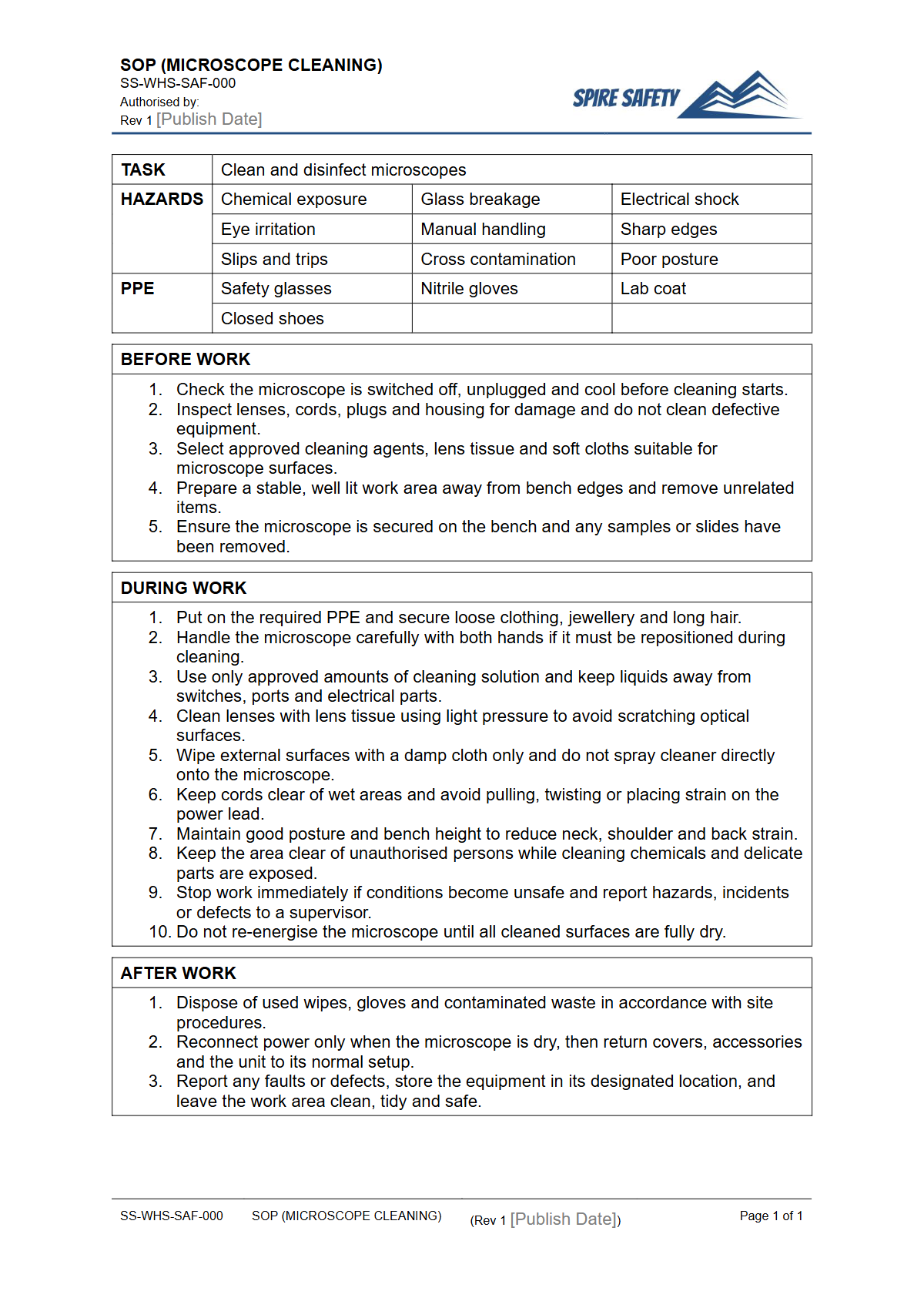
This Free Safe Operating Procedure (Microscope Cleaning) Template provides a structured starting point for laboratories, educational institutions, and research facilities to document the required steps for maintaining their equipment safely and effectively.
The primary purpose of this SOP is to minimise risks associated with the task. These can include exposure to hazardous cleaning chemicals, ergonomic strain from poor posture, and the potential for costly damage to sensitive optical components.
By outlining clear, sequential instructions, required Personal Protective Equipment (PPE), and emergency protocols, this template helps organisations fulfil their duty of care and promote a consistent standard of work. It serves as a vital tool for training new staff and for regular refresher training, ensuring everyone understands the correct, safe method for the task.
Video walkthrough
How to use the Free Safe Operating Procedure (Microscope Cleaning) Template
This resource is available for immediate download as a DOCX file, allowing for easy editing and customisation, as well as a print-ready PDF. To use it effectively, you must adapt its contents to the specific context of your workplace.
An SOP is not a one-size-fits-all document; its value comes from its direct relevance to the tasks your workers perform.
Important: You must customise this Safe Operating Procedure to align with your organisation’s specific equipment, chemical inventory, and risk assessments. This involves reviewing the manufacturer's manual for each microscope, consulting the Safety Data Sheets (SDS) for all cleaning agents, and incorporating site-specific emergency contacts and procedures.
Integrating this SOP into your broader WHS management systems ensures it functions as part of a cohesive safety framework, rather than a standalone document.
Key Elements of a Microscope Cleaning SOP
A comprehensive SOP for microscope cleaning should be clear, concise, and easy for any trained user to follow. This template is organised to include all critical information, guiding you to develop a robust document for your workplace. Key sections you will need to customise include:
Hazards and Risk Control
This section prompts you to identify all potential hazards associated with the task. Examples include chemical risks from solvents like isopropyl alcohol, biological hazards if viewing live specimens, and ergonomic risks from prolonged, static postures.
For each hazard, you must specify the control measures to be implemented, such as using local exhaust ventilation or ensuring proper ergonomic setup.
Personal Protective Equipment (PPE)
Detail the specific PPE required to perform the job safely. This typically includes non-shedding nitrile gloves to protect from chemicals and prevent skin oils from contaminating optics, along with safety glasses to guard against splashes.
A lab coat may also be necessary depending on the chemicals used.
Step-by-Step Procedure
This is the core of the SOP. The procedure should be broken down into logical, sequential steps, covering pre-operation checks, the cleaning process itself, and post-cleaning tasks.
It should differentiate between cleaning the microscope frame, stage, eyepieces, and objective lenses, as each may require different techniques and materials to avoid damage. Vague instructions lead to errors, so be as specific as possible.
When to use this Safe Operating Procedure
This SOP should be the primary reference document for all microscope cleaning activities. It is used:
- As a training tool: For inducting new laboratory staff, students, or researchers who will be using the equipment.
- Before performing the task: As a pre-start checklist to ensure all safety measures are in place and the correct materials are on hand.
- During periodic maintenance: For scheduled deep cleaning routines, distinct from the light cleaning performed after daily use.
- For auditing and review: Supervisors can use the SOP as a benchmark to assess whether correct procedures are being followed. For complex laboratory environments, engaging specialist WHS consulting can help refine and integrate these procedures effectively.
Who should use it
This Safe Operating Procedure is intended for all personnel who are authorised and trained to clean and maintain microscopes within your organisation. This includes:
- Laboratory Technicians and Assistants
- Research Scientists and Associates
- Students (in educational settings, under supervision)
- Quality Control Analysts
- Instrument Maintenance Staff
- Supervisors and Lab Managers responsible for training and compliance
Ensuring that only competent individuals perform this task is crucial for preventing equipment damage and workplace incidents. If this document is helpful, you may find other useful documents in our free WHS resources library to support your safety management efforts.
Common mistakes
Common mistakes to avoid
- Using abrasive materials like standard paper towels or tissues on lenses, which causes scratches.
- Applying cleaning fluid directly to a lens instead of onto a cleaning wipe or lens paper.
- Using incorrect solvents (e.g., acetone) that can dissolve seals and damage lens coatings.
- Forgetting to clean eyepieces, which are a common source of perceived dirt in the visual field.
Legal references
Legal considerations
The following legal requirements may be relevant to this type of work.
- Work Health and Safety Act (Harmonised) — Provides the primary duties for protecting workers and other people from work health and safety risks.
- Work Health and Safety Regulations (Harmonised) — Sets out requirements supporting the management of workplace hazards and risks.
The following codes may be relevant to this type of work.
- Managing WHS Risks Code of Practice — Provides practical guidance on identifying hazards, assessing risks and applying effective controls.
- Work Health and Safety Consultation, Cooperation and Coordination Code of Practice — Provides practical guidance on consulting workers and coordinating with other duty holders.
- Managing the Work Environment and Facilities Code of Practice — Provides practical guidance on safe work environments, workplace facilities and related controls.
Did you know
Lens Fungus
Leaving immersion oil on an objective lens can damage the coating and promote fungus growth, which etches the glass and can permanently ruin the optic.
Cost of Damage
Improper cleaning is a leading cause of damage to scientific instruments. A single high-end research microscope objective can cost thousands of dollars to replace.
FAQ
Frequently asked questions
01What cleaning agents are safe for microscopes?
02How often should a microscope be cleaned?
03Is this microscope cleaning SOP template suitable for all types of microscopes?
04Why is a Safe Operating Procedure necessary for cleaning a microscope?
Share this resource
Free Safe Operating Procedure (Microscope Cleaning) Template
Browse Categories
How To Use It
- 1Download and open in Word or PDF.
- 2Replace the placeholders with your business details.
- 3Get it reviewed by a WHS specialist before rollout.
Need it customised?
Our WHS consultants can adapt this template to your site, run a gap analysis, or audit what you already have in place.
Book a Free Consultation WHS consulting servicesor call 1300 156 382
Related templates
- Free Safe Operating Procedure (MIG Spot Welding) Template
- Free Safe Operating Procedure (Milk Fridge Cleaning) Template
- Free Safe Operating Procedure (Milk Frother) Template
- Free Safe Operating Procedure (Milk Vat Cleaning) Template
- Free Safe Operating Procedure (Milking Machine) Template
- Free Safe Operating Procedure (Milkshake Mixer) Template