
Free Safe Operating Procedure (Milk Vat Cleaning) Template
Download our free Safe Operating Procedure for milk vat cleaning. This customisable template helps dairy farms manage chemical and manual handling risks.
Free Safe Operating Procedure (Milk Vat Cleaning) Template
DOCX • 126 KB + PDF
Updated Oct 2026
No signup required
Purpose of the Free Safe Operating Procedure (Milk Vat Cleaning) Template
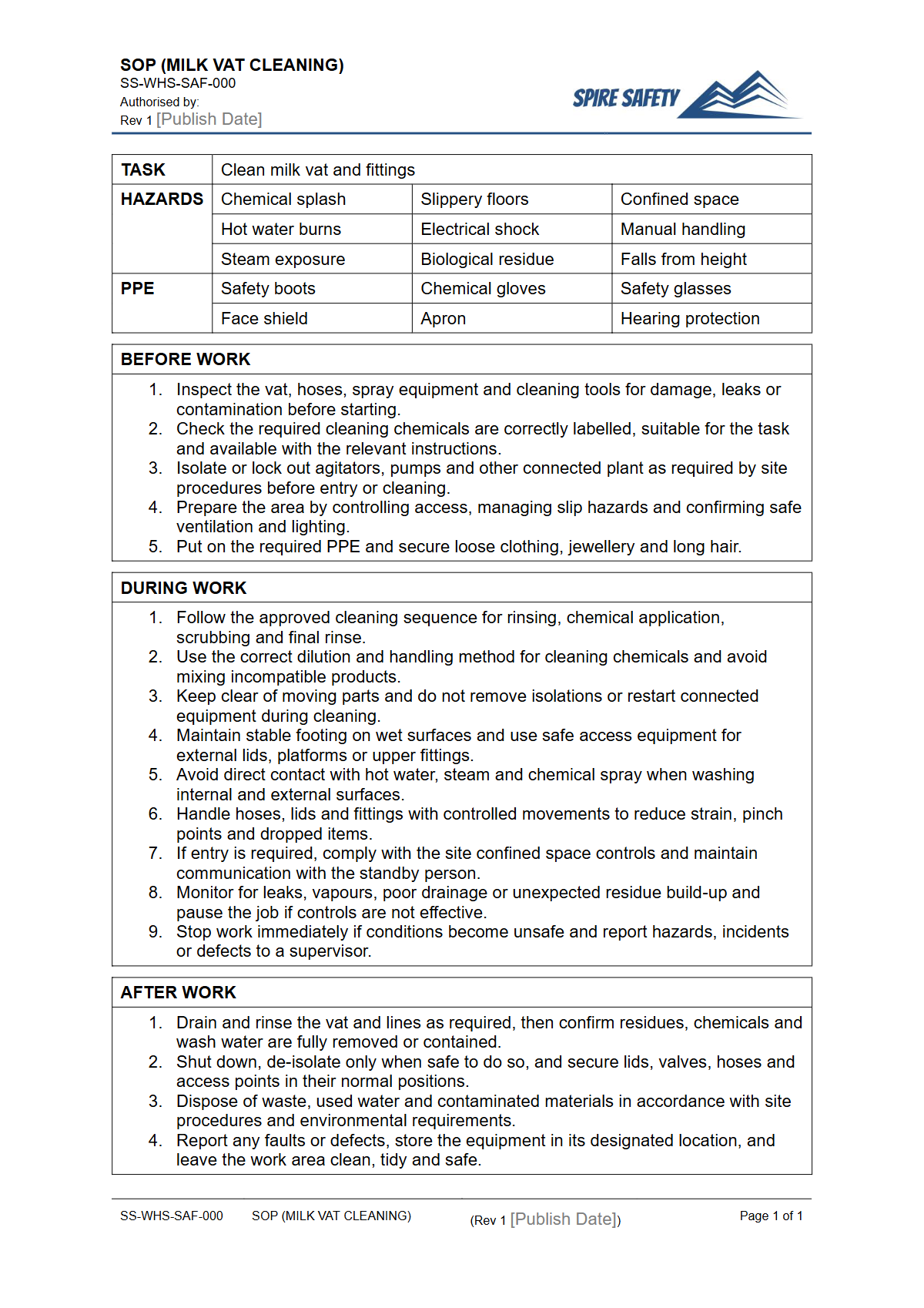
This Safe Operating Procedure (SOP) for milk vat cleaning provides a structured framework for dairy operators and food processing facilities to document a safe system of work. The primary purpose is to minimise the risk of injury and illness to workers by clearly outlining the hazards and control measures associated with the task.
A properly implemented SOP is a cornerstone of effective WHS management systems, helping to ensure consistent and safe work practices.
Key hazards addressed in this process include:
- Chemical Exposure: Contact with detergents, sanitisers, and acids can cause burns, respiratory irritation, or long-term health effects.
- Slips, Trips, and Falls: Wet floors are inherent to the cleaning process, increasing the risk of falls.
- Thermal Hazards: Use of hot water creates a risk of scalding and serious burns.
- Electrical Hazards: Interaction with electrically powered pumps, agitators, and control units while using water presents a risk of electric shock.
- Ergonomic Injuries: Manual scrubbing, lifting chemical containers, and working in awkward postures can lead to musculoskeletal disorders.
By standardising the cleaning process, this SOP also helps supports your compliance efforts with food safety and hygiene standards, preventing milk contamination from chemical residues or inadequate cleaning.
Video walkthrough
How to use the Free Safe Operating Procedure (Milk Vat Cleaning) Template
This document is a template and is not a complete Safe Operating Procedure. It must be customised to reflect the specific equipment, chemicals, and conditions of your workplace.
To effectively use this template, you should consult with the workers who perform the task and review the Safety Data Sheets (SDS) for all chemicals used.
Key customisation steps include:
- Identifying the specific make and model of the milk vat and any associated cleaning equipment.
- Listing the exact names of cleaning and sanitising chemicals, along with their required concentrations, contact times, and temperature requirements.
- Detailing the site-specific sequence for draining, pre-rinsing, washing, post-rinsing, and sanitising.
- Specifying the exact Personal Protective Equipment (PPE) required, such as chemical-resistant gloves, safety glasses or face shields, and waterproof boots.
- Outlining the steps for isolating energy sources (lockout-tagout) before any manual entry or maintenance.
For tasks that require workers to access the top of the vat, a safe method of access must be established. This may involve fixed platforms or, for temporary access, a mobile ladder, which should be covered by its own procedure, such as our FREE Step Ladder SOP Template. We strongly recommend that a competent person reviews and approves the final, site-specific document before it is put into use.
When to use this Safe Operating Procedure
An SOP for milk vat cleaning should be used as a primary reference document for several key activities within your organisation. It is a 'live' document that forms an integral part of daily operations and safety management.
Its primary uses include guiding workers through the task safely each time it is performed and serving as a foundational tool for training new employees or conducting refresher courses for existing staff. Furthermore, the development and review of this SOP is a critical part of the risk management process, helping to identify and control hazards before they cause an incident. A current and well-maintained SOP is also a key piece of documentation reviewed during any internal or external WHS compliance auditing.
Who should use this Safe Operating Procedure
This SOP is intended for all personnel involved in the milk vat cleaning process. This includes:
- Workers/Operators: To follow the step-by-step instructions to perform the cleaning task safely and effectively.
- Supervisors and Managers: To train workers, monitor compliance with the procedure, and ensure all safety controls are in place and functional.
- WHS Representatives and Officers: To use as a reference during workplace inspections, incident investigations, and safety consultations.
- Persons Conducting a Business or Undertaking (PCBUs): To help meet their primary duty of care under WHS legislation by providing and maintaining a safe system of work.
Ultimately, a collaborative approach where workers are consulted during the SOP's development and review ensures the procedure is practical, accurate, and effective. Just as it's vital to have clear instructions for farm machinery, such as those detailed in a Free Air Compressor SOP (Safe Operating Procedure) Template, cleaning procedures demand the same level of rigour. For more templates to support your safety systems, you can browse our complete free WHS resources library.
Common mistakes
Common mistakes to avoid
- Using incorrect chemical concentrations, leading to ineffective cleaning or equipment damage.
- Failing to wear appropriate Personal Protective Equipment (PPE), especially eye and skin protection.
- Neglecting to isolate energy sources (e.g., agitator, cooling unit) before starting manual cleaning.
- Not rinsing thoroughly, leaving chemical residues that can contaminate the next batch of milk.
Legal references
Legal considerations
The following legal requirements may be relevant to this type of work.
- Work Health and Safety Act (Harmonised) — Provides the primary duties for protecting workers and other people from work health and safety risks.
- Work Health and Safety Regulations (Harmonised) — Sets out requirements supporting the management of workplace hazards and risks.
The following codes may be relevant to this type of work.
- Managing WHS Risks Code of Practice — Provides practical guidance on identifying hazards, assessing risks and applying effective controls.
- Work Health and Safety Consultation, Cooperation and Coordination Code of Practice — Provides practical guidance on consulting workers and coordinating with other duty holders.
- Managing the Work Environment and Facilities Code of Practice — Provides practical guidance on safe work environments, workplace facilities and related controls.
Did you know
Corrosive Bacteria
The lactic acid produced by bacteria in residual milk is corrosive and can damage the stainless steel surface of a milk vat over time if it is not cleaned effectively after every collection.
Temperature Shock
Introducing very hot water into a refrigerated tank can cause 'temperature shock,' creating stress on the metal and welds. This is why most cleaning procedures include a temperate pre-rinse to gradually warm the surface.
FAQ
Frequently asked questions
01What are the main hazards involved in cleaning a milk vat?
02Is a Safe Operating Procedure a legal requirement in Australia?
03How often should a milk vat cleaning SOP be reviewed?
04Can this template be used for automated Clean-In-Place (CIP) systems?
Share this resource
Free Safe Operating Procedure (Milk Vat Cleaning) Template
Browse Categories
How To Use It
- 1Download and open in Word or PDF.
- 2Replace the placeholders with your business details.
- 3Get it reviewed by a WHS specialist before rollout.
Need it customised?
Our WHS consultants can adapt this template to your site, run a gap analysis, or audit what you already have in place.
Book a Free Consultation WHS consulting servicesor call 1300 156 382
Related templates
- Free Safe Operating Procedure (Milking Machine) Template
- Free Safe Operating Procedure (Milkshake Mixer) Template
- Free Safe Operating Procedure (Mincer Bowl Cutter Operation) Template
- Free Safe Operating Procedure (Mine Dewatering) Template
- Free Safe Operating Procedure (Mine Ventilation Fan) Template
- Free Safe Operating Procedure (Mixed Recycling Sort) Template