
Free Safe Operating Procedure (Mine Ventilation Fan) Template
Manage risks associated with mine ventilation fan operation with our structured Safe Operating Procedure template. Download the free DOCX and PDF today.
Free Safe Operating Procedure (Mine Ventilation Fan) Template
DOCX • 126 KB + PDF
Updated Oct 2026
No signup required
Purpose of the Free Safe Operating Procedure (Mine Ventilation Fan) Template
This Free Safe Operating Procedure (Mine Ventilation Fan) Template provides a structured framework for documenting the safe operation, maintenance, and inspection of primary, secondary, and auxiliary ventilation fans in a mining environment. Effective ventilation is critical for controlling atmospheric contaminants like dust, gases, and diesel particulate matter, managing heat, and ensuring a safe, breathable atmosphere for all personnel underground.
A documented SOP helps standardise procedures, reduce the risk of equipment failure, and ensure consistent, safe work practices across all shifts.
Using a clear and comprehensive SOP is a fundamental part of managing high-risk activities. This template is designed to assist your organisation in meeting its work health and safety obligations by formalising the steps required for safe fan operation.
It serves as a vital tool for worker training, incident investigation, and demonstrating due diligence. Properly implemented, it helps prevent catastrophic events such as fires, explosions, or asphyxiation linked to ventilation failure.
Video walkthrough
How to use the Free Safe Operating Procedure (Mine Ventilation Fan) Template
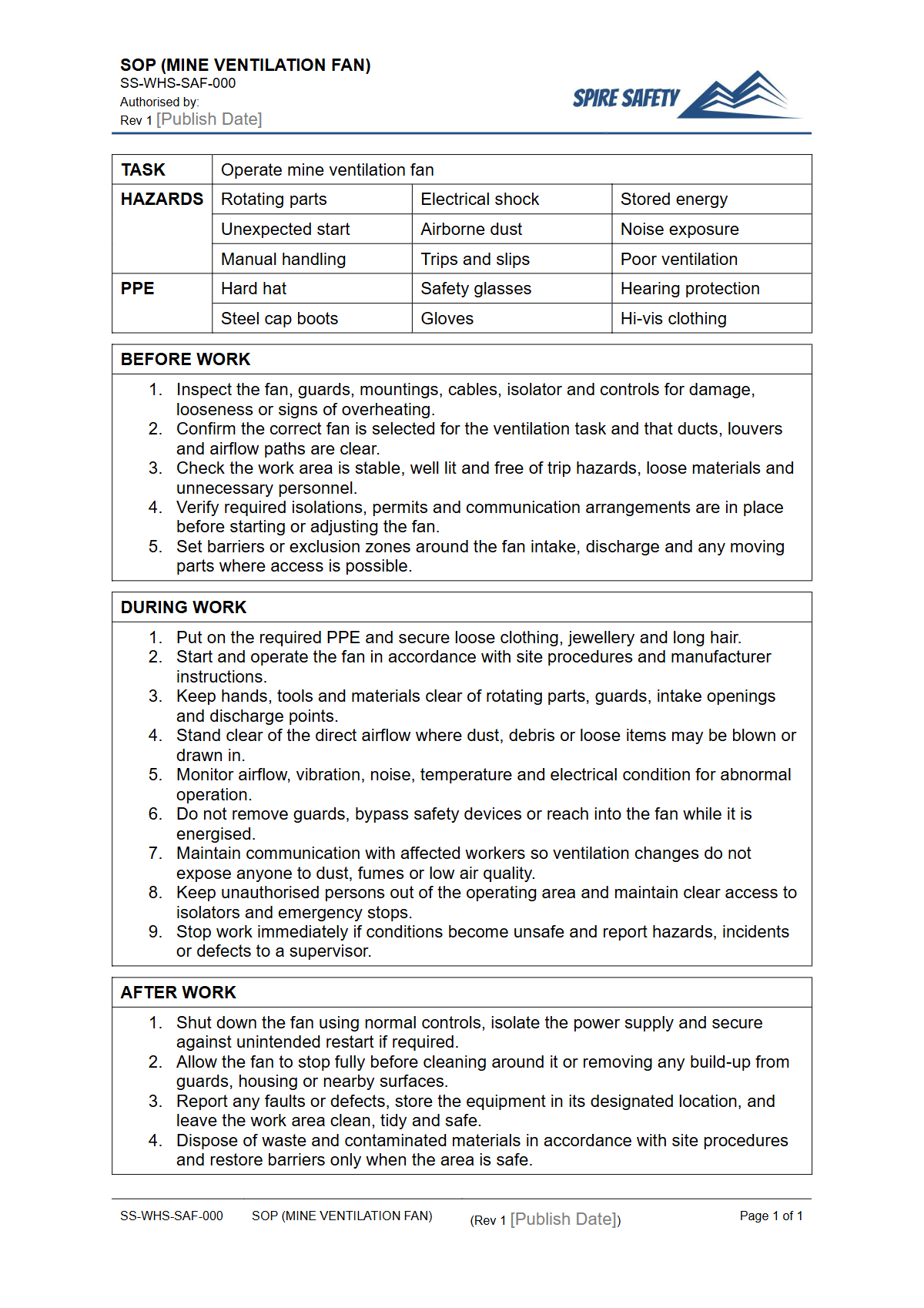
To use this Free Safe Operating Procedure (Mine Ventilation Fan) Template, download the DOCX file and begin customising it to reflect your specific operational context. The document is pre-formatted with key sections, including required PPE, risk controls, pre-start checks, and emergency procedures.
Your task is to populate these sections with details relevant to your specific fan models, site layout, and established safety protocols. Once finalised, the procedure can be saved as a PDF for easy distribution and access in work areas.
IMPORTANT: This document is a template and must be customised to your workplace. We have provided a structured starting point aligned with Australian WHS principles, but you are responsible for ensuring the final SOP is tailored to your site-specific machinery, hazards, risk controls, and legal obligations.
Failure to conduct a thorough customisation process can result in a non-effective procedure.
Key Sections of the Template
The template guides you through several critical areas required for a robust SOP. It prompts you to identify all potential hazards associated with the task, such as electrical energy, rotating parts, noise, and confined spaces.
You must then detail the specific risk controls for each hazard, like lockout/tagout procedures, guarding, and hearing protection. Documenting these steps is as crucial for ventilation systems as it is for mobile plant, as outlined in our FREE Grader SOP Template.
The procedure includes a step-by-step guide for pre-operational checks, startup, normal operation, and shutdown. This ensures that operators follow a safe and consistent sequence every time.
It also contains a dedicated section for emergency procedures, detailing the immediate actions to take in case of fan failure, fire, or other critical incidents. Like other heavy equipment procedures, such as our Free Air Compressor SOP Template, it emphasises proactive checks to prevent failure.
When to use it
This Safe Operating Procedure should be used and readily available during all phases of a mine ventilation fan's lifecycle. It is not just a document for normal operation but a critical guide for installation, commissioning, routine inspections, and planned maintenance activities.
It should be consulted before any interaction with the fan system, especially for non-routine tasks or troubleshooting. Furthermore, the SOP is a primary reference document during safety audits, worker inductions, and refresher training sessions. Formalising these procedures is a core component of a strong WHS management system.
Who should use it
This SOP is intended for all personnel who interact with or work in proximity to mine ventilation fans. This includes, but is not limited to, Ventilation Officers, mine deputies or supervisors, electricians, mechanical fitters, and designated equipment operators.
It is also an essential resource for safety managers and trainers responsible for developing and delivering training programs. Supervisors should use the SOP to conduct task observations and verify that the documented safe work practices are being followed correctly in the field. Regular verification helps maintain high safety standards, a process that can be formalised through scheduled WHS compliance auditing.
The document serves as a clear communication tool, ensuring that everyone, from a new starter to an experienced maintenance artisan, understands the expectations for safe behaviour and the critical steps needed to manage risks. For more templates covering different types of plant and equipment, you can explore our complete free WHS resources library.
Common mistakes
Common mistakes to avoid
- Failing to adequately customise the template with site-specific fan models and procedures.
- Neglecting to implement and verify effective lockout/tagout (LOTO) procedures before any maintenance.
- Performing inadequate pre-start checks, leading to operation with undetected faults.
- Providing insufficient training on emergency response procedures for fan failure.
Legal references
Legal considerations
The following legal requirements may be relevant to this type of work.
- Work Health and Safety Act (Harmonised) — Provides the primary duties for protecting workers and other people from work health and safety risks.
- Work Health and Safety Regulations (Harmonised) — Sets out requirements supporting the management of workplace hazards and risks.
The following codes may be relevant to this type of work.
- Managing WHS Risks Code of Practice — Provides practical guidance on identifying hazards, assessing risks and applying effective controls.
- Work Health and Safety Consultation, Cooperation and Coordination Code of Practice — Provides practical guidance on consulting workers and coordinating with other duty holders.
- Managing the Work Environment and Facilities Code of Practice — Provides practical guidance on safe work environments, workplace facilities and related controls.
Did you know
Air Volume
A single large primary ventilation fan at an underground mine can move over 500 cubic metres of air per second. This is equivalent to emptying an Olympic-sized swimming pool of air in just five seconds.
Historic Importance
Before mechanised ventilation, mine airflow was often managed using furnaces at the base of an upcast shaft to create a convection current. This was a hazardous practice that contributed to numerous mine explosions.
FAQ
Frequently asked questions
01What hazards should a mine ventilation fan SOP address?
02How often should a mine ventilation fan SOP be reviewed?
03Is a Safe Operating Procedure a legal requirement for mine ventilation fans in Australia?
04What training is required to operate a mine ventilation fan safely?
Share this resource
Free Safe Operating Procedure (Mine Ventilation Fan) Template
Browse Categories
How To Use It
- 1Download and open in Word or PDF.
- 2Replace the placeholders with your business details.
- 3Get it reviewed by a WHS specialist before rollout.
Need it customised?
Our WHS consultants can adapt this template to your site, run a gap analysis, or audit what you already have in place.
Book a Free Consultation WHS consulting servicesor call 1300 156 382
Related templates
- Free Safe Operating Procedure (Mixed Recycling Sort) Template
- Free Safe Operating Procedure (Mobile Crane Setup) Template
- Free Safe Operating Procedure (Mobility Aid Storage) Template
- Free Safe Operating Procedure (Mobility Scooter Charge) Template
- Free Safe Operating Procedure (Mobility Scooter Clean) Template
- Free Safe Operating Procedure (Moisture Meter) Template