
Free Safe Operating Procedure (Mobility Scooter Charge) Template
Clearly outline the steps for safely charging mobility scooters in your workplace. Download our free Safe Operating Procedure template to get started today.
Free Safe Operating Procedure (Mobility Scooter Charge) Template
DOCX • 126 KB + PDF
Updated Oct 2026
No signup required
Purpose of the Free Safe Operating Procedure (Mobility Scooter Charge) Template
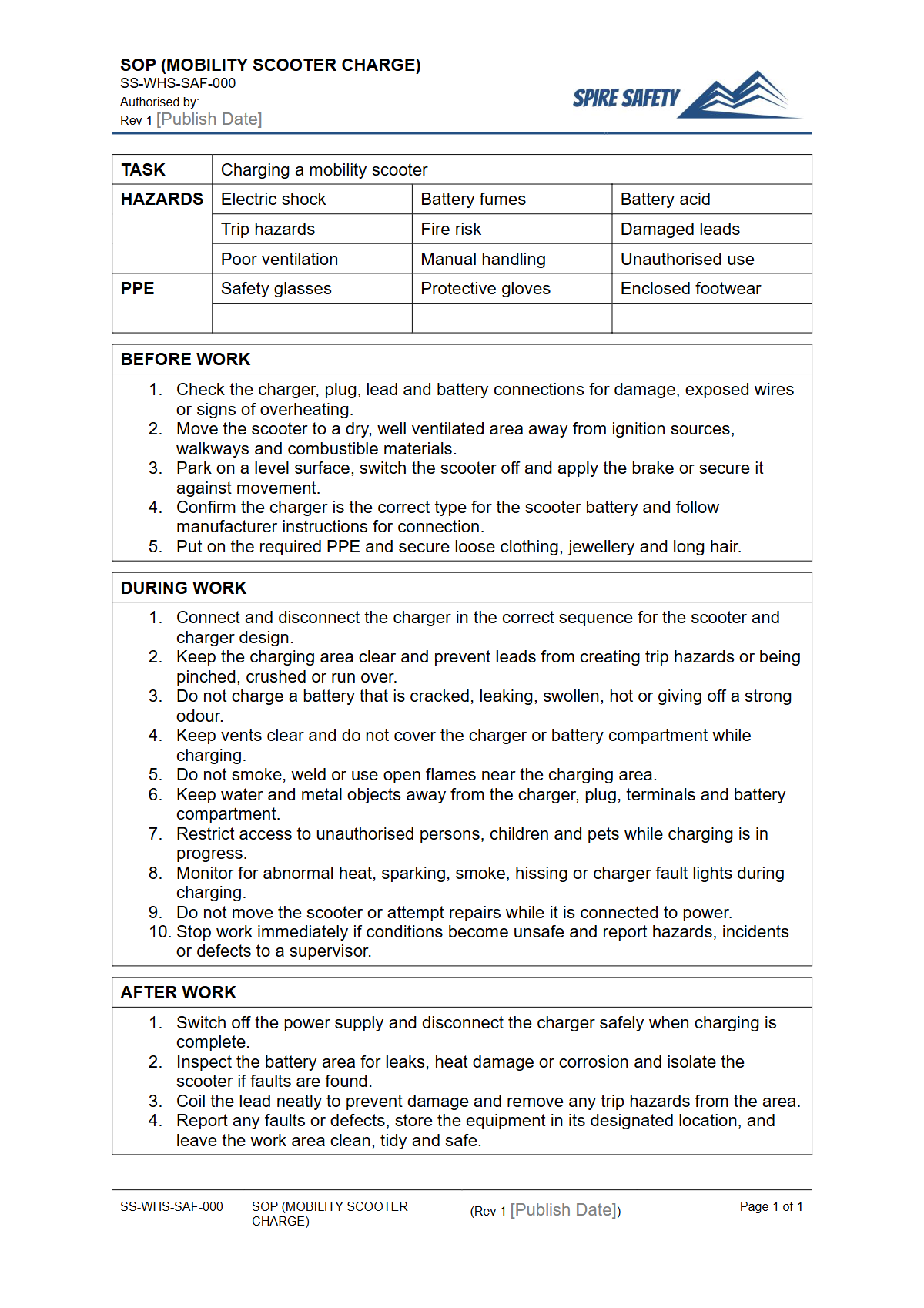
Charging mobility scooters introduces specific electrical, fire, and chemical hazards into the workplace. This Free Safe Operating Procedure (Mobility Scooter Charge) Template provides a structured framework for organisations to document and implement a consistent, safe process for this common task.
Using a formal SOP helps control risks such as electrical shock, battery fires, chemical spills from damaged batteries, and trip hazards from charging cables. By standardising the procedure, you ensure all workers understand the required safety checks, the correct charging sequence, and the appropriate emergency response, thereby reducing the likelihood of incidents and injuries.
A documented procedure is a key part of demonstrating how your organisation meets its primary duty of care under WHS legislation. It serves as a vital training tool for new and existing staff and provides a clear benchmark for supervision and safety observations.
This template is designed as a starting point, aligned with Australian WHS principles, to help you formalise your workplace-specific safety measures for charging mobility scooters.
Video walkthrough
How to use the Free Safe Operating Procedure (Mobility Scooter Charge) Template
This Free Safe Operating Procedure (Mobility Scooter Charge) Template is provided in both DOCX and PDF formats for your convenience. To effectively implement it, download the DOCX version and adapt it to the unique circumstances of your workplace.
This involves identifying the specific models of mobility scooters and chargers in use, the location of charging stations, and any environmental factors that could affect safety.
Important: This is a template only. We are not WHS consultants, and this document must be customised to suit your specific workplace, equipment, and processes.
You must consult with your workers and other relevant stakeholders during this process. Once customised, the SOP should be used to train all relevant personnel.
Ensure the finalised procedure is easily accessible to all workers who perform or supervise the task.
Integrating this SOP into your broader WHS management systems ensures a consistent approach to safety across all operational tasks. The process should detail pre-use checks, step-by-step charging instructions, post-charging checks, and procedures for dealing with faults or emergencies. This systematic approach is similar to the structured process outlined in our Free Air Compressor SOP Template.
Key Hazards in Mobility Scooter Charging
While a routine task, charging mobility scooters carries several significant risks that a Safe Operating Procedure helps to mitigate. A comprehensive risk assessment should be conducted to identify all potential hazards, including:
- Electrical Hazards: Risk of electric shock or short circuits from damaged chargers, cables, or power outlets. Using incorrect chargers or overloading circuits can also lead to electrical faults and fire.
- Fire and Explosion: Overcharging, using incompatible chargers, or charging damaged batteries (particularly lithium-ion types) can cause overheating, thermal runaway, and fire. Charging in poorly ventilated areas can allow flammable gases to accumulate.
- Chemical Hazards: Lead-acid batteries contain corrosive sulfuric acid. A damaged or improperly handled battery can leak, posing a risk of severe chemical burns to skin and eyes.
- Manual Handling and Ergonomics: Connecting and disconnecting heavy batteries or manoeuvring scooters in tight spaces can lead to musculoskeletal injuries if not managed correctly.
- Trip Hazards: Charging cables running across floors or walkways create significant trip hazards for workers and others in the vicinity.
Documenting controls for these hazards is a fundamental part of a robust safety framework, just as you would for other powered equipment using a Circular Saw SOP.
When to use this Safe Operating Procedure
This SOP should be implemented in any commercial or organisational setting where mobility scooters are charged. This is especially critical in environments with vulnerable people or high foot traffic. Key settings include:
- Aged care facilities and retirement villages
- Hospitals and other healthcare settings
- Shopping centres and large retail outlets
- Residential complexes and strata-managed properties
- Warehouses and large industrial sites where scooters are used for personal mobility
- Tourism and hire businesses
Regular reviews of this procedure, which can be incorporated into your internal WHS compliance auditing program, ensure it remains current and effective. This process is critical for managing equipment with inherent risks, similar to the hazards managed in our Safe Operating Procedure for deep fryer operation.
Who should use it
This SOP is intended for use by multiple roles within an organisation to foster a shared understanding of safety responsibilities:
- Persons Conducting a Business or Undertaking (PCBUs): To ensure a safe system of work is in place, documented, and resourced.
- Managers and Supervisors: To train workers, enforce the procedure, and ensure charging areas and equipment are properly maintained.
- Workers: As a clear guide on how to perform the charging task safely, including conducting pre-use inspections and responding to emergencies.
- WHS/OHS Personnel: To integrate the SOP into the overall safety management system, use it for risk assessments, and guide incident investigations.
If you need more templates to build out your safety systems, you can explore our full free WHS resources library for more downloads.
Common mistakes
Common mistakes to avoid
- Using chargers or extension cords that are visibly damaged, frayed, or have exposed wires.
- Charging scooters in cluttered, poorly ventilated areas or near flammable materials.
- Failing to inspect the scooter's battery and charging port for damage or corrosion before connecting the charger.
- Leaving charging cables lying across walkways, creating a serious trip hazard.
Legal references
Legal considerations
The following legal requirements may be relevant to this type of work.
- Work Health and Safety Act (Harmonised) — Provides the primary duties for protecting workers and other people from work health and safety risks.
- Work Health and Safety Regulations (Harmonised) — Sets out requirements supporting the management of workplace hazards and risks.
The following codes may be relevant to this type of work.
- Managing WHS Risks Code of Practice — Provides practical guidance on identifying hazards, assessing risks and applying effective controls.
- Work Health and Safety Consultation, Cooperation and Coordination Code of Practice — Provides practical guidance on consulting workers and coordinating with other duty holders.
- Managing the Work Environment and Facilities Code of Practice — Provides practical guidance on safe work environments, workplace facilities and related controls.
Did you know
Battery Fire Risks
Lithium-ion battery fires, a risk with many modern mobility scooters, can reach temperatures over 600°C and are difficult to extinguish as they can self-reignite due to a process called thermal runaway.
Electrical Safety Standards
The Australian Standard AS/NZS 3760 specifies procedures for the in-service safety inspection and testing of electrical equipment, which includes portable chargers used for mobility scooters.
FAQ
Frequently asked questions
01What key information should be included in a mobility scooter charging SOP?
02How often should our mobility scooter charging procedure be reviewed?
03Are specific training requirements needed for workers who charge mobility scooters?
04Can this template be used for personal mobility scooters brought into a workplace?
Share this resource
Free Safe Operating Procedure (Mobility Scooter Charge) Template
Browse Categories
How To Use It
- 1Download and open in Word or PDF.
- 2Replace the placeholders with your business details.
- 3Get it reviewed by a WHS specialist before rollout.
Need it customised?
Our WHS consultants can adapt this template to your site, run a gap analysis, or audit what you already have in place.
Book a Free Consultation WHS consulting servicesor call 1300 156 382
Related templates
- Free Safe Operating Procedure (Mobility Scooter Clean) Template
- Free Safe Operating Procedure (Moisture Meter) Template
- Free Safe Operating Procedure (Monorail Hoist) Template
- Free Safe Operating Procedure (Mooring Area Inspection) Template
- Free Safe Operating Procedure (Mooring Line Handling) Template
- Free Safe Operating Procedure (Mooring Winch) Template