
Free Safe Operating Procedure (Mooring Winch) Template
Download our free Safe Operating Procedure (Mooring Winch) template to outline safe work methods for maritime and port operations.
Free Safe Operating Procedure (Mooring Winch) Template
DOCX • 126 KB + PDF
Updated Oct 2026
No signup required
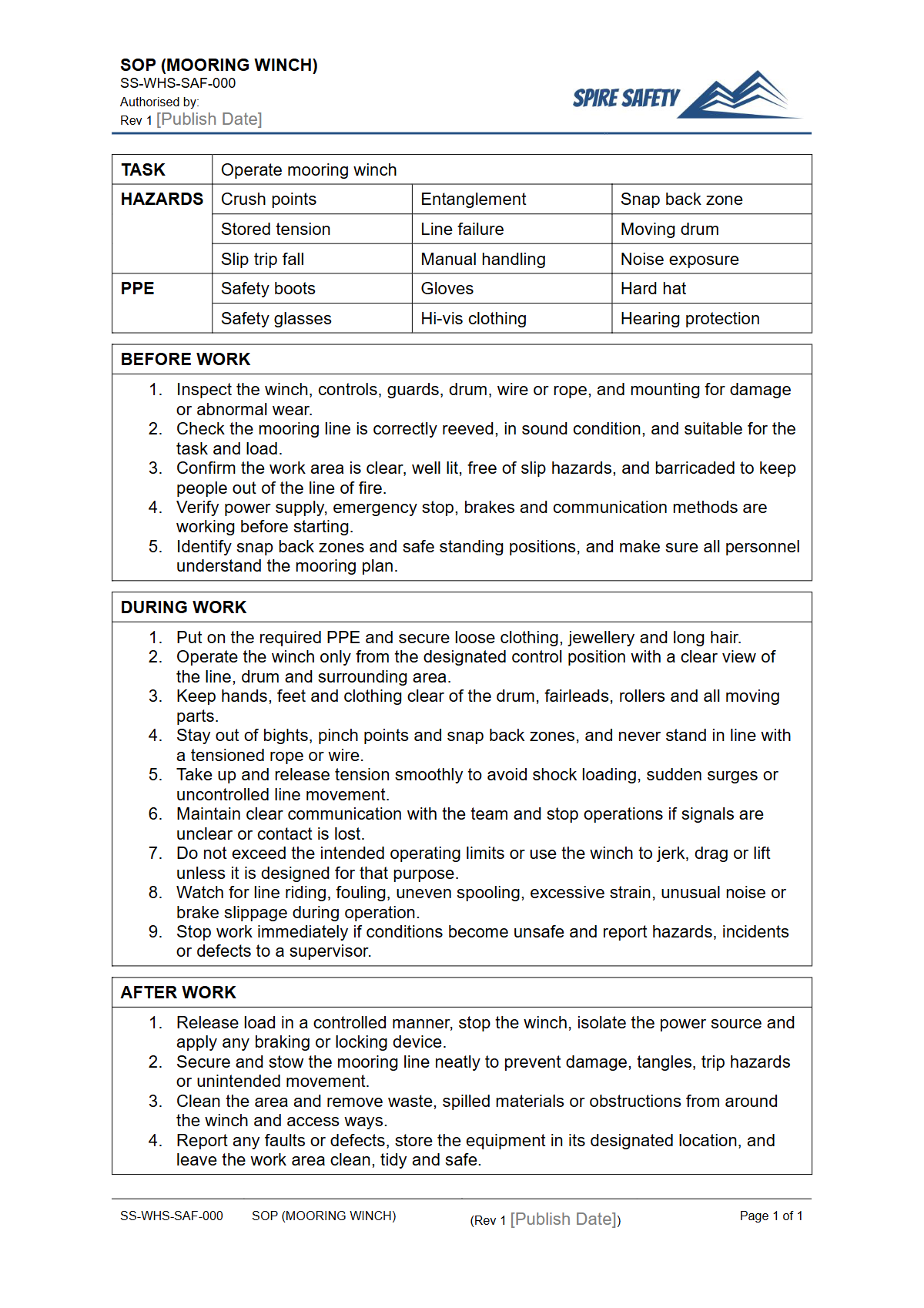
Purpose of the Free Safe Operating Procedure (Mooring Winch) Template
Operating a mooring winch is a high-risk activity that exposes workers to significant hazards, including extreme line tension, equipment failure, and powerful rotational forces. This Free Safe Operating Procedure (Mooring Winch) Template provides a structured starting point for your organisation to document the required steps for safely handling mooring equipment.
It is designed to help you control risks associated with snap-back zones, pinch points, entanglement, and crushing injuries, which are unfortunately common in mooring operations.
Using a standardised Safe Operating Procedure (SOP) ensures that every team member follows a consistent, pre-approved method for performing the task. This not only enhances worker safety but also forms a critical part of your safety management system.
A documented SOP is a cornerstone of effective WHS management systems, providing clear instructions to workers and demonstrating organisational due diligence in managing workplace risks.
Hazards Addressed
This template prompts you to consider and control specific hazards, including:
- Stored energy in tensioned mooring lines (snap-back)
- Pinch, crush, and entanglement points on the winch drum and rollers
- Failure of ropes, wires, stoppers, or winch components
- Slips, trips, and falls on wet or obstructed decks
- Manual handling injuries when handling heavy lines
- Communication failures between the bridge, deck, and shore
Video walkthrough
How to use the Free Safe Operating Procedure (Mooring Winch) Template
To effectively implement this SOP, you should download the DOCX or PDF and integrate it into your existing safety framework. The process involves more than just filling in blanks; it requires careful consideration of your specific operational context.
Begin by reviewing the template with experienced personnel, including vessel masters, deck officers, and experienced deckhands who use the equipment daily. Their input is invaluable for creating a practical and effective procedure.
The document is structured to guide you through key sections, including pre-operational checks, step-by-step operating instructions, and emergency procedures. Ensure you detail the exact type of winch (e.g., hydraulic, electric, steam), line types (wire, synthetic rope), and communication protocols used on your vessel or at your facility.
Regularly verifying that procedures are being followed on deck is just as important as writing them. This can form part of routine inspections or more formal WHS compliance auditing to ensure ongoing effectiveness.
Important: It is crucial to understand that this is a template, not a finished document. We have designed it to be a strong starting point aligned with Australian WHS principles, but you must customise it to reflect the specific mooring winches, vessels, mooring arrangements, and environmental conditions at your workplace.
When to use it
A Safe Operating Procedure for a mooring winch should be a living document, used consistently across all relevant operations. It should be consulted during pre-work briefings or toolbox talks before any mooring or unmooring evolution commences.
This ensures everyone is aligned on the process, especially regarding snap-back zones and communication signals. The SOP is also a vital tool for worker training, induction for new crew members, and periodic refresher courses for experienced staff.
Just as with other heavy equipment like a telehandler, consistent use of the SOP is key. The procedures should be reviewed as part of pre-start checks, similar to those outlined in a FREE Telehandler SOP (Safe Operating Procedure) Template. Furthermore, in the unfortunate event of an incident or near-miss, the SOP serves as a critical baseline document for investigation, helping to identify whether the procedure was followed and if it needs revision.
Who should use it
This SOP is intended for all personnel involved in mooring operations. The primary users are the deck crew who physically operate the winch and handle the lines, including Able Seamen (ABs), Ordinary Seamen (OS), and Bosuns.
Supervisors, such as the Chief Officer or Duty Officer, must use the SOP to oversee the operation, enforce safe practices, and lead toolbox talks. Vessel Masters have ultimate responsibility for the safety of the crew and should ensure these procedures are properly implemented and adhered to.
The responsibility for using and understanding this procedure extends to all personnel involved in the task, a standard practice for all high-risk machinery, including equipment covered in our FREE Conveyer System SOP (Safe Operating Procedure) Template. WHS managers and safety officers should also use this template as a tool to standardise safety documentation across a fleet or facility. You can explore our entire free WHS resources library for more templates and guides to support your safety management activities.
Common mistakes
Common mistakes to avoid
- Failing to clearly mark and enforce exclusion from snap-back zones.
- Using damaged, worn, or incorrectly specified ropes, wires, or winch components.
- Poor or unclear communication between the bridge team, deck crew, and shore-based linesmen.
- Neglecting routine inspection and maintenance of the winch, brakes, and associated fittings.
Legal references
Legal considerations
The following legal requirements may be relevant to this type of work.
- Work Health and Safety Act (Harmonised) — Provides the primary duties for protecting workers and other people from work health and safety risks.
- Work Health and Safety Regulations (Harmonised) — Sets out requirements supporting the management of workplace hazards and risks.
The following codes may be relevant to this type of work.
- Managing WHS Risks Code of Practice — Provides practical guidance on identifying hazards, assessing risks and applying effective controls.
- Work Health and Safety Consultation, Cooperation and Coordination Code of Practice — Provides practical guidance on consulting workers and coordinating with other duty holders.
- Managing the Work Environment and Facilities Code of Practice — Provides practical guidance on safe work environments, workplace facilities and related controls.
Did you know
Incredible Stored Energy
A mooring line under heavy tension stores enormous amounts of kinetic energy. If it parts, the broken ends can snap back at speeds exceeding 700 km/h, striking with incredible force.
Maritime Regulation
The Australian Maritime Safety Authority (AMSA) is the national authority responsible for maritime safety and provides extensive guidance on safe mooring practices for domestic commercial vessels under the National Law.
FAQ
Frequently asked questions
01What is a snap-back zone?
02How often should a Mooring Winch SOP be reviewed?
03Is this SOP a substitute for a risk assessment?
04Who is responsible for training workers on the SOP?
Share this resource
Free Safe Operating Procedure (Mooring Winch) Template
Browse Categories
How To Use It
- 1Download and open in Word or PDF.
- 2Replace the placeholders with your business details.
- 3Get it reviewed by a WHS specialist before rollout.
Need it customised?
Our WHS consultants can adapt this template to your site, run a gap analysis, or audit what you already have in place.
Book a Free Consultation WHS consulting servicesor call 1300 156 382
Related templates
- Free Safe Operating Procedure (Mortar Mixer) Template
- Free Safe Operating Procedure (Mortar Pump) Template
- Free Safe Operating Procedure (Mortising Machine) Template
- Free Safe Operating Procedure (Motel Room Turnaround) Template
- Free Safe Operating Procedure (Mould Surface Treatment) Template
- Free Safe Operating Procedure (Moving Walkway) Template