
Free Safe Operating Procedure (Mortar Mixer) Template
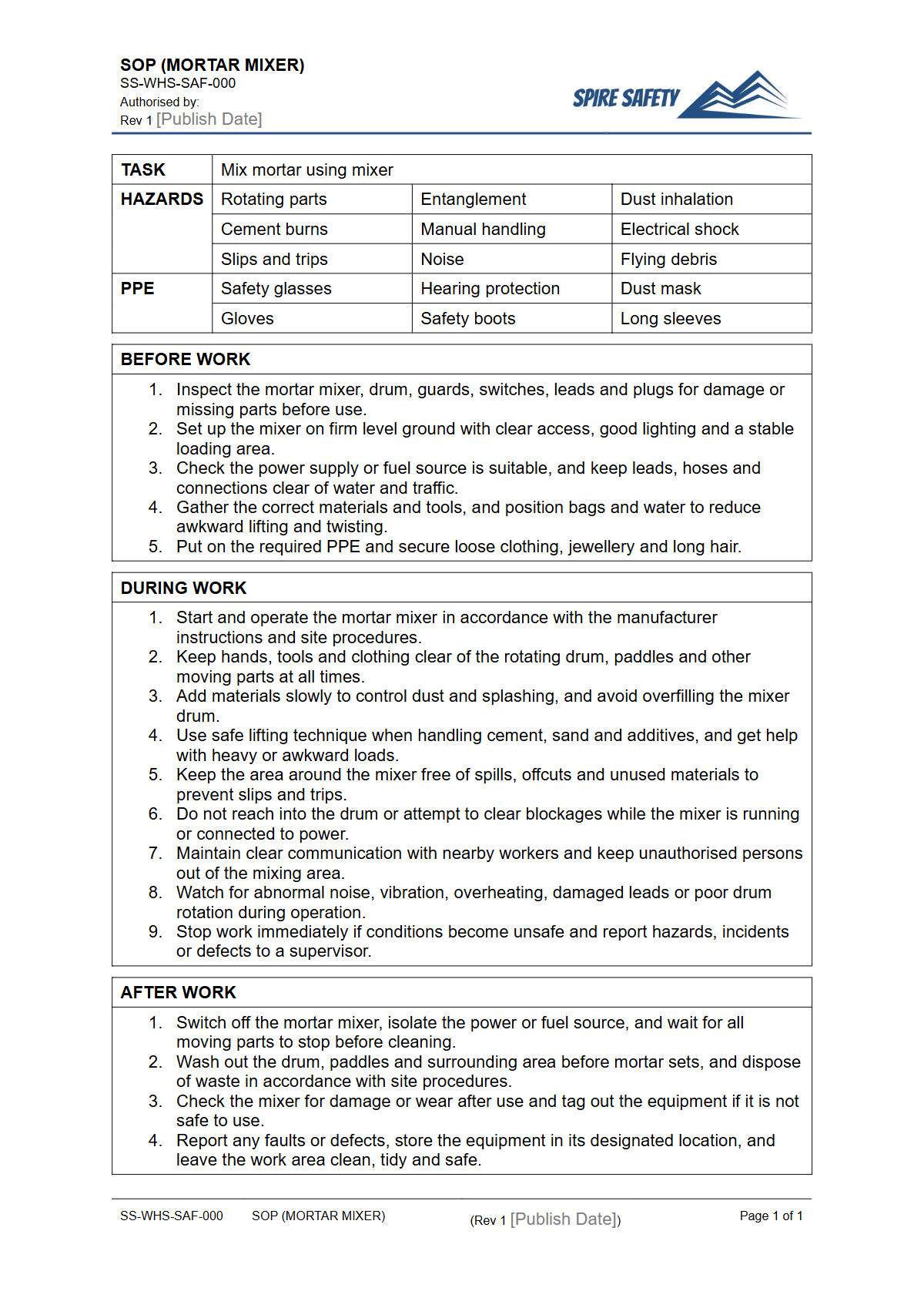
Download our Free Safe Operating Procedure (Mortar Mixer) Template to establish clear, step-by-step instructions for safe equipment use.
Free Safe Operating Procedure (Mortar Mixer) Template
DOCX • 126 KB + PDF
Updated Oct 2026
No signup required
Purpose of the Free Safe Operating Procedure (Mortar Mixer) Template
Operating a mortar mixer, while a common task on many construction and building sites, presents significant health and safety risks if not managed correctly. This Free Safe Operating Procedure (Mortar Mixer) Template provides a structured framework for your business to document safe work methods and control measures.
Using a clear SOP helps your organisation meet its primary duty of care under Australian WHS laws by formalising procedures and ensuring they are communicated effectively to all workers.
Key hazards associated with mortar mixers include entanglement with rotating paddles, manual handling injuries from lifting heavy bags of cement and sand, and ergonomic strains from awkward postures. Workers may also be exposed to hazardous substances, particularly respirable crystalline silica (RCS) from cement dust, as well as high noise levels and electrical risks.
This template guides you in outlining critical safety steps, from pre-start checks to shutdown and cleaning, creating a safer work environment. This process is similar for other common site equipment, as detailed in our free Air Compressor SOP template.
What is a Safe Operating Procedure?
A Safe Operating Procedure (SOP) is a written document that provides step-by-step instructions on how to safely perform a specific task or operate a piece of machinery. It is a vital administrative control that forms a key part of a broader safety management system.
The goal of an SOP is to minimise risk to people, equipment, and the environment by ensuring tasks are performed in a consistently safe manner. It acts as a tool for training, supervision, and incident investigation, promoting a proactive safety culture within the organisation.
Video walkthrough
How to use the Free Safe Operating Procedure (Mortar Mixer) Template
This resource is provided in both DOCX and PDF formats. The DOCX file is fully editable, allowing you to tailor the content to your specific workplace requirements.
The PDF version is ideal for printing and displaying in work areas or for digital distribution once finalised. It is crucial to adapt this template to reflect the actual make and model of the mortar mixer in use, your site-specific emergency procedures, and the unique environmental conditions of your workplace.
A generic document is not sufficient for compliance or safety; it must be made relevant to the task at hand. This process of customisation is fundamental to implementing robust WHS management systems that are practical and effective.
Please note: This document is a template and must be customised to reflect the specific equipment, materials, and work environment at your site. We are not responsible for the implementation or the outcome of the procedures you develop from this template.
When to use it
A Safe Operating Procedure for a mortar mixer should be a living document, integrated into daily operations. It is not a set-and-forget tool. It should be used during:
- Worker Training and Induction: As a foundational document for training new operators and verifying their understanding before they are authorised to use the equipment.
- Pre-operational Inspections: As a reference guide for workers completing daily pre-start checks to ensure the mixer is safe to use.
- Task Planning and Supervision: By supervisors to conduct toolbox talks, reinforce correct procedures, and monitor work practices on site.
- Audits and Reviews: During safety inspections and formal WHS compliance auditing to verify that documented procedures are being followed correctly.
- Incident Investigations: To analyse what went wrong and determine if the existing procedure was adequate or if it was not followed, helping to prevent recurrence.
Who should use it
Various personnel within an organisation have a role to play in the development and use of this SOP. Properly implemented, it becomes a shared resource that enhances safety across multiple levels of the business.
- Operators and Workers: The primary users, who must follow the SOP to perform their work safely and consistently.
- Supervisors and Team Leaders: Responsible for ensuring workers are trained on and adhere to the SOP. They also play a key role in providing feedback for its review and improvement, especially as they manage various plant items like those covered in a Telehandler SOP.
- WHS Managers and Advisors: Professionals who typically lead the development, review, and integration of SOPs into the organisation's overall WHS framework.
- Maintenance Personnel: To understand the requirements for safely isolating, locking out, and servicing the equipment.
By standardising operating instructions for common equipment, you create a more predictable and controlled work environment. This principle applies to many tools, as shown in our guide for a free Circular Saw SOP. For more templates and safety resources, you can browse our complete free WHS resources library.
Common mistakes
Common mistakes to avoid
- Bypassing or removing safety guards and grates to speed up loading or cleaning.
- Reaching into the mixer drum with hands or tools while it is still powered on.
- Overloading the mixer beyond its rated capacity, which can strain the motor and create spillage.
- Neglecting to wear appropriate Personal Protective Equipment (PPE), especially respiratory and eye protection.
Legal references
Legal considerations
The following legal requirements may be relevant to this type of work.
- Work Health and Safety Act (Harmonised) — Provides the primary duties for protecting workers and other people from work health and safety risks.
- Work Health and Safety Regulations (Harmonised) — Sets out requirements supporting the management of workplace hazards and risks.
The following codes may be relevant to this type of work.
- Managing WHS Risks Code of Practice — Provides practical guidance on identifying hazards, assessing risks and applying effective controls.
- Work Health and Safety Consultation, Cooperation and Coordination Code of Practice — Provides practical guidance on consulting workers and coordinating with other duty holders.
- Managing the Work Environment and Facilities Code of Practice — Provides practical guidance on safe work environments, workplace facilities and related controls.
Did you know
The Danger in the Dust
Cement dust contains respirable crystalline silica (RCS). Chronic inhalation of RCS can lead to silicosis, a serious and irreversible lung disease. Using water suppression and wearing appropriate respiratory protection (e.g., a P2 respirator) are critical controls when mixing mortar.
FAQ
Frequently asked questions
01What are the main hazards of using a mortar mixer?
02Is a Safe Operating Procedure legally required for a mortar mixer in Australia?
03How often should a mortar mixer SOP be reviewed?
04Can this template be used for a concrete mixer?
Share this resource
Free Safe Operating Procedure (Mortar Mixer) Template
Browse Categories
How To Use It
- 1Download and open in Word or PDF.
- 2Replace the placeholders with your business details.
- 3Get it reviewed by a WHS specialist before rollout.
Need it customised?
Our WHS consultants can adapt this template to your site, run a gap analysis, or audit what you already have in place.
Book a Free Consultation WHS consulting servicesor call 1300 156 382
Related templates
- Free Safe Operating Procedure (Mortar Pump) Template
- Free Safe Operating Procedure (Mortising Machine) Template
- Free Safe Operating Procedure (Motel Room Turnaround) Template
- Free Safe Operating Procedure (Mould Surface Treatment) Template
- Free Safe Operating Procedure (Moving Walkway) Template
- Free Safe Operating Procedure (Mud Mixing System) Template