
Free Safe Operating Procedure (Mud Mixing System) Template
Need a Safe Operating Procedure for a mud mixing system? This template helps you document safe work practices and manage risks.
Free Safe Operating Procedure (Mud Mixing System) Template
DOCX • 126 KB + PDF
Updated Oct 2026
No signup required
Purpose of the Free Safe Operating Procedure (Mud Mixing System) Template
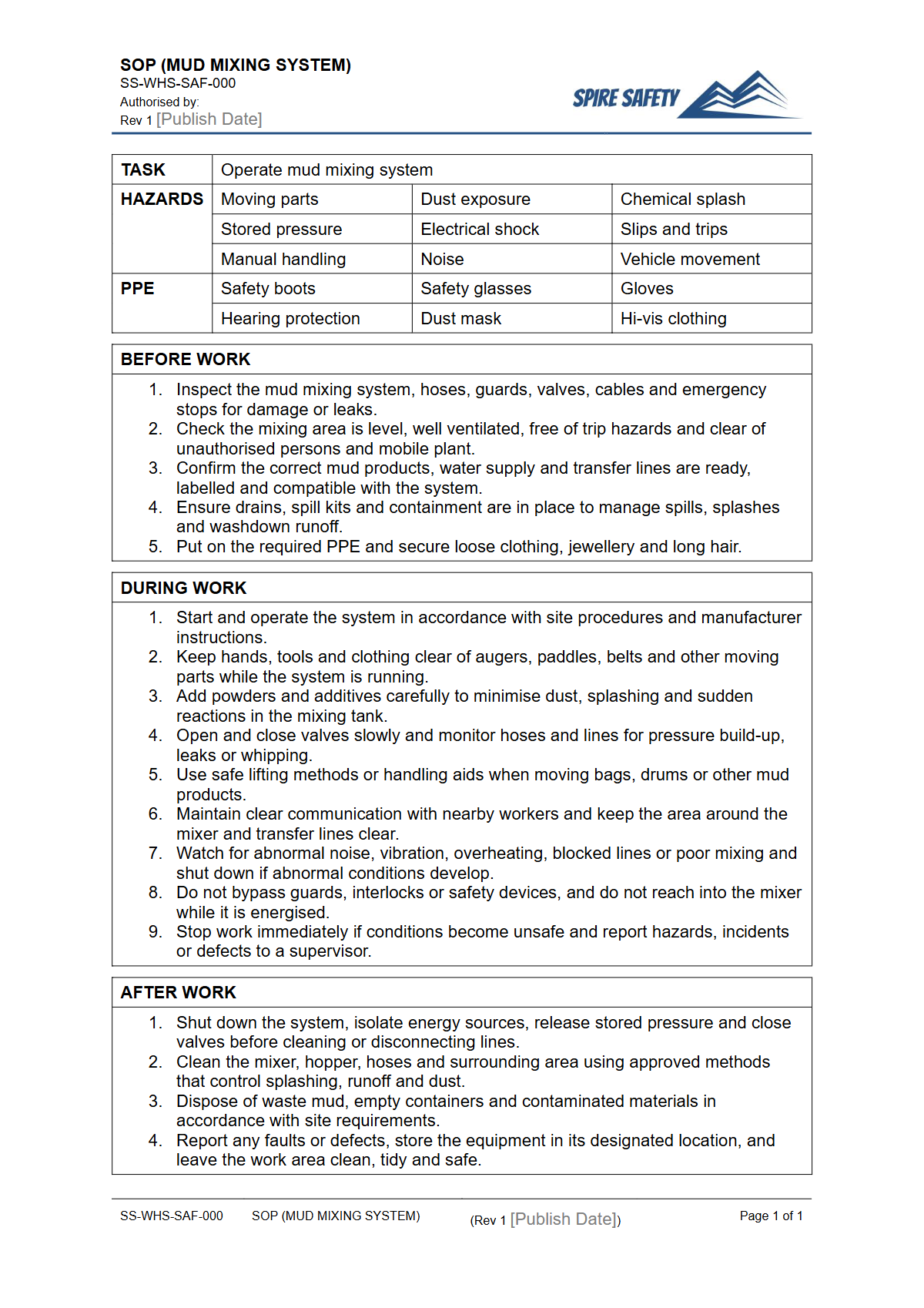
This Free Safe Operating Procedure (Mud Mixing System) Template provides a structured framework for documenting the required steps to safely operate mud mixing equipment. Often used in drilling, mining, and civil construction, these systems present significant hazards if not managed correctly.
An SOP is a critical administrative control that outlines safe work methods, identifies potential hazards, and specifies the control measures required to minimise risk to workers.
Developing and implementing a clear SOP helps to manage risks such as chemical exposure to drilling fluids, entanglement in rotating parts, high-pressure fluid injection, and musculoskeletal injuries from manual handling. Using this template as a foundation supports your organisation in establishing consistent, safe work practices. It forms a key part of your overall safety framework and is an essential document within comprehensive WHS management systems.
Video walkthrough
How to use the Free Safe Operating Procedure (Mud Mixing System) Template
To effectively use this Free Safe Operating Procedure (Mud Mixing System) Template, begin by downloading the DOCX file and opening it for editing. The document is pre-formatted with sections covering pre-operational checks, operational steps, shutdown procedures, and emergency responses.
Your primary task is to adapt this general guide to your specific operational context, a process that requires direct consultation with the workers who operate the equipment daily.
You must fill in the details specific to your machinery, the types of drilling mud and chemicals used (referencing Safety Data Sheets), and the unique environmental conditions of your site. This includes specifying the exact personal protective equipment (PPE) required, detailing lock-out tag-out (LOTO) procedures, and outlining emergency protocols. Regular reviews and updates are essential for maintaining the procedure's relevance and effectiveness, a process often verified through WHS compliance auditing.
A Note on Customisation
IMPORTANT: This document is a template and must be customised to be effective. We have designed it as a structured starting point, but you are responsible for ensuring it reflects the specific equipment, chemicals, processes, and risks present in your workplace.
A generic SOP that has not been tailored to your site-specific conditions is insufficient to meet your work health and safety obligations.
When to use this Safe Operating Procedure
A Safe Operating Procedure for a mud mixing system should be used as a primary reference document in several key situations. It is essential for the induction and training of new operators, providing them with a clear, step-by-step guide to safe operation.
It should also be readily available at the work area for experienced personnel to reference, reinforcing correct procedures and preventing complacency.
This SOP should be reviewed before starting non-routine tasks or after any modification to the equipment or process. It is also an invaluable tool during incident investigations, helping to determine if procedural deviations contributed to the event.
In environments where heavy equipment is common, it's wise to have procedures for all machinery, such as a Telehandler SOP for loading materials into the mixer.
Who should use this Safe Operating Procedure
This Safe Operating Procedure is intended for all personnel involved with the mud mixing system. This includes equipment operators, who must follow the procedure to perform their work safely, and their direct supervisors, who are responsible for ensuring the procedures are understood and followed.
WHS managers and safety officers will use this template as a tool to develop and formalise safety documentation as part of their duty of care.
Persons Conducting a Business or Undertaking (PCBUs) can use this SOP to help demonstrate they are taking reasonably practicable steps to ensure worker safety. It serves as evidence of a systematic approach to risk management for high-risk plant.
For complex sites with interconnected equipment, it's beneficial to have a suite of related documents, like a conveyer system Safe Operating Procedure, to cover all aspects of the workflow.
The hazards associated with mud mixing systems extend beyond just the mixer itself. Ancillary equipment often poses its own risks.
For instance, many systems rely on compressed air for various functions, making a specific Air Compressor SOP (Safe Operating Procedure) a necessary companion document to manage those related hazards effectively.
Furthermore, mud mixing is frequently a precursor to other ground-disturbing activities on a worksite. Ensuring that operators of all machinery are working from documented procedures is crucial.
A logical next step for many project managers is to also implement a Trencher SOP for any subsequent excavation work. You can find these and many other templates in our free WHS resources library to build out your safety documentation.
Common mistakes
Common mistakes to avoid
- Using the template 'as-is' without customising it for the specific machinery and chemicals in use.
- Failing to consult with the actual operators of the equipment when drafting or reviewing the procedure.
- Neglecting to provide practical training on the finalised SOP, assuming workers will just read it.
- Not making the SOP readily accessible to workers at the point of use.
Legal references
Legal considerations
The following legal requirements may be relevant to this type of work.
- Work Health and Safety Act (Harmonised) — Provides the primary duties for protecting workers and other people from work health and safety risks.
- Work Health and Safety Regulations (Harmonised) — Sets out requirements supporting the management of workplace hazards and risks.
The following codes may be relevant to this type of work.
- Managing WHS Risks Code of Practice — Provides practical guidance on identifying hazards, assessing risks and applying effective controls.
- Work Health and Safety Consultation, Cooperation and Coordination Code of Practice — Provides practical guidance on consulting workers and coordinating with other duty holders.
- Managing the Work Environment and Facilities Code of Practice — Provides practical guidance on safe work environments, workplace facilities and related controls.
Did you know
Drilling Mud Composition
Drilling mud, or 'drilling fluid', is more than just mud and water. It's a complex mixture that can contain bentonite clay, polymers, and various chemical additives to control viscosity, density, and fluid loss, each presenting unique chemical hazards.
FAQ
Frequently asked questions
01What are the main hazards of a mud mixing system?
02Is an SOP a legal requirement in Australia for mud mixing systems?
03How often should an SOP for a mud mixing system be reviewed?
04Can I use this template for any type of mud mixer?
Share this resource
Free Safe Operating Procedure (Mud Mixing System) Template
Browse Categories
How To Use It
- 1Download and open in Word or PDF.
- 2Replace the placeholders with your business details.
- 3Get it reviewed by a WHS specialist before rollout.
Need it customised?
Our WHS consultants can adapt this template to your site, run a gap analysis, or audit what you already have in place.
Book a Free Consultation WHS consulting servicesor call 1300 156 382
Related templates
- Free Safe Operating Procedure (Mud Pump) Template
- Free Safe Operating Procedure (Mulch Bed Maintenance) Template
- Free Safe Operating Procedure (Mulch Handling) Template
- Free Safe Operating Procedure (Mulch Spreading) Template
- Free Safe Operating Procedure (Mulcher) Template
- Free Safe Operating Procedure (Multimeter Use) Template