
Free Safe Operating Procedure (Mulcher) Template
Download our free Safe Operating Procedure (Mulcher) template to formalise safety protocols for mulching operations. Get started with your DOCX or PDF now.
Free Safe Operating Procedure (Mulcher) Template
DOCX • 126 KB + PDF
Updated Oct 2026
No signup required
Purpose of the Free Safe Operating Procedure (Mulcher) Template
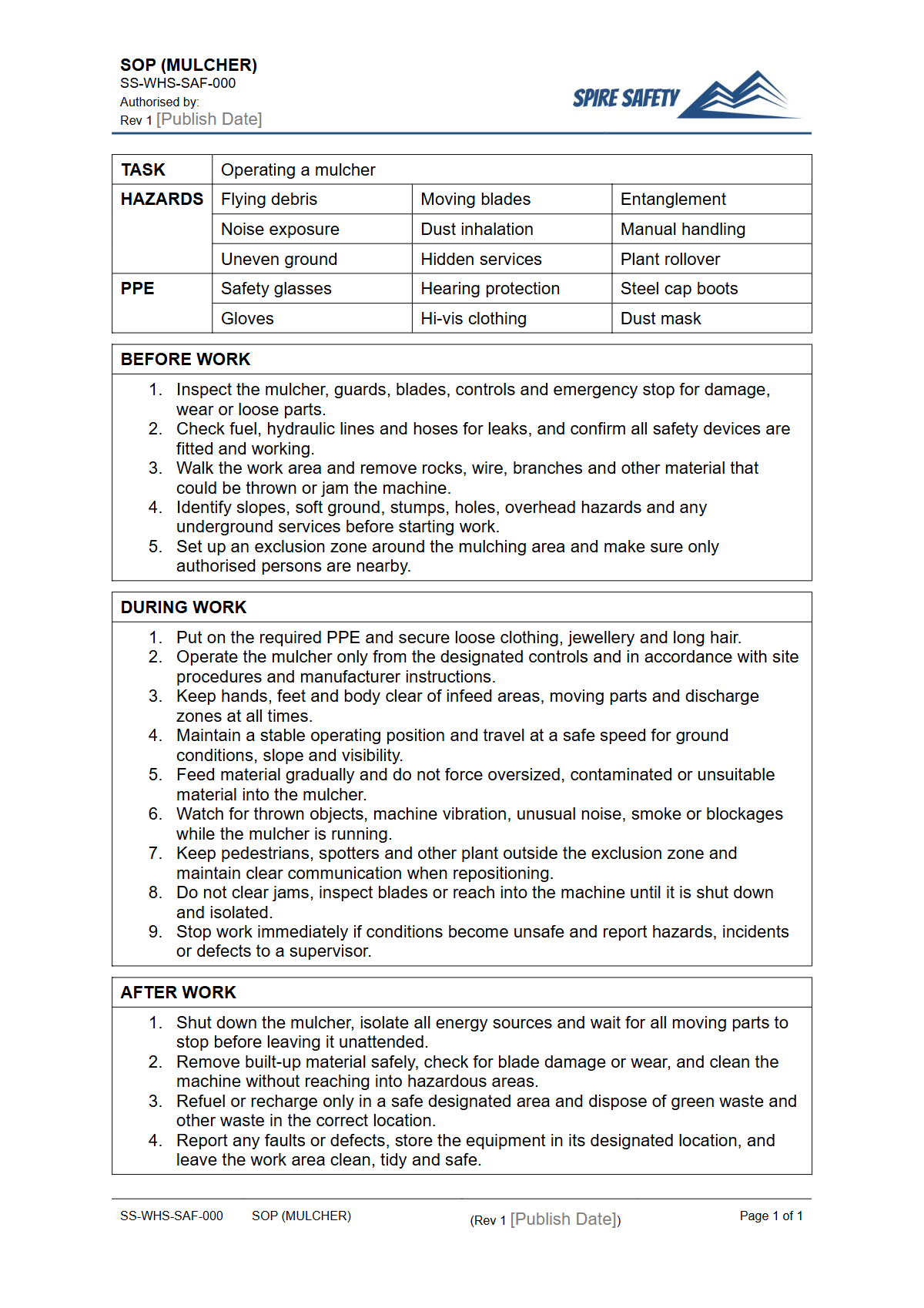
Operating a wood chipper or mulcher involves significant risks, including entanglement in moving parts, being struck by ejected material, and exposure to hazardous noise levels. This Free Safe Operating Procedure (Mulcher) Template provides a structured starting point for developing a comprehensive document that outlines the safety requirements for operating this machinery in your workplace.
A documented SOP is a critical tool for risk management, ensuring that all operators understand the hazards and the control measures required to work safely.
This template is designed to help you clearly define the step-by-step processes for pre-operational checks, safe operation, shutdown procedures, and emergency responses. Formalising these steps helps standardise safe work practices, reduce the likelihood of incidents, and demonstrate your commitment to meeting your WHS duties.
It serves as an essential resource for training, competency assessments, and daily pre-start briefings, forming a key part of your overall safety management system.
Video walkthrough
How to use the Free Safe Operating Procedure (Mulcher) Template
This resource is available for immediate download in both DOCX and PDF formats. While the PDF is useful for quick reference, the DOCX file is fully editable, allowing you to tailor the content to your specific operational needs.
A generic template cannot account for all variables in a work environment. Therefore, it is essential that you modify this document to reflect the make and model of your mulcher, your site-specific hazards, and your organisation's internal safety policies.
Important: We have provided a comprehensive framework based on Australian WHS principles, but you must customise the content to ensure it is relevant and effective for your workplace. This includes adding site-specific emergency contacts, detailing unique environmental hazards, and referencing any other relevant internal procedures.
For other high-risk plant, you might also find our FREE Trencher SOP Template a useful reference for structuring your safety documents.
Key Elements of a Mulcher Safe Operating Procedure
A robust SOP for a mulcher should address every phase of the equipment's use. Our template provides sections for you to detail:
- Required Personal Protective Equipment (PPE): Specifies the necessary PPE, such as high-impact eye protection, hearing protection, safety footwear, and high-visibility clothing.
- Pre-Operational Safety Checks: A checklist to ensure the mulcher is in safe working order before use, covering guards, controls, blade condition, and fluid levels. This is a critical step in preventing mechanical failure during operation.
- Step-by-Step Operating Procedures: Outlines the safe sequence for starting, operating, and stopping the machine. This includes instructions on feeding material correctly, maintaining exclusion zones, and managing blockages.
- Emergency Procedures: Clear instructions on how to respond to an emergency, including equipment shutdown, first aid, and incident reporting.
- Maintenance and Cleaning: Guidelines for safe cleaning, blade replacement, and routine maintenance to ensure the ongoing safety and efficiency of the mulcher.
These components are fundamental to creating an effective document. Integrating this SOP into your broader WHS management systems ensures a consistent and systematic approach to workplace safety, moving beyond just a single document to a holistic safety culture.
When to use a Safe Operating Procedure
An SOP for a mulcher should be used consistently as part of your daily work routine. It is not a document to be filed away and forgotten.
It should be readily accessible to operators at all times and used during worker inductions, new equipment training, and refresher training sessions. It should also be reviewed and referenced before the commencement of any non-routine mulching task or when conditions change, such as working in a new location or with different types of vegetation.
Furthermore, the SOP is a live document that should be reviewed and updated regularly. This should occur at least annually, or more frequently if there is an incident, a near miss, a change in legislation, or when new information about the equipment's hazards becomes available. Other powerful cutting equipment requires similar diligence, as outlined in resources like our FREE Circular Saw SOP Template.
Who should use it
This Safe Operating Procedure template is intended for use by multiple groups within an organisation. PCBUs (Persons Conducting a Business or Undertaking), business owners, and managers can use it to fulfil their primary duty of care to provide a safe system of work.
Supervisors should use it to train workers, enforce safe practices, and conduct pre-start talks. Operators must use it to understand and follow the established safety protocols for the task.
Effectively implementing SOPs across your operations is a key indicator of a healthy safety system. During formal assessments, the presence and quality of such documents are often scrutinised.
Regular WHS compliance auditing can help verify that your documented procedures are being followed correctly in practice. Proper documentation is also essential for other types of heavy machinery, and you can see a similar structure in our FREE Grader SOP (Safe Operating Procedure) Template.
By ensuring everyone who interacts with the machinery is familiar with the SOP, you create a shared understanding of risk and responsibility. For more tools to help manage your workplace safety obligations, browse our complete free WHS resources library.
Common mistakes
Common mistakes to avoid
- Failing to adequately customise the template for the specific mulcher model and work environment.
- Neglecting thorough pre-start inspections, particularly the condition and sharpness of the blades.
- Operating the machine without all guards in place or with safety features disabled.
- Becoming complacent and standing directly in front of the infeed chute while feeding material.
Legal references
Legal considerations
The following legal requirements may be relevant to this type of work.
- Work Health and Safety Act (Harmonised) — Provides the primary duties for protecting workers and other people from work health and safety risks.
- Work Health and Safety Regulations (Harmonised) — Sets out requirements supporting the management of workplace hazards and risks.
The following codes may be relevant to this type of work.
- Managing WHS Risks Code of Practice — Provides practical guidance on identifying hazards, assessing risks and applying effective controls.
- Work Health and Safety Consultation, Cooperation and Coordination Code of Practice — Provides practical guidance on consulting workers and coordinating with other duty holders.
- Managing the Work Environment and Facilities Code of Practice — Provides practical guidance on safe work environments, workplace facilities and related controls.
Did you know
Entanglement Risk
According to Safe Work Australia, contact with machinery is a leading cause of workplace fatalities and serious injuries. The infeed chutes on mulchers are a major entanglement hazard, capable of pulling a worker into the machine in seconds.
FAQ
Frequently asked questions
01What are the main hazards of operating a mulcher?
02Is a Safe Operating Procedure a legal requirement for mulchers in Australia?
03How often should a mulcher SOP be reviewed?
04Can this template be used for all types of mulchers and wood chippers?
Share this resource
Free Safe Operating Procedure (Mulcher) Template
Browse Categories
How To Use It
- 1Download and open in Word or PDF.
- 2Replace the placeholders with your business details.
- 3Get it reviewed by a WHS specialist before rollout.
Need it customised?
Our WHS consultants can adapt this template to your site, run a gap analysis, or audit what you already have in place.
Book a Free Consultation WHS consulting servicesor call 1300 156 382
Related templates
- Free Safe Operating Procedure (Multimeter Use) Template
- Free Safe Operating Procedure (Municipal Litter Pickup) Template
- Free Safe Operating Procedure (Nail Gun) Template
- Free Safe Operating Procedure (Nail Salon Cleanup) Template
- Free Safe Operating Procedure (Nature Strip Mowing) Template
- Free Safe Operating Procedure (Needle Scaler) Template