
Free Safe Operating Procedure (Needle Scaler) Template
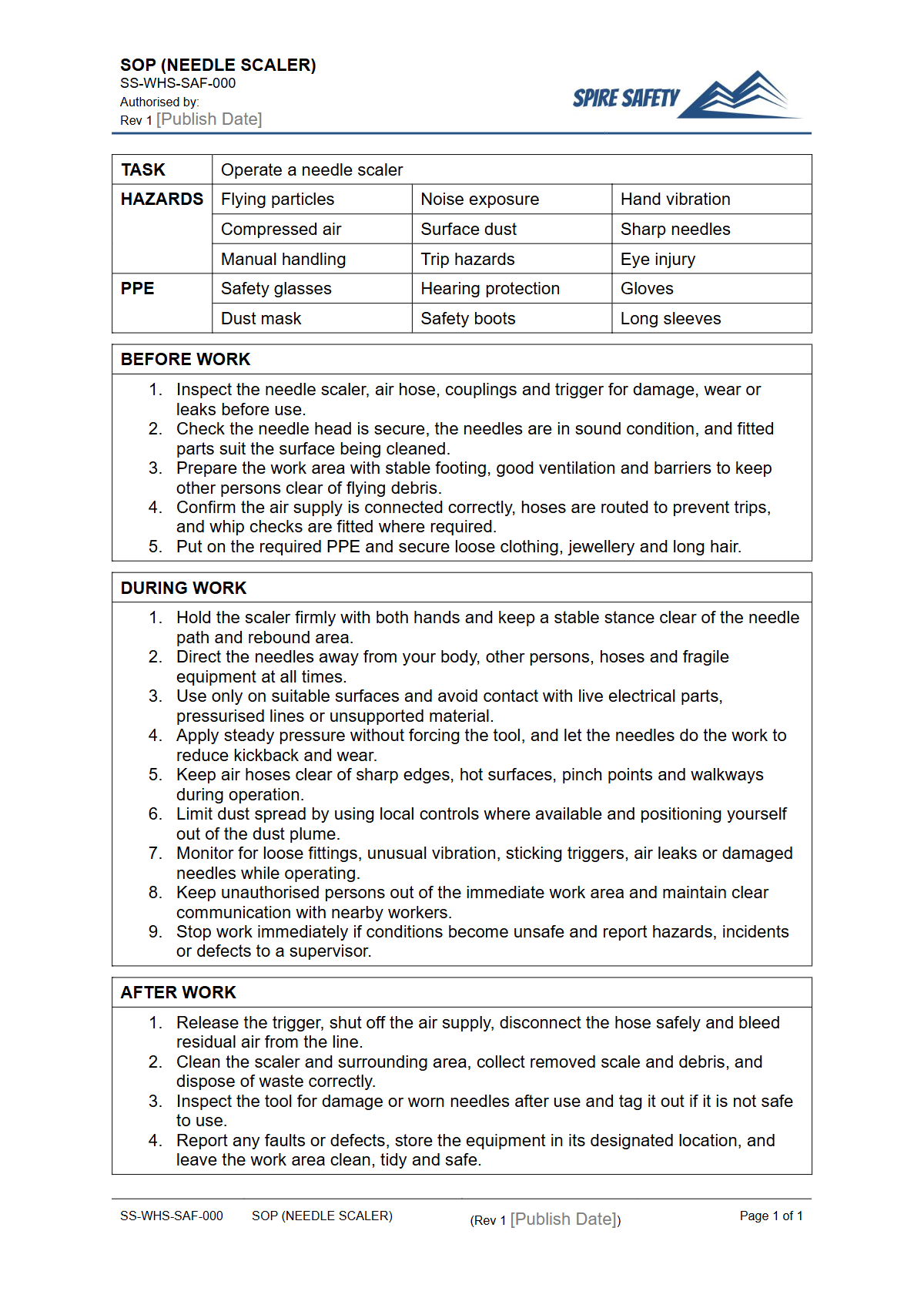
Get started with our free Safe Operating Procedure (Needle Scaler) Template. This document provides a solid foundation for your workplace safety protocols.
Free Safe Operating Procedure (Needle Scaler) Template
DOCX • 126 KB + PDF
Updated Oct 2026
No signup required
Purpose of the Free Safe Operating Procedure (Needle Scaler) Template
A needle scaler is a powerful tool used for surface preparation, such as removing rust, scale, and old paint. However, its operation introduces significant workplace hazards, including high-intensity noise, hand-arm vibration, airborne dust, and projectiles.
This Free Safe Operating Procedure (Needle Scaler) Template provides a structured framework for documenting the required steps to operate the equipment safely. It helps persons conducting a business or undertaking (PCBUs) to fulfil their duty of care by establishing and communicating safe work methods.
Implementing robust SOPs is a critical component of effective WHS management systems, ensuring that all operators follow a consistent, safe process, thereby reducing the risk of injury.
Video walkthrough
How to use the Free Safe Operating Procedure (Needle Scaler) Template
This document is designed as a starting point. Download the template in DOCX format to edit and customise it for your specific workplace.
You will need to detail your site's specific rules, the make and model of the needle scaler in use, and the types of materials being worked on. A well-written SOP forms the basis for training, competency assessments, and workplace inspections.
As pneumatic scalers are common, you may also find our free Air Compressor SOP template a useful companion document.
Important: This is a template only. To be effective, you must customise this Safe Operating Procedure to reflect the specific equipment, environment, and tasks in your workplace.
We are not responsible for the implementation or outcome of your customised document.
When to use it
A Safe Operating Procedure for a needle scaler should be used as a primary reference document in several key situations. It must be read and understood by any worker before they operate the tool for the first time.
It serves as a critical training tool for new or inexperienced employees, ensuring they learn the correct, safe method from the outset. The SOP should also be used as a checklist for conducting pre-start inspections and for regular refresher training or toolbox talks.
Following an incident or near miss involving a needle scaler, the SOP should be reviewed as part of the investigation to identify any gaps or necessary improvements. Regular reviews are also a key activity within formal WHS compliance auditing.
Who should use it
The responsibility for using and maintaining this SOP extends across multiple levels of an organisation. PCBUs and managers are responsible for ensuring that an adequate SOP is developed, implemented, and regularly reviewed.
Supervisors must use the SOP to train and supervise workers, ensuring the documented procedures are followed correctly on the floor. Operators are the primary users of the SOP; they must understand and adhere to its instructions at all times to protect themselves and others.
For broader safety documentation, you can explore our complete free WHS resources library for other relevant templates and guides.
Developing comprehensive procedures for all high-risk equipment is a fundamental safety practice. For example, the principles used here are similar to those required for documenting the use of other power tools, as seen in resources like our FREE Circular Saw SOP Template. If you require expert assistance in developing customised, site-specific safety documentation, consider engaging professional WHS consulting services.
Common mistakes
Common mistakes to avoid
- Failing to check for hazardous materials (like lead paint or asbestos) before starting work.
- Using the tool without appropriate, task-specific Personal Protective Equipment (PPE).
- Neglecting pre-start checks on the tool, air lines, and connections.
- Operating the tool for extended periods without breaks, increasing the risk of Hand-Arm Vibration Syndrome (HAVS).
Legal references
Legal considerations
The following legal requirements may be relevant to this type of work.
- Work Health and Safety Act (Harmonised) — Provides the primary duties for protecting workers and other people from work health and safety risks.
- Work Health and Safety Regulations (Harmonised) — Sets out requirements supporting the management of workplace hazards and risks.
The following codes may be relevant to this type of work.
- Managing WHS Risks Code of Practice — Provides practical guidance on identifying hazards, assessing risks and applying effective controls.
- Work Health and Safety Consultation, Cooperation and Coordination Code of Practice — Provides practical guidance on consulting workers and coordinating with other duty holders.
- Managing the Work Environment and Facilities Code of Practice — Provides practical guidance on safe work environments, workplace facilities and related controls.
Did you know
Vibration Risks
Prolonged use of vibrating tools like needle scalers can lead to Hand-Arm Vibration Syndrome (HAVS), a permanent and painful condition affecting nerves, blood vessels, and joints.
Air Consumption
Pneumatic needle scalers are high-consumption air tools, often requiring a larger industrial air compressor than other common workshop tools to maintain effective operating pressure.
FAQ
Frequently asked questions
01What are the main hazards of using a needle scaler?
02Is training required to use a needle scaler?
03What PPE should be worn when operating a needle scaler?
04How often should a Safe Operating Procedure for a needle scaler be reviewed?
Share this resource
Free Safe Operating Procedure (Needle Scaler) Template
Browse Categories
How To Use It
- 1Download and open in Word or PDF.
- 2Replace the placeholders with your business details.
- 3Get it reviewed by a WHS specialist before rollout.
Need it customised?
Our WHS consultants can adapt this template to your site, run a gap analysis, or audit what you already have in place.
Book a Free Consultation WHS consulting servicesor call 1300 156 382
Related templates
- Free Safe Operating Procedure (Netball Court Cleaning) Template
- Free Safe Operating Procedure (Noise Dosimeter) Template
- Free Safe Operating Procedure (Non-Slip Mat Cleaning) Template
- Free Safe Operating Procedure (Notching Machine) Template
- Free Safe Operating Procedure (Nursery Bench Cleaning) Template
- Free Safe Operating Procedure (Nursery Pot Handling) Template