
Free Safe Operating Procedure (Nursery Bench Cleaning) Template
Download our Free Safe Operating Procedure for Nursery Bench Cleaning to standardise your hygiene processes. This customisable template helps you manage risks.
Free Safe Operating Procedure (Nursery Bench Cleaning) Template
DOCX • 126 KB + PDF
Updated Oct 2026
No signup required
Purpose of the Free Safe Operating Procedure (Nursery Bench Cleaning) Template
A clean nursery is a productive nursery. Managing hygiene on benches is critical for preventing the spread of diseases and pests, ensuring plant health and worker safety.
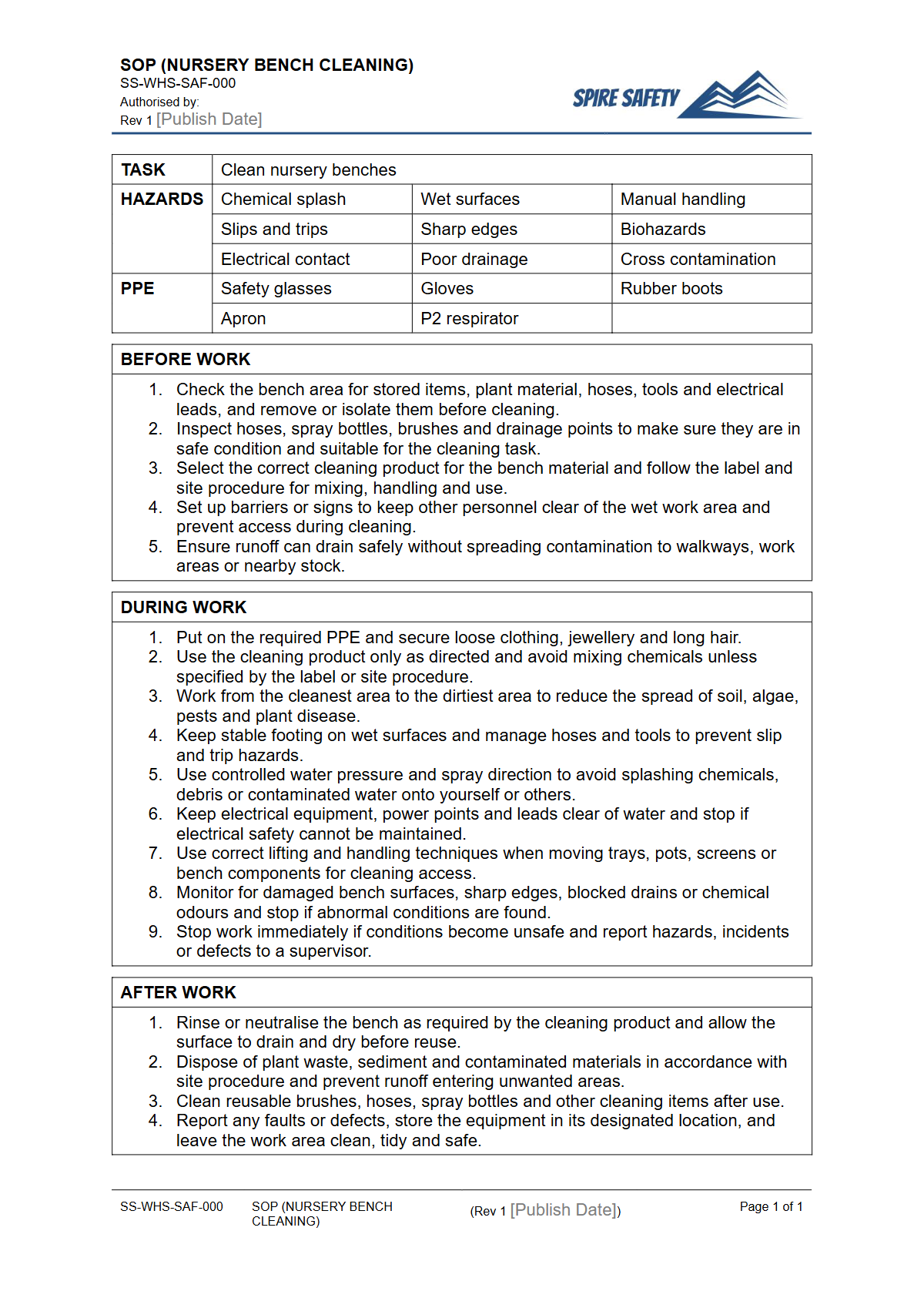
Our Free Safe Operating Procedure (Nursery Bench Cleaning) Template provides a structured framework for documenting the steps, hazards, and controls for this essential task. This resource, available as a customisable DOCX file, helps you establish a consistent and safe method for all staff to follow, forming a key part of your overall safety management.
The primary purpose of this Safe Operating Procedure for Nursery Bench Cleaning is to provide a clear, step-by-step guide for workers. It formalises the process to ensure consistency and effectiveness every time.
By documenting the task, you can systematically identify and control associated risks, such as exposure to cleaning chemicals, ergonomic strain from manual handling, and slip hazards on wet floors. It serves as a vital training tool for new employees and a refresher for existing staff, demonstrating your organisation's commitment to a safe system of work.
Video walkthrough
How to use the Free Safe Operating Procedure (Nursery Bench Cleaning) Template
Download the template using the links on this page. You will receive a DOCX file that is ready for customisation to your specific workplace.
It is crucial to adapt the document to the unique context of your nursery. You must review and edit the content to reflect your environment, including the types of benches you use, the specific cleaning agents and disinfectants approved for your site, the required Personal Protective Equipment (PPE), and your emergency procedures.
This template is a starting point; we have not included every possible hazard or control measure applicable to your specific operations. A well-documented process is a cornerstone of effective WHS management systems.
When to use it
This SOP should be used whenever nursery benches require cleaning and disinfection. This typically occurs at several key points in the production cycle, such as between batches of plants to prevent cross-contamination.
It is also essential following an identified outbreak of a pest or disease to sanitise the area thoroughly. Furthermore, it should be integrated into your regular maintenance schedule to maintain a high standard of general hygiene.
The SOP also acts as a critical reference document during worker training and induction.
Who should use it
This procedure is designed for any personnel responsible for horticultural tasks and maintaining nursery hygiene. This includes nursery hands, growers, and horticulturalists who perform the cleaning.
Supervisors and team leaders should use it to oversee the work, ensure it is performed correctly, and deliver toolbox talks or training sessions. WHS managers and business owners can use the finalised SOP as evidence of a safe system of work, helping to meet their health and safety duties.
For businesses needing specialised guidance in developing these documents, our WHS consulting services can provide expert support.
Key Elements of a Nursery Bench Cleaning SOP
A robust SOP for this task goes beyond a simple checklist. It should contain several detailed sections to be effective.
Hazard Identification
Start by listing all potential hazards. This includes chemical hazards from detergents and disinfectants, musculoskeletal risks from scrubbing or lifting, and biological hazards from plant pathogens.
Also, consider environmental factors like poor ventilation or wet, slippery floors that create slip and trip risks.
Control Measures
For each hazard identified, specify the control measures. This will detail the mandatory PPE (e.g., chemical-resistant gloves, safety glasses), safe handling procedures for chemicals as per their Safety Data Sheets (SDS), and ergonomic practices like using long-handled brushes. Establishing safe work methods for agricultural equipment is just as important, which is why we also offer resources like our free Spreader SOP template.
Step-by-Step Procedure
This is the core of the SOP. Clearly outline the sequence of actions from start to finish.
This should include preparing the area, pre-cleaning to remove physical debris, applying the cleaning/disinfecting agent for the correct contact time, rinsing, and allowing the benches to dry. Documenting these processes is vital for all nursery tasks, whether manual or involving machinery like in our free Planter SOP template.
Emergency Procedures
Include instructions for what to do if something goes wrong. This covers first aid for chemical splashes to the skin or eyes, procedures for cleaning up spills, and who to contact in an emergency.
Integrating SOPs into Your Safety Framework
A single document is only one part of a proactive safety culture. This SOP should be part of your broader safety management system.
Ensure it is easily accessible to all relevant workers, regularly reviewed (at least annually or after an incident), and updated when processes or chemicals change. You can find many other document templates and guides in our free WHS resources library to help build out your safety framework.
Common mistakes
Common mistakes to avoid
- Using an incorrect dilution rate for disinfectants, making them either ineffective or overly hazardous.
- Failing to pre-clean benches of soil and organic debris, which prevents disinfectants from working properly.
- Neglecting to use the specified Personal Protective Equipment (PPE), leading to skin irritation or eye injuries.
- Not allowing for the required 'contact time' for a disinfectant to kill pathogens before rinsing.
Legal references
Legal considerations
The following legal requirements may be relevant to this type of work.
- Work Health and Safety Act (Harmonised) — Provides the primary duties for protecting workers and other people from work health and safety risks.
- Work Health and Safety Regulations (Harmonised) — Sets out requirements supporting the management of workplace hazards and risks.
The following codes may be relevant to this type of work.
- Managing WHS Risks Code of Practice — Provides practical guidance on identifying hazards, assessing risks and applying effective controls.
- Work Health and Safety Consultation, Cooperation and Coordination Code of Practice — Provides practical guidance on consulting workers and coordinating with other duty holders.
- Managing the Work Environment and Facilities Code of Practice — Provides practical guidance on safe work environments, workplace facilities and related controls.
Did you know
Disinfection vs. Cleaning
Cleaning removes soil and organic matter, but disinfection is what actually kills microscopic pathogens like fungi and bacteria. Surfaces must always be cleaned before they can be effectively disinfected.
Administrative Controls
Safe Operating Procedures are a type of 'administrative control' in the hierarchy of risk controls. They are a formal method of directing work to minimise risk when hazards cannot be completely eliminated or substituted.
FAQ
Frequently asked questions
01What are the main hazards when cleaning nursery benches?
02Why is a specific SOP for nursery bench cleaning necessary?
03What PPE is typically required for cleaning nursery benches?
04How often should I review my Nursery Bench Cleaning SOP?
Share this resource
Free Safe Operating Procedure (Nursery Bench Cleaning) Template
Browse Categories
How To Use It
- 1Download and open in Word or PDF.
- 2Replace the placeholders with your business details.
- 3Get it reviewed by a WHS specialist before rollout.
Need it customised?
Our WHS consultants can adapt this template to your site, run a gap analysis, or audit what you already have in place.
Book a Free Consultation WHS consulting servicesor call 1300 156 382
Related templates
- Free Safe Operating Procedure (Nursery Pot Handling) Template
- Free Safe Operating Procedure (Nursery Stock Loading) Template
- Free Safe Operating Procedure (Nursery Tray Cleaning) Template
- Free Safe Operating Procedure (Nut Runner) Template
- Free Safe Operating Procedure (Office Carpet Cleaning) Template
- Free Safe Operating Procedure (Office Chair Cleaning) Template