
Free Safe Operating Procedure (Nursery Tray Cleaning) Template
Establish clear, safe work instructions for cleaning nursery trays with our structured SOP template. Download your free, customisable DOCX to get started.
Free Safe Operating Procedure (Nursery Tray Cleaning) Template
DOCX • 126 KB + PDF
Updated Oct 2026
No signup required
Purpose of the Free Safe Operating Procedure (Nursery Tray Cleaning) Template
Cleaning nursery trays is a repetitive but critical task in any horticultural or agricultural setting. It directly impacts plant health by preventing the spread of soil-borne pathogens.
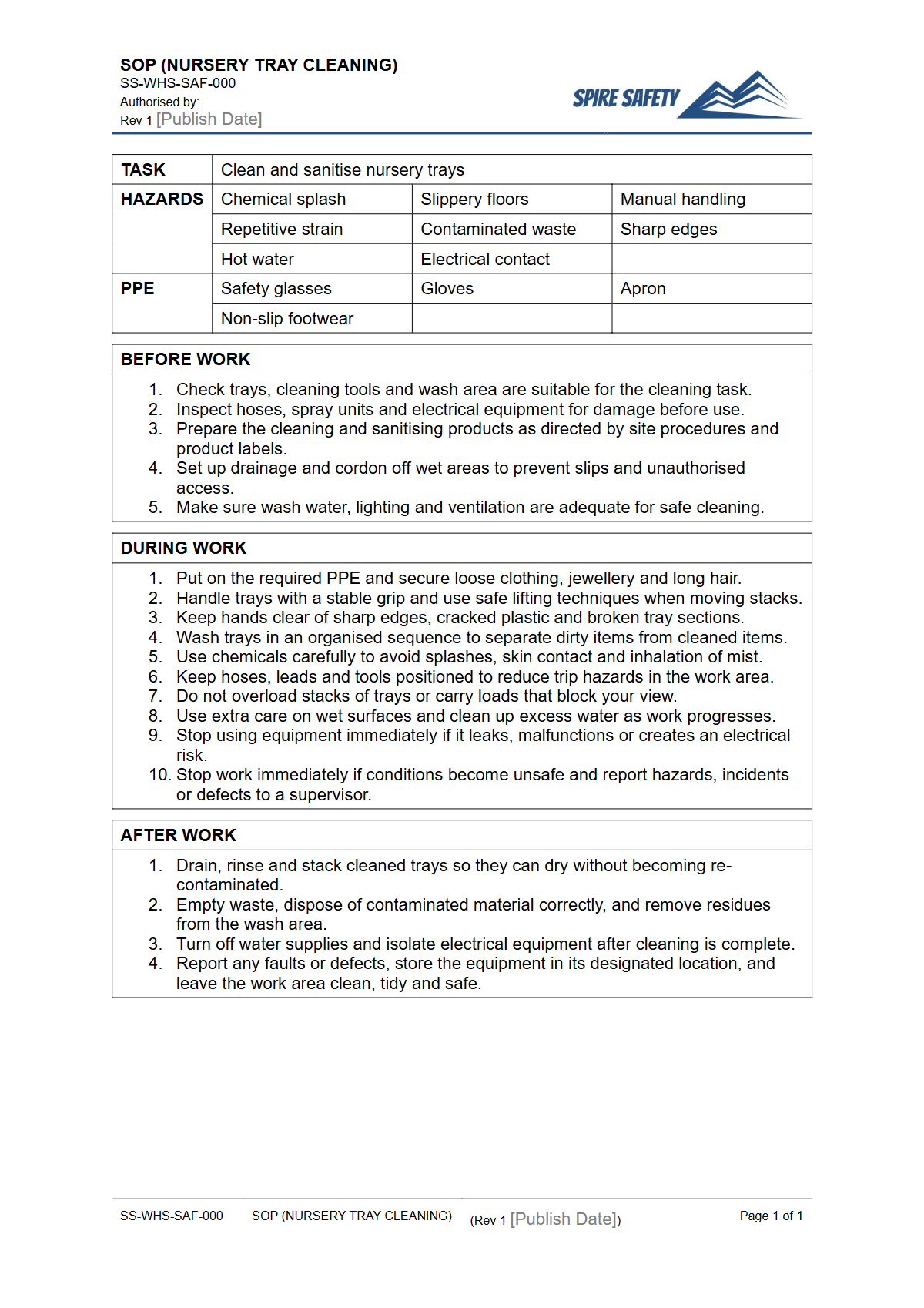
However, the process introduces several workplace hazards. This Free Safe Operating Procedure (Nursery Tray Cleaning) Template provides a structured framework for documenting the required steps to perform this task safely.
It helps a Person Conducting a Business or Undertaking (PCBU) meet their primary duty of care by managing risks associated with manual handling, chemical exposure, slips and trips, and ergonomic strain.
A documented SOP serves as a vital training tool and a clear reference for workers, ensuring consistency and safety across all shifts. By outlining specific controls—such as correct lifting techniques, required Personal Protective Equipment (PPE), and proper chemical handling protocols—you formalise your commitment to a safe system of work.
Using a clear procedure helps minimise the risk of injury and operational downtime. Similar principles of procedural safety apply to other common agricultural tasks, as outlined in our FREE Planter SOP Template.
Video walkthrough
How to use the Free Safe Operating Procedure (Nursery Tray Cleaning) Template
This document is a starting point designed for customisation. Your business is unique, with specific equipment, chemicals, and a distinct physical layout.
To make this SOP effective, you must adapt it to reflect your operational reality. Download the DOCX file and walk through the cleaning process at your site, filling in the blank sections with your site-specific details.
Involve the workers who actually perform the task—their input is invaluable for creating a practical and effective procedure.
You should detail the exact types of cleaning agents used, the correct dilution ratios, contact times, and the specific PPE required for each. Specify the location of safety data sheets (SDS), first aid kits, and emergency eyewash stations.
The procedure should also detail steps for cleaning the work area itself to prevent slip hazards. Integrating such procedures into your overarching safety framework is a key function of effective WHS management systems.
Review and Update
A Safe Operating Procedure is not a 'set and forget' document. It must be reviewed regularly to remain relevant and effective.
Schedule a review at least annually, or immediately following any changes to the task. This includes introducing new cleaning equipment (such as pressure washers or automated tray washers), changing chemical suppliers, altering the workflow, or after a near miss or incident occurs.
Regular reviews are a cornerstone of continuous improvement in safety, a process that can be verified through a formal WHS compliance auditing program.
When to use it
The completed SOP for nursery tray cleaning should be a core part of your operational documentation. It is used in several key situations.
New employees must be trained using the SOP before they are permitted to perform the task unsupervised. It should also be used for refresher training for existing staff to prevent complacency and reinforce safe work habits.
The document serves as a benchmark for workplace inspections and observations. In the unfortunate event of an incident, the SOP provides a record of the prescribed safe work method, which is essential for any investigation. Using SOPs is a standard practice for managing risk for all types of machinery, from simple tools to complex automated lines like those covered in a FREE Conveyer System SOP.
Who should use it
This SOP is intended for a range of personnel within a nursery, farm, or horticultural business. It is primarily for the workers who carry out the tray cleaning tasks daily.
Supervisors and team leaders must use it to conduct training, enforce safe practices, and monitor for compliance. WHS managers and coordinators will use the template as part of the risk management process, ensuring that controls are documented and communicated effectively.
For comprehensive safety integration, seeking guidance from an external specialist can be beneficial; our WHS consulting services can help organisations of all sizes embed these practices into their culture. Even maintenance staff can refer to it, for instance, to understand the operational context when servicing cleaning equipment like a pressure washer or an air compressor, which may have its own dedicated Free Air Compressor SOP.
By ensuring everyone understands their role in the procedure, you foster a proactive safety culture where risks are actively managed. You can find more templates and checklists to support your safety goals in our complete free WHS resources library.
Common mistakes
Common mistakes to avoid
- Using incorrect dilution ratios for cleaning chemicals, reducing their effectiveness or creating a chemical hazard.
- Failing to wear the specified Personal Protective Equipment (PPE), especially eye protection and gloves.
- Adopting poor ergonomic postures, such as prolonged bending at the waist instead of using a raised bench.
- Not allowing trays to dry completely before stacking and storage, which can promote mould and mildew growth.
Legal references
Legal considerations
The following legal requirements may be relevant to this type of work.
- Work Health and Safety Act (Harmonised) — Provides the primary duties for protecting workers and other people from work health and safety risks.
- Work Health and Safety Regulations (Harmonised) — Sets out requirements supporting the management of workplace hazards and risks.
The following codes may be relevant to this type of work.
- Managing WHS Risks Code of Practice — Provides practical guidance on identifying hazards, assessing risks and applying effective controls.
- Work Health and Safety Consultation, Cooperation and Coordination Code of Practice — Provides practical guidance on consulting workers and coordinating with other duty holders.
- Managing the Work Environment and Facilities Code of Practice — Provides practical guidance on safe work environments, workplace facilities and related controls.
Did you know
Pathogen Prevention
Proper tray sanitation is a primary defence against devastating soil-borne pathogens like Pythium and Phytophthora, which can cause 'damping-off' and root rot, leading to major crop losses in commercial nurseries.
Manual Task Risks
According to Safe Work Australia, the agriculture, forestry and fishing industry has one of the highest rates of serious claims for work-related injuries, with manual handling being a leading cause.
FAQ
Frequently asked questions
01What hazards are involved in cleaning nursery trays?
02How often should an SOP for nursery tray cleaning be reviewed?
03Is this template enough for WHS compliance?
04What PPE is typically required for cleaning nursery trays?
Share this resource
Free Safe Operating Procedure (Nursery Tray Cleaning) Template
Browse Categories
How To Use It
- 1Download and open in Word or PDF.
- 2Replace the placeholders with your business details.
- 3Get it reviewed by a WHS specialist before rollout.
Need it customised?
Our WHS consultants can adapt this template to your site, run a gap analysis, or audit what you already have in place.
Book a Free Consultation WHS consulting servicesor call 1300 156 382
Related templates
- Free Safe Operating Procedure (Nut Runner) Template
- Free Safe Operating Procedure (Office Carpet Cleaning) Template
- Free Safe Operating Procedure (Office Chair Cleaning) Template
- Free Safe Operating Procedure (Office Partition Clean) Template
- Free Safe Operating Procedure (Oil Filter Crusher) Template
- Free Safe Operating Procedure (Oil Spill Skimmer) Template