
Free Safe Operating Procedure (Office Partition Clean) Template
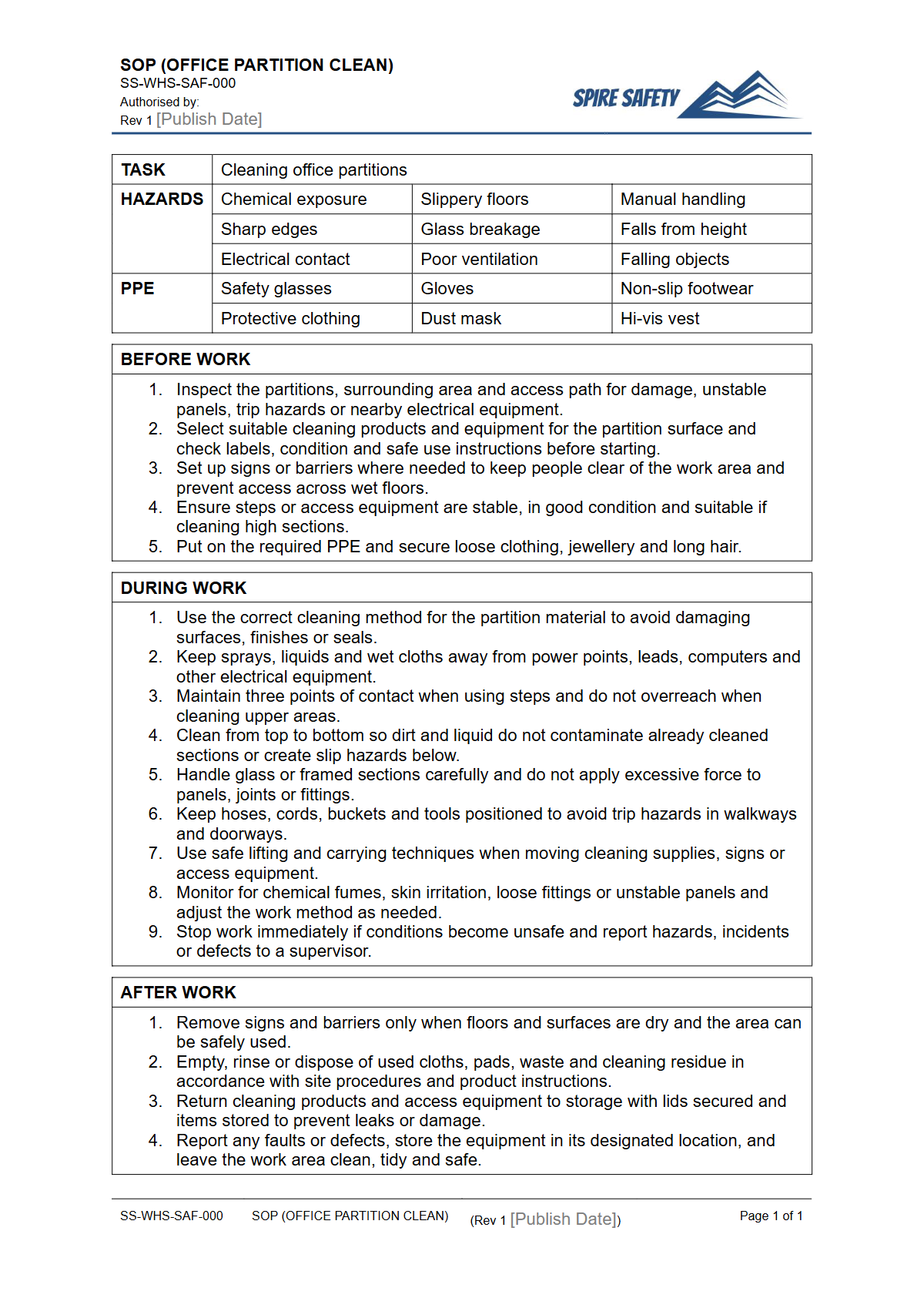
Download our free Safe Operating Procedure (Office Partition Clean) Template. This customisable DOCX and PDF provides a structured framework for your WHS needs.
Free Safe Operating Procedure (Office Partition Clean) Template
DOCX • 126 KB + PDF
Updated Oct 2026
No signup required
Purpose of the Free Safe Operating Procedure (Office Partition Clean) Template
Maintaining a clean and hygienic office environment is essential for employee health and productivity. This free Safe Operating Procedure (Office Partition Clean) Template provides a structured framework for outlining the step-by-step process for safely cleaning office partitions, including fabric, glass, and laminate types.
It helps organisations document key safety controls to manage common hazards such as exposure to cleaning chemicals, manual handling risks, and slips, trips, and falls. Implementing documented procedures is a fundamental part of robust WHS management systems, demonstrating a commitment to workplace safety and operational consistency.
This template is designed as a starting point, aligned with Australian WHS principles. It guides users to consider aspects like required Personal Protective Equipment (PPE), pre-operational checks, the cleaning sequence, and waste disposal.
By formalising these steps, you reduce the likelihood of incidents and ensure every team member follows a consistent, safe method.
Video walkthrough
How to use the Free Safe Operating Procedure (Office Partition Clean) Template
This resource is available for immediate download in both DOCX and PDF formats. The DOCX file is fully editable, allowing you to tailor the content to the specific cleaning products, equipment, and environmental conditions of your workplace.
It is crucial to customise this document to reflect your site-specific risk assessments and control measures.
A note on customisation: We have provided a comprehensive template, but it is your responsibility to ensure it is adapted to your specific workplace. This includes adding details of the exact chemicals used (and referencing their Safety Data Sheets), the types of partitions on-site, and any unique layout or access challenges. Regularly verifying that procedures are followed correctly is also vital, often forming part of internal or external WHS compliance auditing.
To effectively implement this SOP:
- Conduct a Risk Assessment: Before finalising the SOP, perform a thorough risk assessment for the task. Identify all potential hazards and establish effective control measures.
- Consult with Workers: Involve your cleaning staff or facility maintenance team in the drafting process. Their direct experience is invaluable for creating a practical and effective procedure.
- Add Specific Details: Populate the template with your company name, specific site locations, and the makes and models of any equipment used.
- Train Your Team: Once finalised, use the SOP as a training tool for all relevant employees. Ensure they understand every step and the reasoning behind the safety controls.
When to use it
A Safe Operating Procedure for cleaning office partitions should be used consistently as part of your organisation's cleaning and maintenance schedule. It is particularly important during staff induction and refresher training to establish a baseline for safe work practices.
The procedure should be readily accessible in the workplace, either in digital or physical form, for easy reference. While this document covers partitions, other office equipment may require its own procedure, such as that detailed in our Free Air Compressor SOP for cleaning dust from electronics or workshop areas.
Who should use it
This template is designed for use by a range of personnel within an organisation. WHS Managers and Facility Managers can use it to develop and standardise cleaning protocols across a business.
Supervisors can use it to train and oversee cleaning staff, ensuring tasks are performed safely and efficiently. The cleaning operatives themselves are the end-users, following the procedure to guide their day-to-day work.
For smaller businesses without a dedicated safety manager, business owners can use this template as a practical tool to help meet their WHS obligations. If you need assistance developing and implementing a suite of procedures, engaging expert WHS consulting services can provide valuable guidance.
You can also explore our complete free WHS resources library for more templates.
Common mistakes
Common mistakes to avoid
- Using incorrect cleaning chemicals for the partition material, causing discolouration or damage.
- Failing to use 'Caution: Wet Floor' signs when cleaning solutions drip or spill onto walkways.
- Neglecting to consult the Safety Data Sheet (SDS) for each cleaning chemical before use.
- Inadequate training on manual handling techniques for moving office furniture to access partitions.
Legal references
Legal considerations
The following legal requirements may be relevant to this type of work.
- Work Health and Safety Act (Harmonised) — Provides the primary duties for protecting workers and other people from work health and safety risks.
- Work Health and Safety Regulations (Harmonised) — Sets out requirements supporting the management of workplace hazards and risks.
The following codes may be relevant to this type of work.
- Managing WHS Risks Code of Practice — Provides practical guidance on identifying hazards, assessing risks and applying effective controls.
- Work Health and Safety Consultation, Cooperation and Coordination Code of Practice — Provides practical guidance on consulting workers and coordinating with other duty holders.
- Managing the Work Environment and Facilities Code of Practice — Provides practical guidance on safe work environments, workplace facilities and related controls.
Did you know
Air Quality Matters
Poor indoor air quality from accumulated dust and volatile organic compounds (VOCs) released by some cleaning products can negatively impact employee health, concentration, and productivity.
Fabric as a Filter
Fabric-covered office partitions can act as large vertical filters, trapping dust, allergens, and other airborne particles. Regular, deep cleaning is vital for employee wellbeing, especially for those with allergies or respiratory conditions.
FAQ
Frequently asked questions
01What hazards are involved in cleaning office partitions?
02Is a Safe Operating Procedure a legal requirement for office cleaning?
03How often should I review an Office Partition Clean SOP?
04Can I use this template for cleaning other office surfaces?
Share this resource
Free Safe Operating Procedure (Office Partition Clean) Template
Browse Categories
How To Use It
- 1Download and open in Word or PDF.
- 2Replace the placeholders with your business details.
- 3Get it reviewed by a WHS specialist before rollout.
Need it customised?
Our WHS consultants can adapt this template to your site, run a gap analysis, or audit what you already have in place.
Book a Free Consultation WHS consulting servicesor call 1300 156 382
Related templates
- Free Safe Operating Procedure (Oil Filter Crusher) Template
- Free Safe Operating Procedure (Oil Spill Skimmer) Template
- Free Safe Operating Procedure (Orbital Sander) Template
- Free Safe Operating Procedure (Orbital Welder) Template
- Free Safe Operating Procedure (Orchard Floor Cleaning) Template
- Free Safe Operating Procedure (Orchard Pruning) Template