
Free Safe Operating Procedure (Orbital Welder) Template
Download our Free Safe Operating Procedure (Orbital Welder) Template to formalise safety protocols for your high-purity welding tasks.
Free Safe Operating Procedure (Orbital Welder) Template
DOCX • 126 KB + PDF
Updated Oct 2026
No signup required
Purpose of the Free Safe Operating Procedure (Orbital Welder) Template
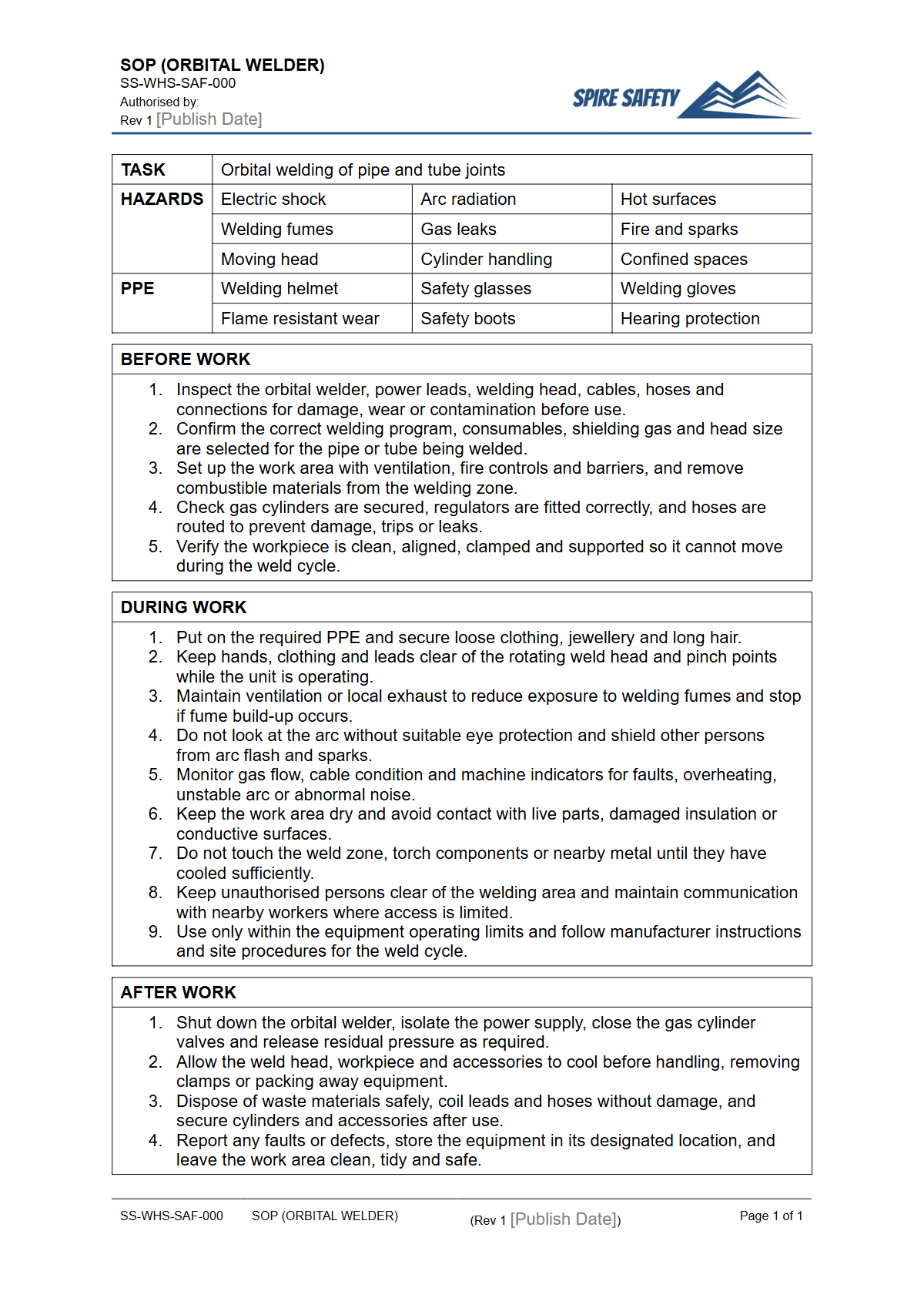
This Free Safe Operating Procedure (Orbital Welder) Template provides a structured framework for documenting the safe use of automated orbital welding systems in your workplace. It is designed to help your organisation standardise operating protocols, manage specific risks, and ensure workers are informed of the hazards associated with orbital welding, such as electrical shock, arc radiation, burns, and exposure to shielding gases.
Implementing a clear SOP is a fundamental step in controlling risks and demonstrating due diligence. Properly developed procedures form a critical part of comprehensive WHS management systems, helping to create a safer and more organised work environment.
Video walkthrough
How to use the Free Safe Operating Procedure (Orbital Welder) Template
To effectively implement this Safe Operating Procedure for orbital welders, download the template and customise it to reflect the specific equipment, environment, and processes at your worksite. The document outlines key sections including required PPE, pre-operational checks, step-by-step operating instructions, and post-operational shutdown tasks.
It is essential that you consult with the operators and supervisors who use the equipment daily to ensure the SOP is practical and accurate. A generic document is not sufficient; we have provided this template as a starting point, and it is your responsibility to adapt it with site-specific details to ensure it is relevant for your workplace. This process is similar for other workshop equipment, such as when documenting steps in a free Air Compressor SOP.
What your Orbital Welder SOP should include:
- Hazard Identification: List all potential hazards, including electrical, radiation (UV/IR), fumes, compressed gas, hot surfaces, and ergonomic risks.
- Personal Protective Equipment (PPE): Specify the exact PPE required, such as welding helmets with appropriate shade lenses, flame-resistant clothing, leather gloves, and safety boots.
- Pre-Operational Checks: Detail the daily checks for the power source, weld head, gas lines, cables, and control pendant to ensure all components are in safe working order.
- Operating Steps: Provide a clear, sequential guide for setting up the machine, programming weld parameters, performing the weld, and monitoring the process.
- Post-Operational Tasks: Outline procedures for shutting down the equipment, cleaning the work area, storing the weld head, and turning off gas cylinders.
- Emergency Procedures: Describe the response actions for equipment malfunction, fire, or medical emergencies.
When to use this Safe Operating Procedure
An SOP for an orbital welder should be used as a primary reference document for all related work activities. It is essential during the induction and training of new operators to ensure they understand the approved, safe method of operation from the outset.
The SOP should be reviewed before commencing any non-routine welding task to refresh knowledge of the safety controls. Furthermore, it serves as a critical tool during safety audits, incident investigations, and regular reviews of your safe work systems.
Just as with other precision tools, having a documented procedure like a FREE Circular Saw SOP ensures consistency and safety across all operations.
Who should use this Safe Operating Procedure
This SOP should be actively used by several key roles within an organisation. Primarily, machine operators must be thoroughly trained on the SOP and follow it for every task.
Supervisors and team leaders are responsible for enforcing its use, ensuring compliance, and providing coaching where needed. Maintenance personnel should also reference the SOP, particularly sections related to equipment checks and safe shutdown for servicing.
Finally, WHS managers and safety officers will use the document to conduct risk assessments, verify training adequacy, and maintain safety records. If your team lacks the internal expertise to adapt this template, seeking external WHS consulting can provide valuable guidance.
Developing robust SOPs is crucial for managing risks associated with specialised machinery. For other automated processes, you might find our FREE Conveyer System SOP a useful reference.
By documenting clear procedures for all high-risk plant, you build a resilient safety culture. Feel free to explore our complete free WHS resources library for more templates to support your safety management system.
Common mistakes
Common mistakes to avoid
- Failing to customise the template with machine-specific model numbers, settings, and workplace conditions.
- Neglecting to consult with experienced operators during the drafting process, leading to impractical or incorrect steps.
- Specifying generic PPE instead of detailing the exact requirements, such as the correct shade number for the welding helmet.
- Treating the SOP as a one-time document and failing to review or update it after equipment modifications or near-miss incidents.
Legal references
Legal considerations
The following legal requirements may be relevant to this type of work.
- Work Health and Safety Act (Harmonised) — Provides the primary duties for protecting workers and other people from work health and safety risks.
- Work Health and Safety Regulations (Harmonised) — Sets out requirements supporting the management of workplace hazards and risks.
The following codes may be relevant to this type of work.
- Managing WHS Risks Code of Practice — Provides practical guidance on identifying hazards, assessing risks and applying effective controls.
- Work Health and Safety Consultation, Cooperation and Coordination Code of Practice — Provides practical guidance on consulting workers and coordinating with other duty holders.
- Managing the Work Environment and Facilities Code of Practice — Provides practical guidance on safe work environments, workplace facilities and related controls.
Did you know
Aerospace Origins
Orbital welding was originally developed in the 1960s for the aerospace industry to address the need for extremely high-purity, reliable tube welds in hydraulic lines that were inaccessible to manual welders.
Shielding Gas is Critical
The inert shielding gas, typically argon, is not just for protecting the weld from atmospheric contamination. It also plays a vital role in stabilising the arc and controlling heat transfer, which is essential for the precision of the orbital welding process.
FAQ
Frequently asked questions
01What are the main hazards associated with orbital welding?
02Is a Safe Operating Procedure legally required for an orbital welder in Australia?
03How often should an orbital welder SOP be reviewed?
04What training is required to operate an orbital welder safely?
Share this resource
Free Safe Operating Procedure (Orbital Welder) Template
Browse Categories
How To Use It
- 1Download and open in Word or PDF.
- 2Replace the placeholders with your business details.
- 3Get it reviewed by a WHS specialist before rollout.
Need it customised?
Our WHS consultants can adapt this template to your site, run a gap analysis, or audit what you already have in place.
Book a Free Consultation WHS consulting servicesor call 1300 156 382
Related templates
- Free Safe Operating Procedure (Orchard Floor Cleaning) Template
- Free Safe Operating Procedure (Orchard Pruning) Template
- Free Safe Operating Procedure (Orchard Weed Control) Template
- Free Safe Operating Procedure (Order Picker) Template
- Free Safe Operating Procedure (Order Pickup Handling) Template
- Free Safe Operating Procedure (Ore Sorter) Template