
Free Safe Operating Procedure (Ore Sorter) Template
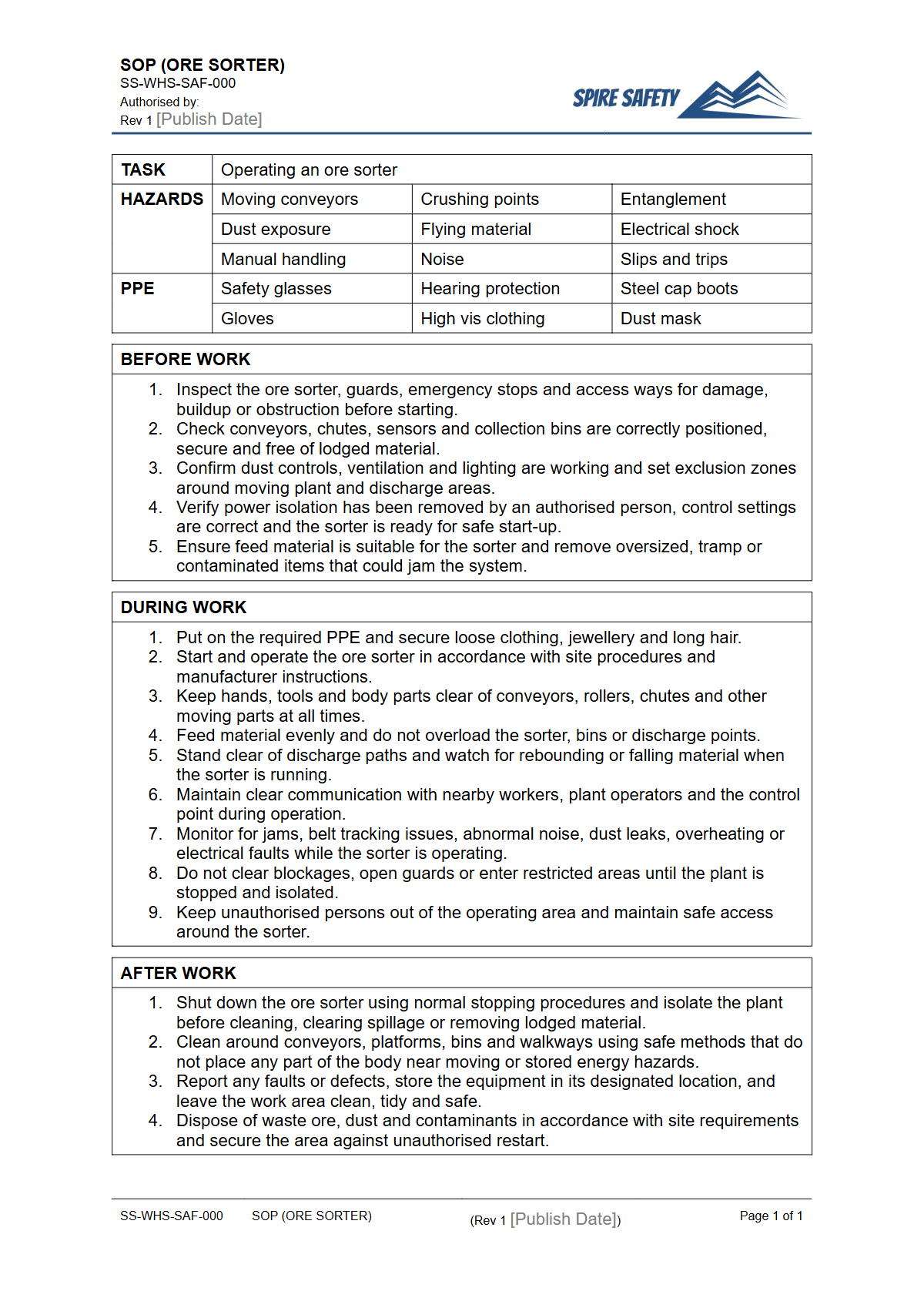
Download our free Safe Operating Procedure (Ore Sorter) Template to formalise safe work methods for your mining or processing operations. Get started today.
Free Safe Operating Procedure (Ore Sorter) Template
DOCX • 126 KB + PDF
Updated Oct 2026
No signup required
Purpose of the Free Safe Operating Procedure (Ore Sorter) Template
This Safe Operating Procedure (SOP) for ore sorters provides a structured framework for documenting the required steps to operate this machinery safely. Using this free template helps your organisation manage WHS risks associated with ore sorting, such as exposure to moving parts, hazardous dust, noise, and potential radiation sources depending on the sorting technology.
Formalising procedures ensures that all operators, from new trainees to experienced workers, follow a consistent, safe method of work, which is a cornerstone of a robust safety management system.
An SOP clearly outlines pre-operational checks, step-by-step operating instructions, and shutdown procedures. It serves as a critical training tool and a reference point for daily operations, helping to minimise the risk of incidents and injuries.
Ore sorters are often integrated with other equipment like conveyor systems. For a comprehensive approach, consider downloading our FREE Conveyer System SOP to ensure seamless safety protocols across connected machinery.
Video walkthrough
How to use the Free Safe Operating Procedure (Ore Sorter) Template
This resource is provided as a fully editable DOCX file and a ready-to-print PDF. The DOCX version allows you to tailor the content directly to the specific make and model of ore sorter used at your site, as well as incorporate your company branding and specific operational details.
It is structured to align with Australian WHS practices and provides a solid foundation for your site-specific documentation.
Important: This is a template only. For it to be effective, you must customise it to reflect the unique hazards and control measures present in your workplace.
We recommend a competent person, such as a site supervisor or WHS manager, reviews and adapts the document in consultation with the machine operators. Once customised, it should be approved, and all relevant personnel must be trained on its contents.
Integrating this SOP into your broader WHS management systems ensures a consistent and documented approach to safety across your organisation. A well-implemented system helps demonstrate due diligence and fosters a proactive safety culture where risks are systematically identified and controlled.
When to use a Safe Operating Procedure
A Safe Operating Procedure for an ore sorter should be used consistently throughout the equipment's lifecycle. It is not a document to be filed away after induction. Key times to use the SOP include:
- Before every use: As a guide for conducting pre-start inspections to verify that the equipment is safe to operate and all guards are in place.
- During operator training: As the primary document for inducting and training new operators on the correct and safe use of the machinery.
- For refresher training: To reinforce safe work practices with existing operators on a regular basis.
- During maintenance planning: To understand the correct shutdown, isolation, and lock-out/tag-out procedures required before maintenance or cleaning can begin.
- After an incident or near miss: As part of an investigation to determine if procedural gaps contributed to the event, and to update the procedure accordingly.
Regular reviews are a key part of maintaining safety standards, which can be verified through a formal WHS compliance auditing process to ensure procedures are being followed correctly and remain effective.
Who should use this document
This document is intended for use by several key roles within a mining, quarrying, or mineral processing operation:
- Plant Operators: The primary users who must follow the procedure for every task involving the ore sorter.
- Supervisors and Site Managers: Responsible for ensuring operators are trained, deemed competent, and adhere to the documented SOP. They also oversee its implementation and regular review.
- WHS Managers/Advisors: Use the SOP as a tool for risk assessment, training development, and incident investigation. They often lead the development and review process.
- Maintenance Personnel: Must refer to the SOP for safe shutdown and isolation procedures before commencing any repair, cleaning, or maintenance work.
While this document is specific to ore sorters, similar principles apply to other heavy machinery. For example, operators of earthmoving equipment should follow documents like our FREE Grader SOP. Ancillary equipment also requires its own procedures, such as those covered in our Free Air Compressor SOP. You can find more templates in our free WHS resources library to build a comprehensive set of workplace procedures.
Common mistakes
Common mistakes to avoid
- Failing to customise the template for the specific make and model of the ore sorter.
- Neglecting to include site-specific emergency procedures and contact details.
- Using the SOP only for induction, not for regular refresher training or pre-start checks.
- Not reviewing or updating the SOP after an incident, near miss, or change in equipment.
Legal references
Legal considerations
The following legal requirements may be relevant to this type of work.
- Work Health and Safety Act (Harmonised) — Provides the primary duties for protecting workers and other people from work health and safety risks.
- Work Health and Safety Regulations (Harmonised) — Sets out requirements supporting the management of workplace hazards and risks.
The following codes may be relevant to this type of work.
- Managing WHS Risks Code of Practice — Provides practical guidance on identifying hazards, assessing risks and applying effective controls.
- Work Health and Safety Consultation, Cooperation and Coordination Code of Practice — Provides practical guidance on consulting workers and coordinating with other duty holders.
- Managing the Work Environment and Facilities Code of Practice — Provides practical guidance on safe work environments, workplace facilities and related controls.
Did you know
Advanced Sorting Technology
Modern ore sorters use technologies like X-ray transmission (XRT) and near-infrared (NIR) sensors to identify and separate valuable minerals from waste rock in real-time at incredible speeds.
Water Conservation
Some ore sorting technologies can significantly reduce water consumption in mineral processing by pre-concentrating ore and rejecting non-valuable material before it enters wet processing stages.
FAQ
Frequently asked questions
01What are the main hazards associated with operating an ore sorter?
02How often should an Ore Sorter SOP be reviewed?
03Is this template suitable for all types of ore sorters?
04Who is responsible for training workers on this Safe Operating Procedure?
Share this resource
Free Safe Operating Procedure (Ore Sorter) Template
Browse Categories
How To Use It
- 1Download and open in Word or PDF.
- 2Replace the placeholders with your business details.
- 3Get it reviewed by a WHS specialist before rollout.
Need it customised?
Our WHS consultants can adapt this template to your site, run a gap analysis, or audit what you already have in place.
Book a Free Consultation WHS consulting servicesor call 1300 156 382
Related templates
- Free Safe Operating Procedure (Organic Waste Handling) Template
- Free Safe Operating Procedure (Oscillating Tool) Template
- Free Safe Operating Procedure (Outboard Motor) Template
- Free Safe Operating Procedure (Outbound Freight Check) Template
- Free Safe Operating Procedure (Outbound Load Staging) Template
- Free Safe Operating Procedure (Outdoor Area Cleaning) Template