
Free Safe Operating Procedure (Oscillating Tool) Template
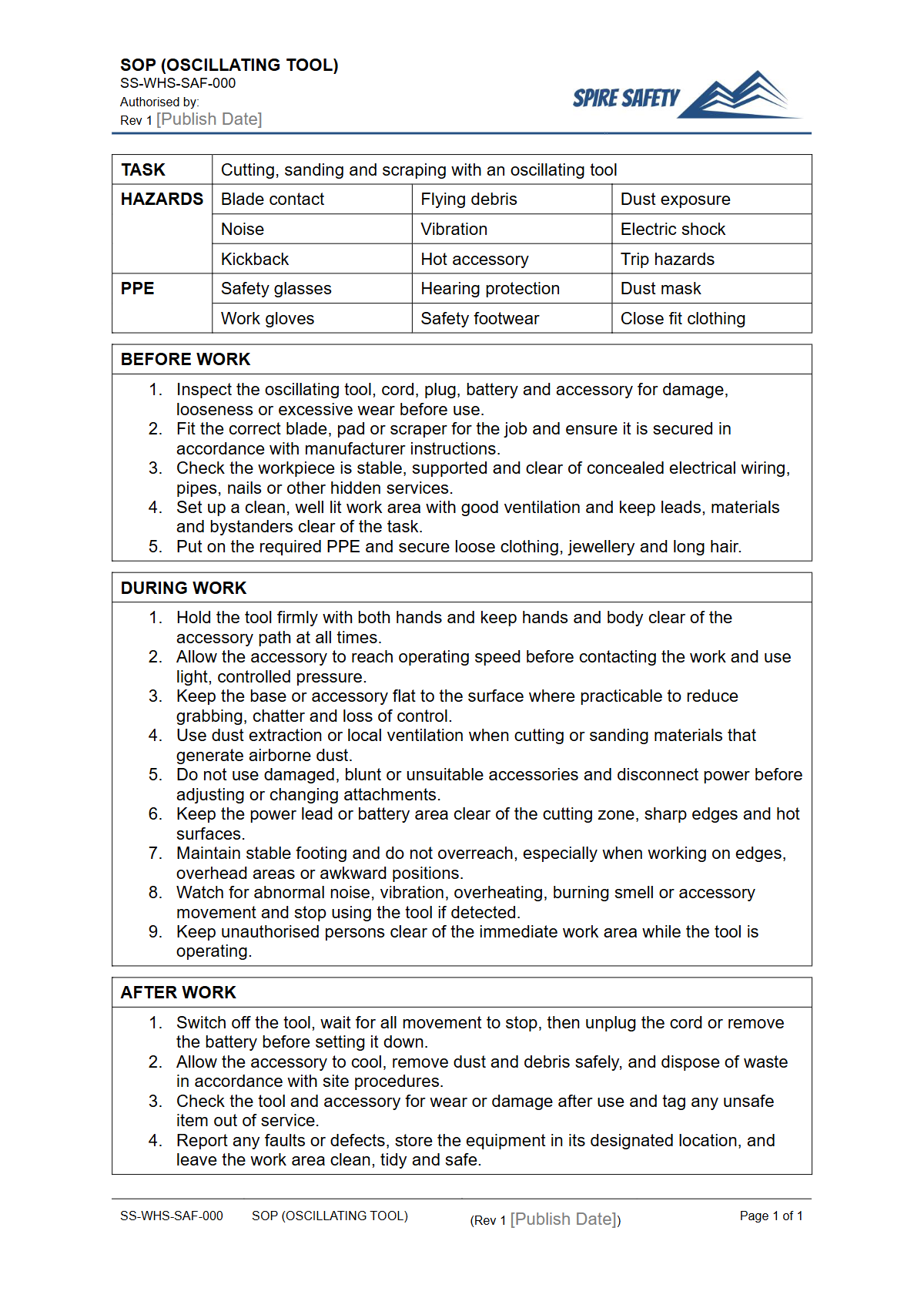
Download our free Safe Operating Procedure (Oscillating Tool) template. This customisable document helps establish safe work methods for using multitools.
Free Safe Operating Procedure (Oscillating Tool) Template
DOCX • 126 KB + PDF
Updated Oct 2026
No signup required
Purpose of the Free Safe Operating Procedure (Oscillating Tool) Template
An oscillating tool, also known as a multitool, is a versatile piece of equipment used for cutting, sanding, grinding, and scraping. However, its versatility introduces a range of hazards, including cuts and lacerations from sharp blades, dust inhalation from sanding, noise, and hand-arm vibration.
This Free Safe Operating Procedure (Oscillating Tool) Template provides a structured framework for documenting the safe use of this equipment in your workplace. Its purpose is to standardise operations, minimise risk, and provide a clear, easy-to-follow guide for workers.
By formally documenting the process, you create a baseline for training, supervision, and performance monitoring, helping to fulfil your duties under WHS legislation.
A well-developed SOP is a critical component of a proactive safety culture. It moves beyond assumptions and verbal instructions to create a reliable and repeatable process.
This not only protects your workers but also helps maintain the longevity of the equipment by ensuring it is used correctly. The template covers key areas including pre-start checks, operational steps, required Personal Protective Equipment (PPE), and emergency procedures.
Much like our FREE Circular Saw SOP Template, it is designed to be adapted to the specific tasks and materials found in your work environment.
Video walkthrough
How to use the Free Safe Operating Procedure (Oscillating Tool) Template
Downloading this template is the first step towards creating a robust, workplace-specific document. To ensure it is effective and integrated into your safety processes, follow these steps:
- Download and Customise: The file is available in DOCX for easy editing. Open the document and begin filling in the blank fields. Add details specific to your workplace, such as the exact models of oscillating tools used, the types of blades or attachments, and the materials being worked on.
- Consult with Your Team: Involve the workers who actually use the oscillating tools. They have firsthand experience with the task and can provide valuable insights into the practical steps, potential hazards, and effective controls. This consultation is a key requirement of WHS law and ensures the final document is practical and accepted by the team.
- Specify PPE and Controls: Review the suggested PPE and hazard controls. You may need to add or remove items based on your own WHS consulting and risk assessment. For example, specific types of respiratory protection may be required for certain sanding tasks, or specific glove types for blade changes.
- Train and Communicate: Once finalised, the SOP is not just a document to be filed away. Use it as a central part of your training for new and existing employees. Conduct toolbox talks to introduce the SOP or review it periodically. Ensure it is readily accessible to all relevant workers at the point of work.
- Review and Revise: The SOP should be a living document. Schedule regular reviews (e.g., annually, or after an incident) to ensure it remains current with new equipment, processes, or changes in legislation.
Important Note: This document is a template and does not constitute legal advice. We are not your safety consultants.
It is your responsibility to customise the content to reflect the specific risks, equipment, and operating environment of your business and to consult with your workers to ensure the procedure is safe and practical for your workplace.
When to use this Safe Operating Procedure
The Safe Operating Procedure for an oscillating tool should be a core part of your daily operations. It is not just for new workers but serves as a constant reference for safe work practices. Use this SOP:
- During the induction and training of new employees or contractors.
- As a refresher for experienced workers, especially before performing non-routine tasks.
- As a guide for pre-start inspections and function tests.
- During toolbox talks to discuss specific hazards associated with a job.
- As a reference document during safety audits or incident investigations.
Integrating the SOP into these regular activities ensures that safety remains a top priority and that correct procedures are consistently reinforced.
Who is responsible for the SOP
Creating a safe work environment is a shared responsibility. While the PCBU (Person Conducting a Business or Undertaking) has the primary duty of care, different roles within the organisation contribute to the SOP's effectiveness:
- PCBU/Management: Responsible for ensuring resources are available to develop, implement, and review SOPs as part of the overall WHS management system. They must ensure the SOP is suitable and that workers are trained in its use.
- Supervisors: Responsible for ensuring workers follow the SOP on a day-to-day basis. They provide direct oversight, enforce the documented procedures, and are often the first point of contact for safety issues.
- Workers: Responsible for following the approved SOP, participating in training, conducting pre-start checks, wearing the correct PPE, and reporting any hazards or problems with the equipment or procedure immediately.
Our template is designed to be clear and practical for all users, from management to the workshop floor. You can find many other useful templates and guides in our free WHS resources library to support your safety efforts across a variety of equipment, like the procedures detailed in our Free Air Compressor SOP Template.
Common mistakes
Common mistakes to avoid
- Using a dull or incorrect blade for the material, leading to poor performance and increased risk of the tool kicking back.
- Applying excessive force to the tool instead of letting the blade's oscillation do the cutting, which can strain the motor and increase vibration.
- Neglecting to inspect the tool, power cord, and blade for damage before each use.
- Failing to wear appropriate PPE, particularly safety glasses and respiratory protection when sanding or cutting materials that produce fine dust.
Legal references
Legal considerations
The following legal requirements may be relevant to this type of work.
- Work Health and Safety Act (Harmonised) — Provides the primary duties for protecting workers and other people from work health and safety risks.
- Work Health and Safety Regulations (Harmonised) — Sets out requirements supporting the management of workplace hazards and risks.
The following codes may be relevant to this type of work.
- Managing WHS Risks Code of Practice — Provides practical guidance on identifying hazards, assessing risks and applying effective controls.
- Work Health and Safety Consultation, Cooperation and Coordination Code of Practice — Provides practical guidance on consulting workers and coordinating with other duty holders.
- Managing the Work Environment and Facilities Code of Practice — Provides practical guidance on safe work environments, workplace facilities and related controls.
Did you know
Medical Origins
The technology behind the modern oscillating tool was originally developed in the 1960s for medical use. The oscillating action was designed to cut through hard plaster casts without cutting the soft skin underneath.
Vibration Risk
Prolonged use of vibrating tools like oscillating multitools can lead to Hand-Arm Vibration Syndrome (HAVS). Early symptoms include tingling and numbness in the fingers, which can progress to permanent nerve damage if not managed.
FAQ
Frequently asked questions
01What are the main hazards of using an oscillating tool?
02Is a Safe Operating Procedure a legal requirement for oscillating tools in Australia?
03How often should an oscillating tool SOP be reviewed?
04Can this template be used for any brand of oscillating multitool?
Share this resource
Free Safe Operating Procedure (Oscillating Tool) Template
Browse Categories
How To Use It
- 1Download and open in Word or PDF.
- 2Replace the placeholders with your business details.
- 3Get it reviewed by a WHS specialist before rollout.
Need it customised?
Our WHS consultants can adapt this template to your site, run a gap analysis, or audit what you already have in place.
Book a Free Consultation WHS consulting servicesor call 1300 156 382
Related templates
- Free Safe Operating Procedure (Outboard Motor) Template
- Free Safe Operating Procedure (Outbound Freight Check) Template
- Free Safe Operating Procedure (Outbound Load Staging) Template
- Free Safe Operating Procedure (Outdoor Area Cleaning) Template
- Free Safe Operating Procedure (Outdoor Furniture Clean) Template
- Free Safe Operating Procedure (Outdoor Tile Cleaning) Template