
Free Safe Operating Procedure (Outdoor Tile Cleaning) Template
Download our free Safe Operating Procedure for outdoor tile cleaning to manage risks like slips, trips, and chemical exposure.
Free Safe Operating Procedure (Outdoor Tile Cleaning) Template
DOCX • 126 KB + PDF
Updated Oct 2026
No signup required
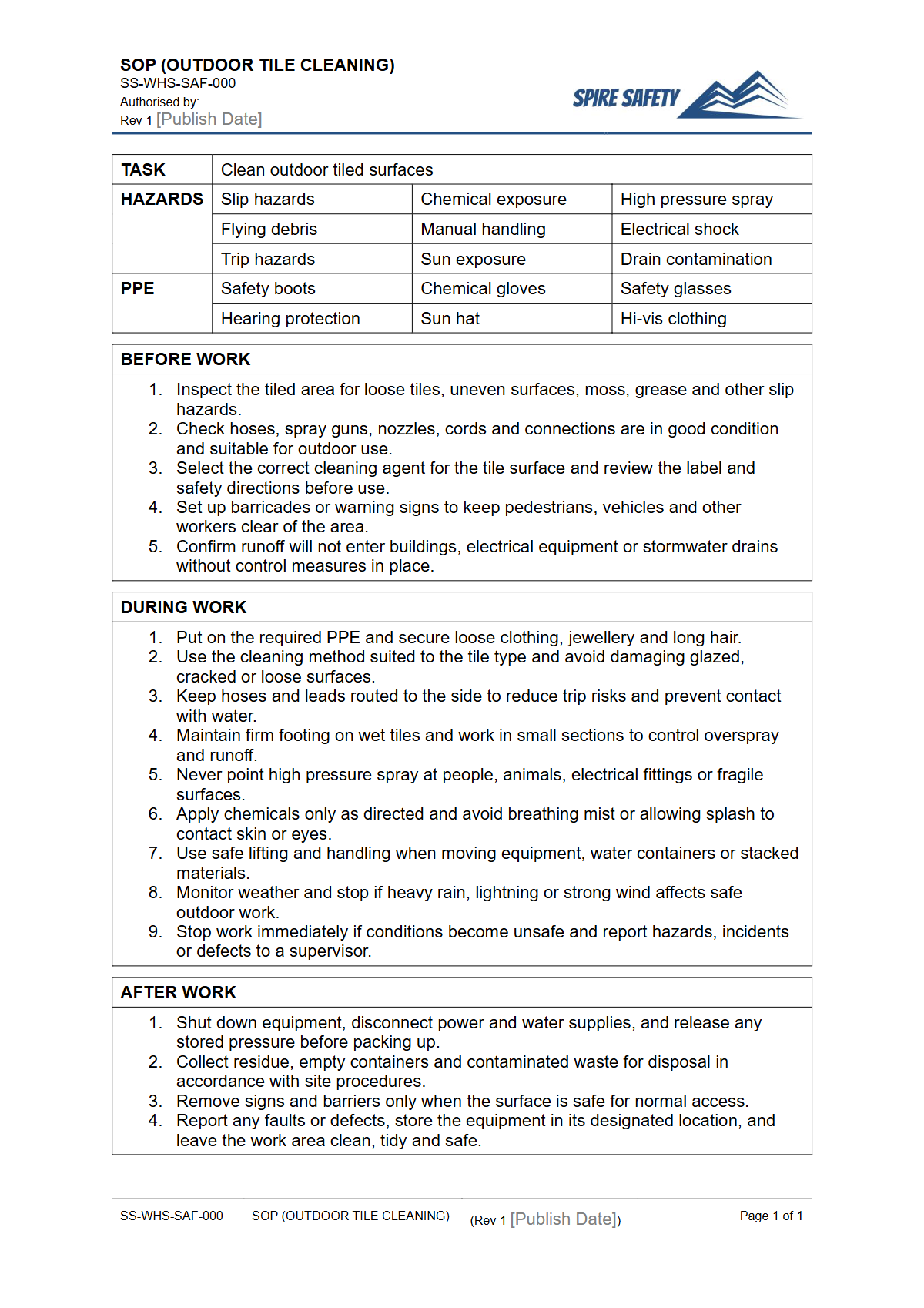
Purpose of the Free Safe Operating Procedure (Outdoor Tile Cleaning) Template
This Safe Operating Procedure (SOP) template for outdoor tile cleaning provides a structured framework for documenting a safe system of work. Completing this document helps your organisation identify and control hazards associated with high-pressure water jetting, chemical handling, and working in outdoor environments.
By outlining step-by-step instructions, you can manage significant risks such as slips on wet surfaces, exposure to hazardous chemicals, manual handling injuries from moving equipment, and electrical hazards from pressure washers.
A well-developed SOP is a fundamental component of a robust safety system, demonstrating a commitment to proactive risk management. It serves as a clear, practical tool for workers and supervisors, ensuring tasks are performed consistently and safely every time.
Integrating clear procedures like this one is a cornerstone of effective WHS management systems, helping you meet your duties under Australian WHS legislation.
Video walkthrough
How to use the Free Safe Operating Procedure (Outdoor Tile Cleaning) Template
Our free outdoor tile cleaning SOP template is provided in both DOCX and PDF formats for your convenience. The DOCX file is fully editable, allowing you to tailor it precisely to your operational needs.
To use the template effectively, you should consult with the workers who will be performing the task, as their direct experience is invaluable for identifying practical risks and effective controls.
Follow these steps to implement the SOP:
- Download the template.
- Conduct a site-specific risk assessment for the outdoor tile cleaning task. Consider the specific location, the type of tiles, the condition of the area, and any environmental factors.
- Customise the document with details about your specific equipment (e.g., pressure washer model, nozzle types), the chemicals being used (referencing their Safety Data Sheets), and the required Personal Protective Equipment (PPE).
- Clearly outline the pre-start checks, step-by-step operating sequence, and shutdown procedures.
- Have the final document reviewed and approved by a competent person within your organisation.
- Train all relevant workers on the finalised SOP and ensure it is readily accessible at the worksite.
IMPORTANT: This is a template only. We have developed it as a starting point, but you must customise it to reflect the specific equipment, chemicals, environment, and risks in your workplace.
If you need assistance with complex risk assessments or procedure development, our expert WHS consulting team can provide tailored support.
When to use it
A Safe Operating Procedure for outdoor tile cleaning should be a living document used throughout the work cycle, not just a file saved on a server. It is essential for initial worker training and induction, providing a clear and authoritative guide to performing the job safely from day one.
It should also be used as a reference for pre-start toolbox talks to refresh workers' knowledge of the key hazards and controls before the task begins.
Furthermore, the SOP is a critical tool for incident investigation. If a near miss or injury occurs, the procedure can be reviewed to determine if it was followed and if it needs to be updated to prevent a recurrence.
Regular reviews, typically annually or after any change in equipment, chemicals, or process, are vital to ensure the SOP remains current and effective. The implementation and consistent use of such procedures are often key checkpoints in formal safety reviews and WHS compliance auditing.
Who should use it
This SOP is intended for use by multiple roles within an organisation:
- Persons Conducting a Business or Undertaking (PCBUs) use it to fulfil their primary duty of care to ensure a safe work environment and safe systems of work.
- Managers and Supervisors use it to train staff, direct work, and monitor safety performance on-site. They are responsible for ensuring the procedures are understood and followed.
- Workers use the SOP as a practical, step-by-step guide to perform their tasks safely. They should also be involved in its development and review to ensure it is practical and reflects the realities of the job.
- WHS Professionals and Safety Officers use it as part of the broader safety management system for risk assessments, training programs, and compliance activities.
Related Procedures for Equipment Safety
A comprehensive safety system often requires multiple SOPs for different types of equipment used on a site. For instance, if your work involves other powered tools, you may need additional specific procedures.
As an example of another equipment-specific document, you might find our Free Air Compressor SOP useful for outlining the safe use of that machinery.
Similarly, for tasks involving handheld power tools in a different context, a dedicated SOP is crucial. A document like our FREE Circular Saw SOP Template can provide a useful structure for managing the unique risks of that equipment.
Building a library of customised SOPs ensures all high-risk tasks are covered by a documented safe work method. You can explore our complete free WHS resources library for more templates to support your safety management system.
Common mistakes
Common mistakes to avoid
- Using the template as-is without customising it for the specific worksite, equipment, and chemicals.
- Failing to adequately train workers on the final, approved procedure before they start work.
- Not obtaining and reviewing the Safety Data Sheet (SDS) for every chemical used in the cleaning process.
- Skipping pre-start inspections of the pressure washer, hoses, nozzles, and electrical cords for damage.
Legal references
Legal considerations
The following legal requirements may be relevant to this type of work.
- Work Health and Safety Act (Harmonised) — Provides the primary duties for protecting workers and other people from work health and safety risks.
- Work Health and Safety Regulations (Harmonised) — Sets out requirements supporting the management of workplace hazards and risks.
The following codes may be relevant to this type of work.
- Managing WHS Risks Code of Practice — Provides practical guidance on identifying hazards, assessing risks and applying effective controls.
- Work Health and Safety Consultation, Cooperation and Coordination Code of Practice — Provides practical guidance on consulting workers and coordinating with other duty holders.
- Managing the Work Environment and Facilities Code of Practice — Provides practical guidance on safe work environments, workplace facilities and related controls.
Did you know
Slip, Trip, and Fall Statistics
According to Safe Work Australia, slips, trips, and falls are the second leading cause of serious workers' compensation claims, highlighting the critical importance of managing wet and slippery surfaces during cleaning operations.
High-Pressure Water Dangers
Water jets from a professional pressure washer can exceed 4000 PSI, a force strong enough to cause serious lacerations, penetrating injuries, and infections if they make contact with skin.
FAQ
Frequently asked questions
01What are the main hazards of outdoor tile cleaning?
02Is a Safe Operating Procedure a legal requirement in Australia?
03How often should an SOP for outdoor tile cleaning be reviewed?
04Can I use this template for indoor tile cleaning as well?
Share this resource
Free Safe Operating Procedure (Outdoor Tile Cleaning) Template
Browse Categories
How To Use It
- 1Download and open in Word or PDF.
- 2Replace the placeholders with your business details.
- 3Get it reviewed by a WHS specialist before rollout.
Need it customised?
Our WHS consultants can adapt this template to your site, run a gap analysis, or audit what you already have in place.
Book a Free Consultation WHS consulting servicesor call 1300 156 382
Related templates
- Free Safe Operating Procedure (Oval Boundary Setup) Template
- Free Safe Operating Procedure (Overflow Bin Response) Template
- Free Safe Operating Procedure (Overhead Crane) Template
- Free Safe Operating Procedure (Oxygen Cylinder Change) Template
- Free Safe Operating Procedure (Oyster Shucking) Template
- Free Safe Operating Procedure (Package Damage Check) Template