
Free Safe Operating Procedure (Oval Boundary Setup) Template
Download our free Safe Operating Procedure (Oval Boundary Setup) template to formalise safety protocols for setting up sporting ovals and event spaces.
Free Safe Operating Procedure (Oval Boundary Setup) Template
DOCX • 126 KB + PDF
Updated Oct 2026
No signup required
Purpose of the Free Safe Operating Procedure (Oval Boundary Setup) Template
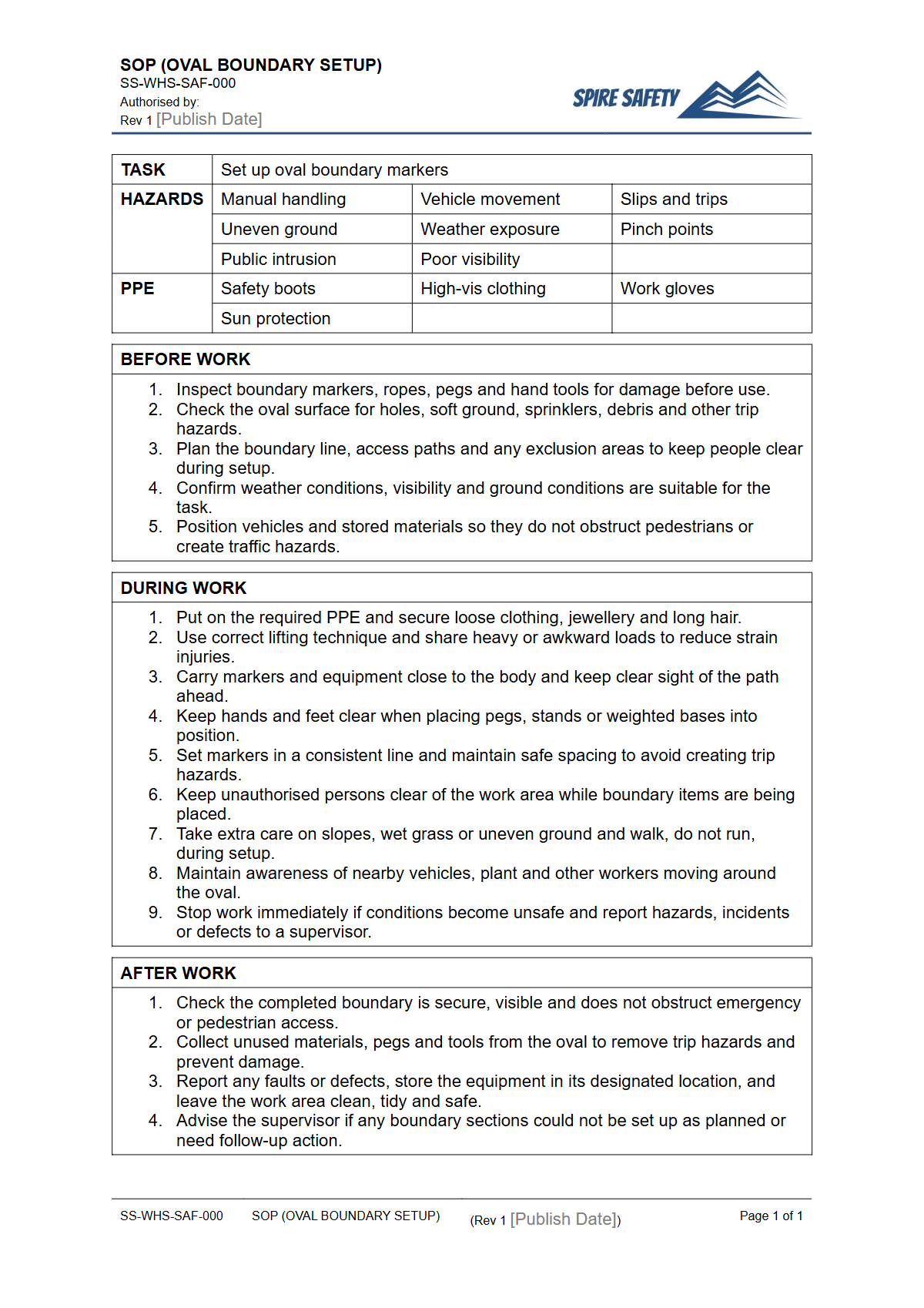
Setting up temporary boundaries for sporting ovals, school sports days, or community events involves specific risks that must be managed. This Free Safe Operating Procedure (Oval Boundary Setup) Template provides a structured framework for documenting the step-by-step process, ensuring tasks are performed safely and consistently.
By formalising procedures, organisations can minimise hazards like manual handling injuries, slips, trips, and falls, and unsafe interaction with the public. A documented SOP is a fundamental component of an effective WHS management system, demonstrating a commitment to workplace health and safety.
The template helps a Person Conducting a Business or Undertaking (PCBU) meet their primary duty of care. It provides a clear, repeatable process for workers and volunteers, reducing confusion and the likelihood of incidents.
Using this SOP helps ensure that all equipment is checked before use, the correct personal protective equipment (PPE) is worn, and environmental hazards are identified and controlled before work begins.
Video walkthrough
How to use the Free Safe Operating Procedure (Oval Boundary Setup) Template
This Safe Operating Procedure template is available as a DOCX file for easy editing and customisation, and a PDF for straightforward printing and distribution. It is designed as a comprehensive starting point, aligned with Australian WHS principles.
To make it effective, you must adapt it to the specific requirements of your workplace.
Important: We have developed this template as a guide. You must consult with your workers and conduct a site-specific risk assessment to identify all potential hazards.
The procedure should be customised to reflect your unique equipment (e.g., types of posts, ropes, or barricades), ground conditions, and local environment. For larger-scale events, where equipment like telehandlers might be used to move barricades or temporary structures, a specific FREE Telehandler SOP Template is essential.
When to use it
This SOP should be used every time a temporary boundary is erected or dismantled on an oval, field, or public space. It is particularly relevant for:
- Pre-season setup for sports like football, cricket, or athletics.
- Preparation for school carnivals and sports days.
- Setting up for community festivals, markets, or outdoor events.
- Regular maintenance or replacement of boundary markers.
The procedure should also form the basis of staff and volunteer training. It needs to be reviewed regularly—at least annually—and immediately following any incident, near miss, or change in the setup process.
Regular reviews can be integrated into your organisation's schedule of WHS compliance auditing to ensure ongoing relevance and effectiveness.
Who should use it
This SOP is intended for any person involved in the physical task of setting up and packing away oval boundaries. This includes:
- Groundskeeping staff at schools, councils, and sporting facilities.
- Maintenance workers.
- Volunteers at community sports clubs.
- Event coordinators and their teams.
Supervisors and managers should also use the document to train workers, verify competency, and supervise the task to ensure it is performed according to the agreed-upon safe procedure. For organisations needing assistance to implement procedures and train staff, seeking specialist WHS consulting can provide valuable guidance.
Key elements covered in the template
Our template prompts you to consider all stages of the task to build a comprehensive procedure. It includes sections for detailing:
- Required PPE: Such as high-visibility clothing, gloves for hand protection, steel-capped boots, and sun protection (hat, sunscreen).
- Pre-operational Checks: A checklist for inspecting equipment like ropes, posts, markers, and bollards for wear, damage, or defects before use.
- Hazard Identification: Prompts to identify site-specific hazards like uneven surfaces, sprinkler heads, public access paths, and weather conditions.
- Step-by-Step Instructions: A logical sequence for both setting up and dismantling the boundary, including safe manual handling techniques. While setting up boundaries is often a manual task, managing larger grounds may involve machinery, requiring its own specific documentation such as our FREE Trencher SOP Template.
- Emergency Procedures: Steps to take in case of an injury or incident.
This procedure complements other groundskeeping tasks, such as those covered in our FREE Spreader SOP Template, to create a comprehensive safety plan for oval maintenance and preparation. By systematically addressing each element, you create a robust SOP that is practical and easy for workers to follow.
By implementing a clear and concise SOP, you not only protect your workers but also enhance the overall safety culture of your organisation. Take the first step by downloading this template and customising it for your workplace. For more tools to support your safety management system, explore our complete free WHS resources library.
Common mistakes
Common mistakes to avoid
- Using damaged equipment like frayed ropes, cracked posts, or bent stakes.
- Failing to inspect the work area for hazards like sprinkler heads, potholes, or uneven ground before starting.
- Not using high-visibility clothing, especially when setting up in low light, near roads, or in areas with public access.
- Assuming volunteers or new staff know the correct procedure without providing clear instruction or supervision.
Legal references
Legal considerations
The following legal requirements may be relevant to this type of work.
- Work Health and Safety Act (Harmonised) — Provides the primary duties for protecting workers and other people from work health and safety risks.
- Work Health and Safety Regulations (Harmonised) — Sets out requirements supporting the management of workplace hazards and risks.
The following codes may be relevant to this type of work.
- Managing WHS Risks Code of Practice — Provides practical guidance on identifying hazards, assessing risks and applying effective controls.
- Work Health and Safety Consultation, Cooperation and Coordination Code of Practice — Provides practical guidance on consulting workers and coordinating with other duty holders.
- Managing the Work Environment and Facilities Code of Practice — Provides practical guidance on safe work environments, workplace facilities and related controls.
Did you know
Slips, Trips & Falls
Slips, trips and falls are a leading cause of workplace injury in Australia, often resulting in serious sprains, fractures, and back injuries. Documented procedures for setting up and packing down workspaces like ovals can significantly reduce these risks.
Duty of Care for Volunteers
The model WHS Act extends the definition of a 'worker' to include volunteers. This means organisations like community sports clubs have the same primary duty of care for volunteers as they do for paid employees.
FAQ
Frequently asked questions
01What hazards are involved in setting up an oval boundary?
02Do I need a Safe Operating Procedure for volunteers setting up a sports oval?
03How often should we review our Oval Boundary Setup SOP?
04Can I use this template for setting up festival or market boundaries?
Share this resource
Free Safe Operating Procedure (Oval Boundary Setup) Template
Browse Categories
How To Use It
- 1Download and open in Word or PDF.
- 2Replace the placeholders with your business details.
- 3Get it reviewed by a WHS specialist before rollout.
Need it customised?
Our WHS consultants can adapt this template to your site, run a gap analysis, or audit what you already have in place.
Book a Free Consultation WHS consulting servicesor call 1300 156 382
Related templates
- Free Safe Operating Procedure (Overflow Bin Response) Template
- Free Safe Operating Procedure (Overhead Crane) Template
- Free Safe Operating Procedure (Oxygen Cylinder Change) Template
- Free Safe Operating Procedure (Oyster Shucking) Template
- Free Safe Operating Procedure (Package Damage Check) Template
- Free Safe Operating Procedure (Package Label Check) Template