
Free Safe Operating Procedure (Package Damage Check) Template
Download our Free Safe Operating Procedure (Package Damage Check) Template to formalise your inspection process. Get your customisable DOCX and PDF now.
Free Safe Operating Procedure (Package Damage Check) Template
DOCX • 126 KB + PDF
Updated Oct 2026
No signup required
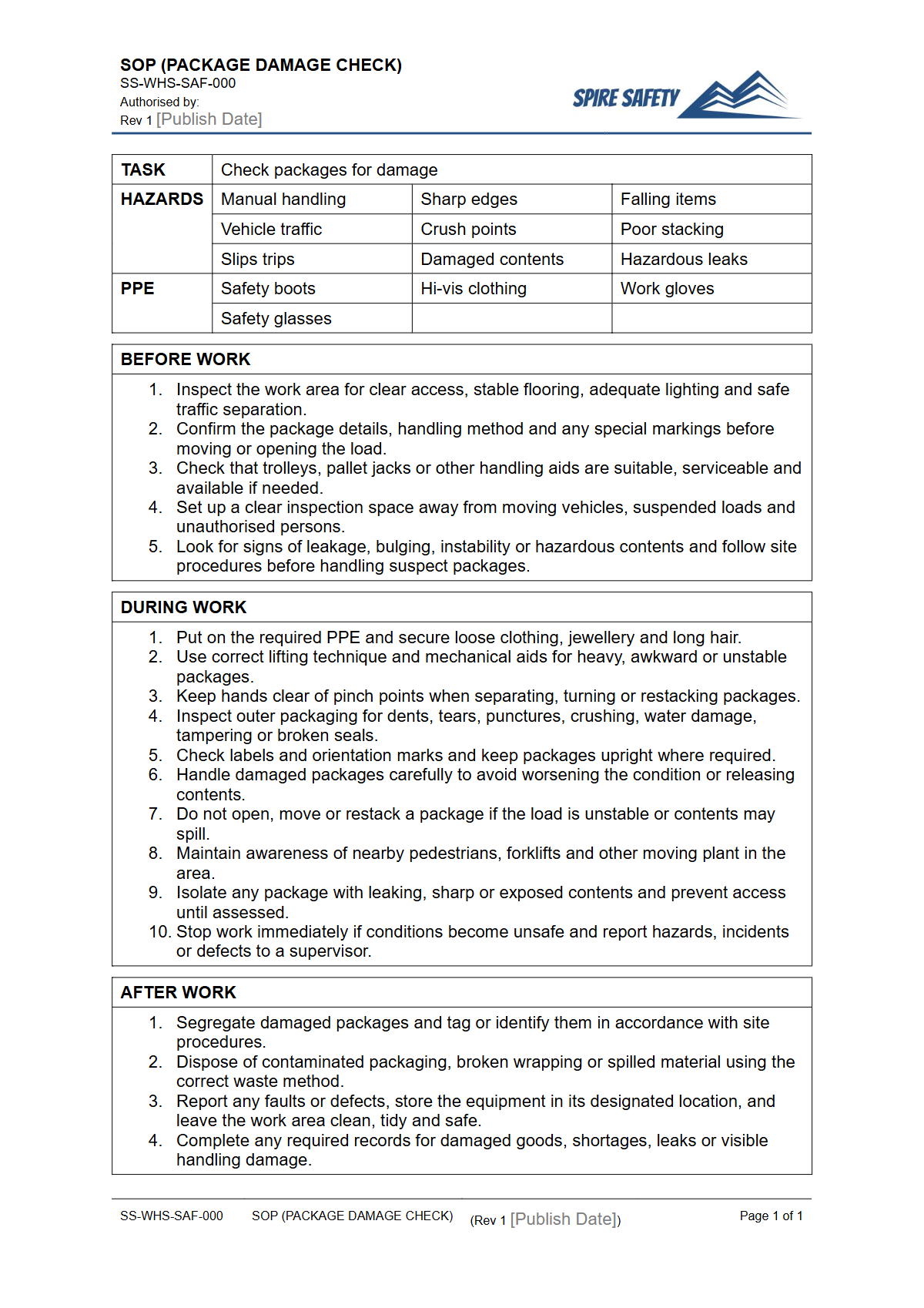
Purpose of the Free Safe Operating Procedure (Package Damage Check) Template
Receiving and handling packages is a daily task in many Australian industries, from logistics and warehousing to retail and manufacturing. However, damaged packages can introduce significant workplace hazards, including spills, unstable loads, sharp protrusions, and exposure to harmful substances.
This Free Safe Operating Procedure (Package Damage Check) Template provides a structured starting point for creating a formal process to identify, assess, and manage these risks. Implementing a clear SOP helps your organisation meet its duty of care obligations under WHS legislation by ensuring a consistent and safe approach to handling potentially compromised goods.
Key Objectives of this Safe Operating Procedure
- Standardise the inspection process for all incoming and outgoing goods.
- Clearly define criteria for accepting or rejecting a damaged package.
- Outline safe handling methods to minimise risks to workers.
- Establish clear reporting and documentation requirements for incidents and non-conformances.
Video walkthrough
How to use the Free Safe Operating Procedure (Package Damage Check) Template
This template is designed to be adapted to your specific operational needs. To use it effectively, download the DOCX file and begin customising the content.
You should involve your team, including warehouse staff, supervisors, and safety representatives, in the customisation process to ensure the procedure is practical and addresses all relevant hazards in your environment. Key areas for customisation include specifying the types of packages handled, potential hazards, required Personal Protective Equipment (PPE), and your company’s specific reporting chain.
This document forms a critical part of broader WHS management systems, providing clear instructions for a high-risk task.
Important: This is a template document. To be effective and assist in your safety compliance, it must be customised to the unique needs and risks of your workplace.
We recommend a thorough risk assessment is conducted before finalising and implementing the procedure. Consult with your workers and health and safety personnel throughout the process.
When to use a Package Damage Check SOP
A package damage check should be integrated into key points of your supply chain. The procedure should be initiated whenever goods are transferred, received, or dispatched. This includes:
- Upon arrival of goods at the receiving dock.
- Before loading goods onto vehicles for dispatch.
- During internal transfers between warehouse locations or departments.
- When packages are moved through automated systems, which can sometimes cause damage. The process should complement procedures for the safe operation of conveyor systems.
- Whenever a worker observes potential damage to a package, regardless of its location in the facility.
Who should use it
This Safe Operating Procedure should be used by all personnel involved in the handling, movement, and storage of goods. The responsibility for identifying and reporting damage is shared, but specific roles may have designated duties within the procedure.
This includes warehouse operatives, forklift drivers, logistics coordinators, receiving and dispatch clerks, and delivery drivers. Effective training is essential to ensure everyone understands their responsibilities. For workers who use machinery to move goods, this SOP should be used alongside equipment-specific instructions, such as an SOP for telehandler use.
What the Template Includes
Our template provides a comprehensive framework to build upon. It prompts you to detail essential safety components, including:
- Pre-operational Checks: Steps to take before beginning the task, such as inspecting the work area and gathering necessary PPE.
- Hazard Identification: A section to list potential hazards like manual handling injuries, chemical spills, falling objects, and cuts.
- Control Measures: Guidance on implementing controls to mitigate identified risks.
- Step-by-Step Procedure: A logical sequence for inspecting packages, from initial visual checks to physical inspection and decision-making (accept, quarantine, reject).
- Reporting and Documentation: Sections for recording findings, notifying supervisors, and completing necessary paperwork. Regular reviews of these records can be verified through a WHS compliance auditing process.
By customising and implementing this SOP, you create a safer working environment and a more efficient, accountable logistics process. Explore our complete free WHS resources library for more templates to support your safety goals.
Common mistakes
Common mistakes to avoid
- Failing to customise the template for specific package types, weights, and workplace hazards.
- Neglecting to train all relevant staff, including casual, temporary, and new workers, on the procedure.
- Inconsistent application of the SOP across different shifts, departments, or sites.
- Poor documentation of checks and non-conformances, leading to a lack of evidence for analysis and improvement.
Legal references
Legal considerations
The following legal requirements may be relevant to this type of work.
- Work Health and Safety Act (Harmonised) — Provides the primary duties for protecting workers and other people from work health and safety risks.
- Work Health and Safety Regulations (Harmonised) — Sets out requirements supporting the management of workplace hazards and risks.
The following codes may be relevant to this type of work.
- Managing WHS Risks Code of Practice — Provides practical guidance on identifying hazards, assessing risks and applying effective controls.
- Work Health and Safety Consultation, Cooperation and Coordination Code of Practice — Provides practical guidance on consulting workers and coordinating with other duty holders.
- Managing the Work Environment and Facilities Code of Practice — Provides practical guidance on safe work environments, workplace facilities and related controls.
Did you know
A Leading Indicator
Damaged freight is not just a financial loss; it can be a leading indicator of underlying safety issues in the supply chain, such as improper loading techniques, equipment malfunction, or inadequate load restraint.
Due Diligence
Clear, documented procedures like an SOP are a key part of demonstrating due diligence and proving that you have taken reasonably practicable steps to ensure safety under Australian WHS legislation.
FAQ
Frequently asked questions
01What should be included in a package damage check SOP?
02Is a package damage check a legal WHS requirement in Australia?
03How often should we review our package damage check SOP?
04Can this template be used for dangerous goods?
Share this resource
Free Safe Operating Procedure (Package Damage Check) Template
Browse Categories
How To Use It
- 1Download and open in Word or PDF.
- 2Replace the placeholders with your business details.
- 3Get it reviewed by a WHS specialist before rollout.
Need it customised?
Our WHS consultants can adapt this template to your site, run a gap analysis, or audit what you already have in place.
Book a Free Consultation WHS consulting servicesor call 1300 156 382
Related templates
- Free Safe Operating Procedure (Package Label Check) Template
- Free Safe Operating Procedure (Pad Printing) Template
- Free Safe Operating Procedure (Paddock Gate Handling) Template
- Free Safe Operating Procedure (Paddock Weed Removal) Template
- Free Safe Operating Procedure (Paint Booth Operation) Template
- Free Safe Operating Procedure (Paint Mixing) Template