
Free Safe Operating Procedure (Paint Mixing) Template
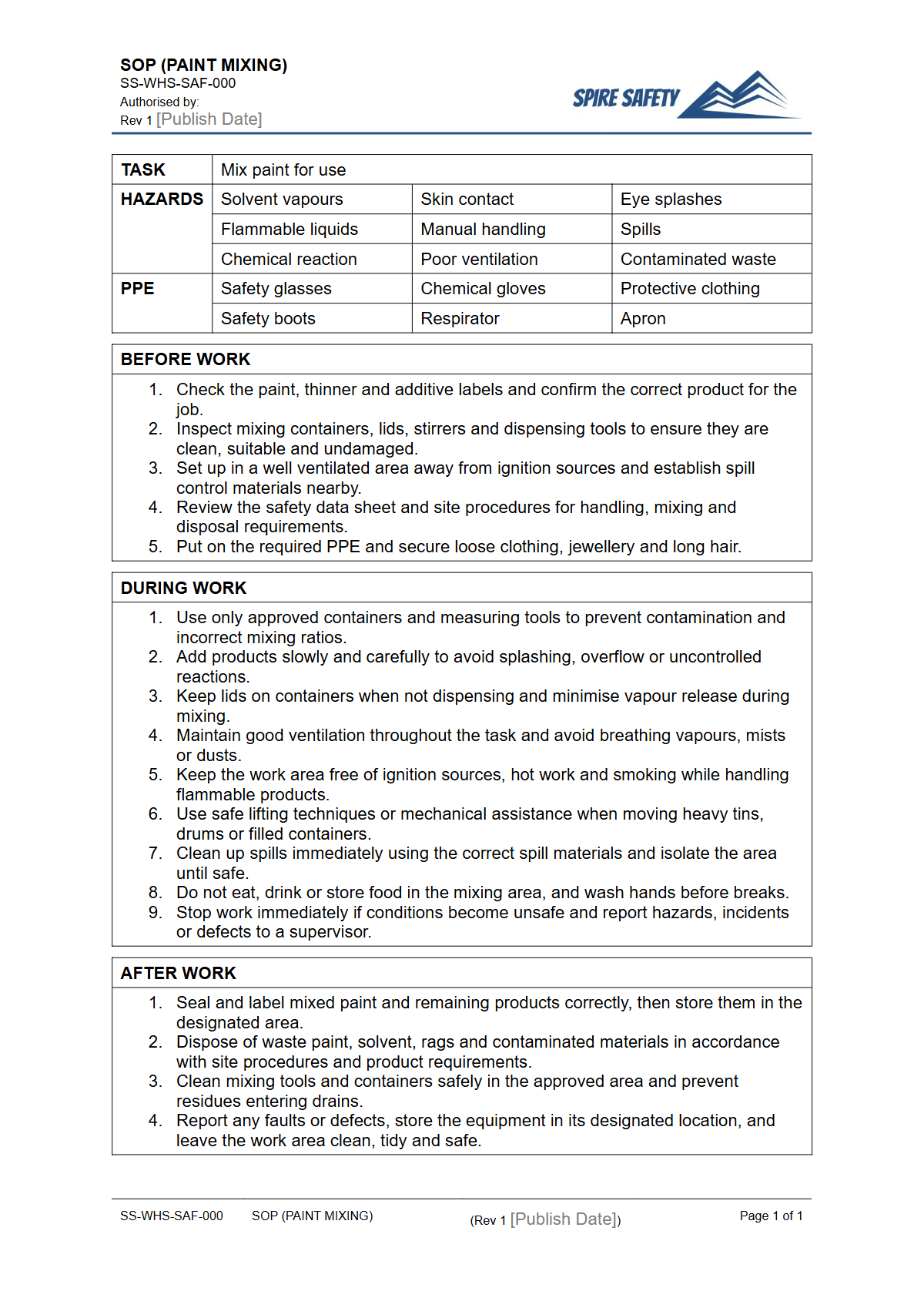
Download our free Safe Operating Procedure (Paint Mixing) template. This customisable document helps you outline risks and controls for paint mixing tasks.
Free Safe Operating Procedure (Paint Mixing) Template
DOCX • 126 KB + PDF
Updated Oct 2026
No signup required
Purpose of the Free Safe Operating Procedure (Paint Mixing) Template
Our Free Safe Operating Procedure (Paint Mixing) Template provides a structured framework for documenting the required steps to safely mix paints and solvents in your workplace. Paint mixing presents significant health and safety risks, including exposure to hazardous chemicals through inhalation or skin contact, fire and explosion hazards from flammable vapours, and ergonomic strains from manual handling.
This SOP template helps you systematically identify these hazards and establish robust control measures, forming a critical part of your overall safety management documentation.
Using a formal Safe Operating Procedure (SOP) demonstrates a commitment to worker safety and helps meet your duty of care obligations under Australian WHS legislation. It provides a clear, consistent set of instructions for workers, reducing the likelihood of errors and incidents.
A well-drafted SOP is a fundamental building block for effective WHS management systems, ensuring that safety is integrated into daily operations rather than being an afterthought.
Video walkthrough
How to use the Free Safe Operating Procedure (Paint Mixing) Template
This template is available as a fully editable DOCX file and a print-ready PDF. To use it effectively, you must add details specific to your organisation’s equipment, chemicals, and work environment.
The document is logically structured to guide you through the process, covering key areas such as required Personal Protective Equipment (PPE), pre-operational checks, emergency procedures, and a step-by-step guide to the mixing task itself.
Important: This document provides a starting point aligned with Australian WHS practice. However, we stress that it must be customised by a competent person to reflect the specific paints, thinners, hardeners, mixing equipment, and ventilation systems at your workplace.
You should consult the Safety Data Sheets (SDS) for all chemicals being used and incorporate their specific handling, storage, and first aid requirements into this SOP. For tasks involving pneumatic tools, you may also need to reference a specific Free Air Compressor SOP (Safe Operating Procedure) Template.
When to use this Safe Operating Procedure
A Safe Operating Procedure for paint mixing should be developed and implemented before any worker undertakes the task for the first time. It serves as a primary training document for new employees and a vital refresher for existing staff.
The SOP should be readily accessible in the paint mixing area at all times for quick reference. It is also a key document to review during safety meetings, after any incident or near-miss, or when new chemicals or processes are introduced.
Regular reviews and updates are essential for maintaining its relevance and effectiveness, often forming part of a scheduled WHS compliance auditing program.
Who should use this Safe Operating Procedure
This SOP is intended for use by multiple groups within an organisation. Persons Conducting a Business or Undertaking (PCBUs) and managers can use it to fulfil their due diligence obligations by ensuring a safe system of work is documented and implemented.
Supervisors should use the SOP to train workers and monitor their adherence to safe work practices. Most importantly, workers who perform paint mixing tasks must use the SOP as their guide to performing the job safely and consistently.
In workplaces with multiple hazards, this document should be used alongside other task-specific procedures, such as a FREE Circular Saw SOP (Safe Operating Procedure) Template for fabrication tasks.
Integrating this procedure into your operational workflow ensures that everyone, from management to the workshop floor, has a shared understanding of the risks and the necessary controls. In larger facilities, the process may involve automated delivery of materials.
In such cases, the SOP should also reference procedures for associated machinery, like a FREE Conveyer System SOP if applicable. This holistic approach ensures all interconnected risks are managed effectively.
By customising and implementing this template, you create a safer environment for your team and a clear record of your risk management processes. For more templates and safety guides, feel free to browse our complete free WHS resources library.
Common mistakes
Common mistakes to avoid
- Using a generic SOP without customising it for site-specific chemicals and equipment.
- Failing to consult the Safety Data Sheet (SDS) for each chemical component.
- Conducting mixing in a poorly ventilated area, leading to high concentrations of harmful vapours.
- Using incorrect, poorly fitting, or inadequately maintained Personal Protective Equipment (PPE).
Legal references
Legal considerations
The following legal requirements may be relevant to this type of work.
- Work Health and Safety Act (Harmonised) — Provides the primary duties for protecting workers and other people from work health and safety risks.
- Work Health and Safety Regulations (Harmonised) — Sets out requirements supporting the management of workplace hazards and risks.
The following codes may be relevant to this type of work.
- Managing WHS Risks Code of Practice — Provides practical guidance on identifying hazards, assessing risks and applying effective controls.
- Work Health and Safety Consultation, Cooperation and Coordination Code of Practice — Provides practical guidance on consulting workers and coordinating with other duty holders.
- Managing the Work Environment and Facilities Code of Practice — Provides practical guidance on safe work environments, workplace facilities and related controls.
Did you know
Invisible Hazards
Many modern paints, particularly two-pack polyurethane types, contain isocyanates. These compounds are a leading cause of occupational asthma and can sensitise workers even at very low exposure levels, making effective ventilation and RPE critical.
FAQ
Frequently asked questions
01What PPE is required for mixing paint?
02How do you safely dispose of mixed paint and solvents?
03Is a Safe Operating Procedure a legal requirement in Australia?
04What is the difference between a Safe Operating Procedure (SOP) and a Safe Work Method Statement (SWMS)?
Share this resource
Free Safe Operating Procedure (Paint Mixing) Template
Browse Categories
How To Use It
- 1Download and open in Word or PDF.
- 2Replace the placeholders with your business details.
- 3Get it reviewed by a WHS specialist before rollout.
Need it customised?
Our WHS consultants can adapt this template to your site, run a gap analysis, or audit what you already have in place.
Book a Free Consultation WHS consulting servicesor call 1300 156 382
Related templates
- Free Safe Operating Procedure (Paint Stripping) Template
- Free Safe Operating Procedure (Paintless Dent Repair) Template
- Free Safe Operating Procedure (Pallet Cage) Template
- Free Safe Operating Procedure (Pallet Exchange) Template
- Free Safe Operating Procedure (Pallet Racking Access) Template
- Free Safe Operating Procedure (Palletiser) Template