
Free Safe Operating Procedure (Pallet Exchange) Template
Effectively manage manual pallet exchanges with our comprehensive Safe Operating Procedure template. Download your free, customisable DOCX and PDF now.
Free Safe Operating Procedure (Pallet Exchange) Template
DOCX • 126 KB + PDF
Updated Oct 2026
No signup required
Purpose of the Free Safe Operating Procedure (Pallet Exchange) Template
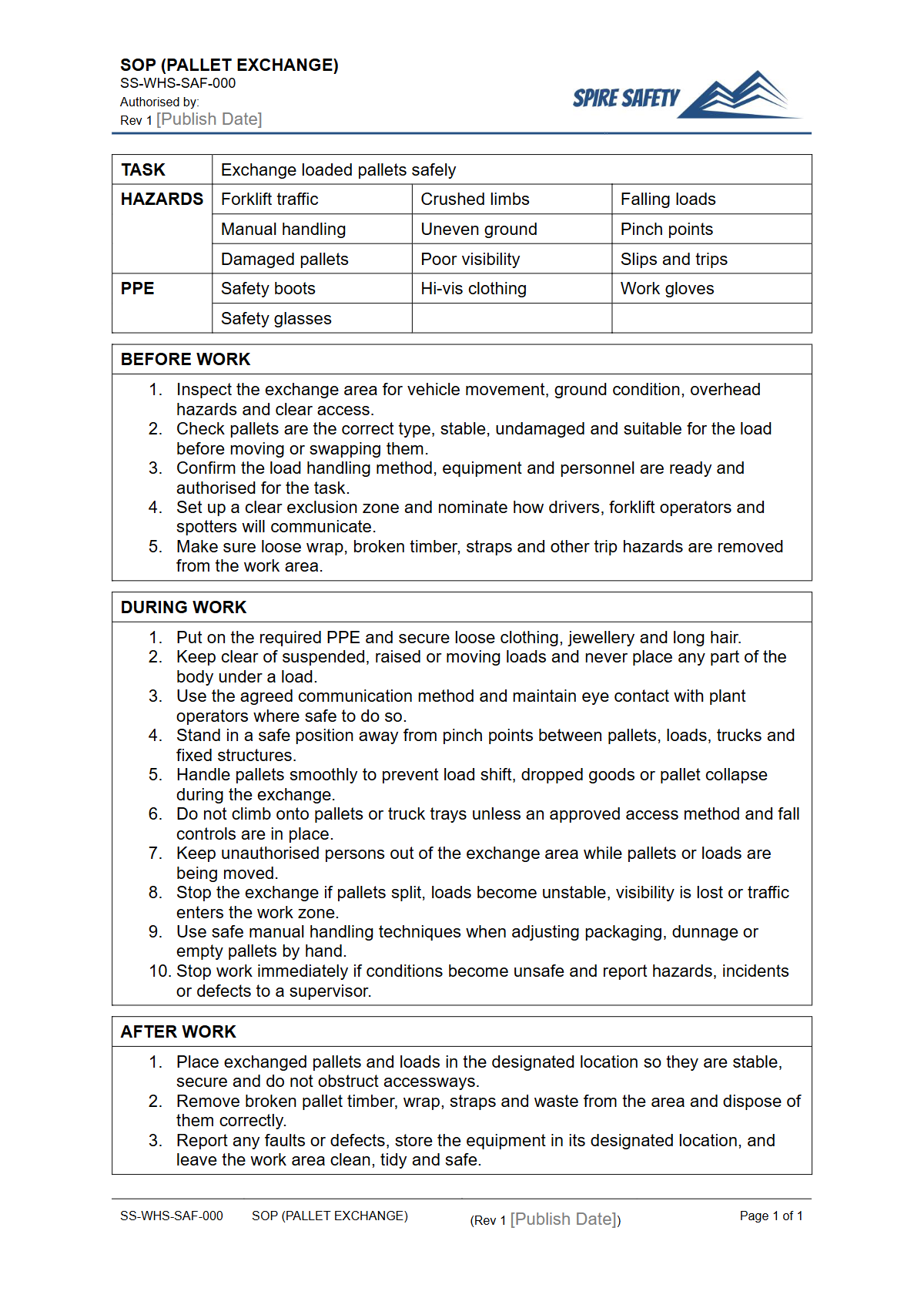
Managing the manual exchange of pallets is a common but high-risk task in many Australian workplaces. Our Free Safe Operating Procedure (Pallet Exchange) Template provides a structured framework to document safe work methods, control hazards, and meet your WHS obligations.
This downloadable template helps you standardise processes for tasks like transferring goods from one pallet to another, reducing the risk of musculoskeletal injuries and improving overall warehouse safety.
The primary purpose of this Safe Operating Procedure (SOP) template is to provide a clear, step-by-step guide for performing pallet exchanges safely. Pallet exchange, whether transferring goods or swapping pallets with a supplier, involves significant manual handling risks.
These include lifting, carrying, and stacking heavy or awkward items, which can lead to serious musculoskeletal disorders (MSDs) like sprains and strains. By implementing a formal SOP, your organisation can systematically identify hazards, assess risks, and implement effective control measures.
This document serves as a crucial training tool for workers and a key component of your overall WHS management systems, demonstrating a commitment to proactive safety management.
Video walkthrough
How to use the Free Safe Operating Procedure (Pallet Exchange) Template
This resource is available as a fully editable DOCX file and a ready-to-print PDF. We recommend downloading the DOCX version to tailor the content to your specific workplace environment, equipment, and personnel.
Please note: This document is a template and not a complete safety solution. You must customise it by conducting a site-specific risk assessment, consulting with your workers, and incorporating your unique operational details.
Once customised, the SOP should be used for worker induction, training, and ongoing competency checks. Similar structured processes should be applied for related equipment, such as those outlined in our FREE Pallet Jack SOP (Safe Operating Procedure) Template.
When to use a Pallet Exchange SOP
A formal SOP for pallet exchange should be consulted and followed whenever this task is performed. It is particularly critical in environments with high-volume goods movement, such as:
- Receiving docks where goods are transferred from supplier pallets to internal pallets.
- Dispatch areas where products are loaded onto transport pallets.
- Warehouse storage zones where stock may need to be re-palletised for picking or consolidation.
- Cool rooms or freezers where handling is more challenging due to temperature and protective clothing.
Implementing this procedure ensures consistency and safety across all shifts and departments. For more complex lifting and moving tasks involving machinery, you might also need specific procedures like our FREE Telehandler SOP (Safe Operating Procedure) Template.
Who should use this SOP
This Safe Operating Procedure is designed for all personnel involved in the pallet exchange process. This includes:
- Warehouse and Logistics Staff: The primary users who perform the physical task and need to understand the step-by-step safety requirements.
- Forklift Operators: Who may be involved in positioning or moving pallets before and after the manual exchange.
- Supervisors and Team Leaders: Responsible for ensuring the procedure is followed, providing training, and monitoring for safe work practices.
- WHS Managers and Officers: Who use the SOP as part of risk assessments, incident investigations, and continuous improvement of safety protocols.
Effective implementation relies on everyone understanding their roles and responsibilities. If your operations involve integrated systems, you might also reference our FREE Conveyer System SOP (Safe Operating Procedure) Template to ensure seamless safety from one process to the next.
Key Safety Considerations for Pallet Exchange
Manual Handling Risks
The core hazard in pallet exchange is manual handling. The template guides you to specify control measures such as team lifts, using mechanical aids where possible, and training in correct kinetic lifting techniques.
Never underestimate the cumulative strain from repetitive lifting, even with seemingly light loads. If you need expert guidance on assessing and controlling these risks, our WHS consulting services can provide tailored support for your business.
Pallet Condition
A critical step, often overlooked, is inspecting pallets before use. The SOP includes a checkpoint for this.
Workers must be trained to identify and quarantine damaged pallets with protruding nails, splinters, or broken boards, as these can cause injuries or fail under load. Ensure your procedure clearly outlines how to report and dispose of unsafe pallets.
Work Environment
The area where pallet exchanges occur must be suitable. This means having a flat, stable surface, adequate lighting, and sufficient space to work without obstruction.
The SOP should prompt users to check the work area for slip or trip hazards before commencing the task. A well-organised workspace is fundamental to preventing incidents.
By thoroughly customising this template, you create a powerful tool for embedding safety into your daily operations. For more templates and safety guides, explore our complete free WHS resources library.
Common mistakes
Common mistakes to avoid
- Failing to provide workers with adequate training on correct kinetic lifting techniques.
- Using damaged, poor-quality, or non-standard pallets that can splinter or break during handling.
- Not providing adequate space, clear pathways, or good lighting for pallet exchange activities.
- Treating the SOP as a 'set and forget' document without reviewing it regularly or after an incident.
Legal references
Legal considerations
The following legal requirements may be relevant to this type of work.
- Work Health and Safety Act (Harmonised) — Provides the primary duties for protecting workers and other people from work health and safety risks.
- Work Health and Safety Regulations (Harmonised) — Sets out requirements supporting the management of workplace hazards and risks.
The following codes may be relevant to this type of work.
- Managing WHS Risks Code of Practice — Provides practical guidance on identifying hazards, assessing risks and applying effective controls.
- Work Health and Safety Consultation, Cooperation and Coordination Code of Practice — Provides practical guidance on consulting workers and coordinating with other duty holders.
- Managing the Work Environment and Facilities Code of Practice — Provides practical guidance on safe work environments, workplace facilities and related controls.
Did you know
Musculoskeletal Injuries
According to Safe Work Australia data, the transport, postal, and warehousing industry has one of the highest rates of serious workers' compensation claims, with musculoskeletal disorders being a primary cause.
Australian Pallet Standards
The most common pallet size in Australia is the 1165 x 1165 mm square pallet. This standard size was designed to fit efficiently in Australian railway containers.
FAQ
Frequently asked questions
01What is a pallet exchange?
02Is pallet exchange a significant manual handling risk?
03Who is responsible for enforcing a Pallet Exchange SOP?
04Does this template cover pallet inverter machines?
Share this resource
Free Safe Operating Procedure (Pallet Exchange) Template
Browse Categories
How To Use It
- 1Download and open in Word or PDF.
- 2Replace the placeholders with your business details.
- 3Get it reviewed by a WHS specialist before rollout.
Need it customised?
Our WHS consultants can adapt this template to your site, run a gap analysis, or audit what you already have in place.
Book a Free Consultation WHS consulting servicesor call 1300 156 382
Related templates
- Free Safe Operating Procedure (Pallet Racking Access) Template
- Free Safe Operating Procedure (Palletiser) Template
- Free Safe Operating Procedure (Panel Beating) Template
- Free Safe Operating Procedure (Panel Lifter) Template
- Free Safe Operating Procedure (Panel Saw) Template
- Free Safe Operating Procedure (Panini Press) Template