
Free Safe Operating Procedure (Pallet Racking Access) Template
Manage warehouse risks with our free Safe Operating Procedure for pallet racking access. This customisable template helps you outline safe work practices.
Free Safe Operating Procedure (Pallet Racking Access) Template
DOCX • 126 KB + PDF
Updated Oct 2026
No signup required
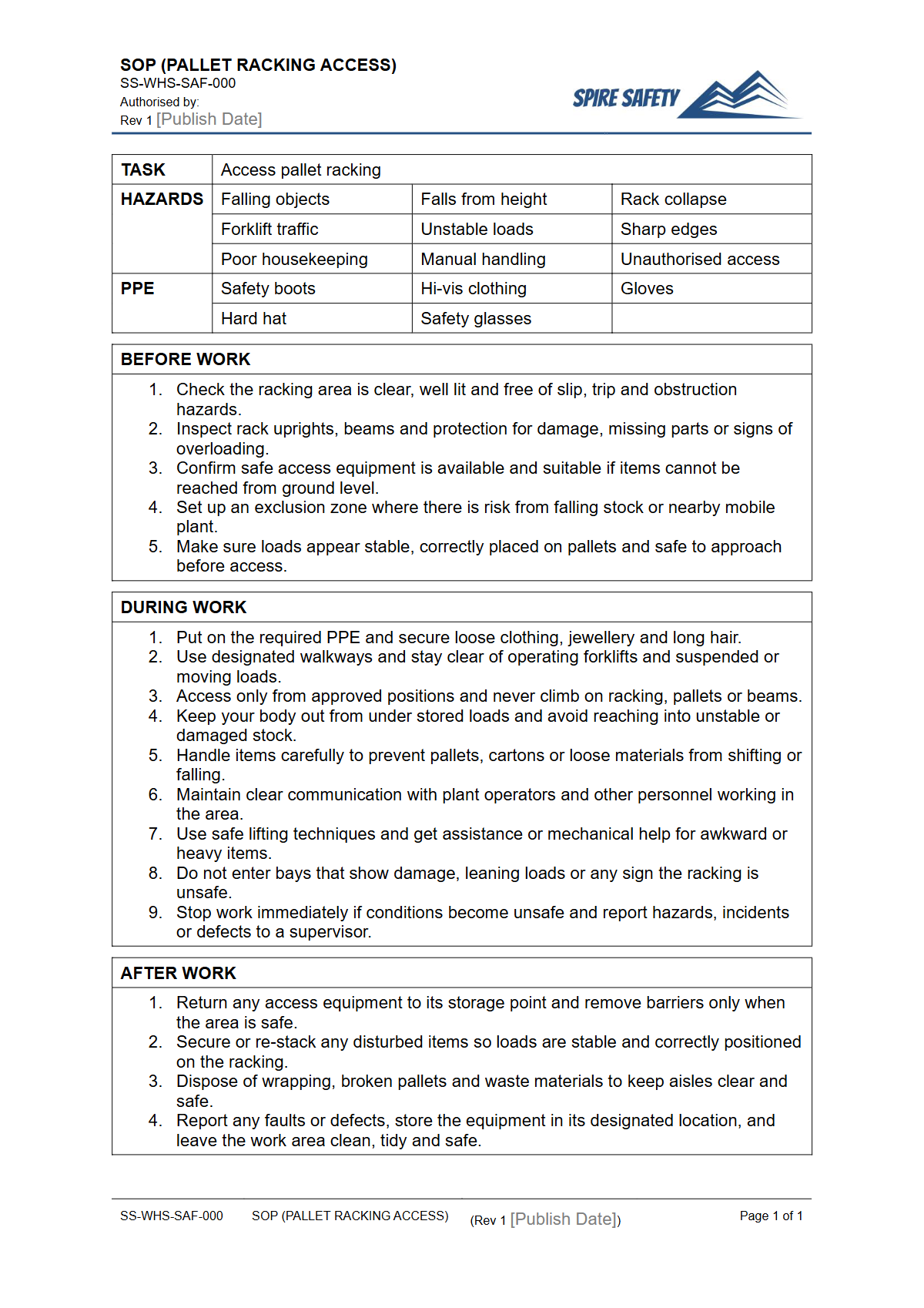
Purpose of the Free Safe Operating Procedure (Pallet Racking Access) Template
Pallet racking is a fundamental component of most warehouses, distribution centres, and storage facilities, but it also presents significant risks if not managed correctly. Incidents involving racking can lead to serious injuries from falls, structural collapse, or falling objects.
This Free Safe Operating Procedure (Pallet Racking Access) Template provides a structured framework to help your organisation document the required steps for safely interacting with and accessing pallet racking systems. By establishing clear, repeatable instructions, you can train workers effectively, reduce the likelihood of errors, and demonstrate a commitment to a safe system of work.
A well-defined SOP is a critical tool for identifying hazards and implementing control measures before work begins. Using this template helps standardise operator behaviour, ensures that pre-operational checks and weight limits are observed, and integrates safety into your daily operations.
It serves as a foundational document within your broader WHS management systems, reinforcing safe practices for everyone in the workplace.
Video walkthrough
How to use the Free Safe Operating Procedure (Pallet Racking Access) Template
This Safe Operating Procedure template is provided in both DOCX and PDF formats for your convenience. The DOCX version is fully editable, allowing you to tailor the content to the specific types of racking, equipment (e.g., forklifts, reach trucks), and unique environmental conditions of your worksite.
It is crucial that you adapt this document to reflect your actual processes and risk controls.
Important: This is a template only. To be effective, you must customise it with your site-specific details, including racking manufacturer's instructions, safe working load limits, types of mobile plant used, and emergency contact information.
We have populated the document with common headings and safety considerations, but your organisation is responsible for ensuring the final SOP is accurate and relevant to your operations.
Once customised, the SOP should be used to train all relevant personnel, including warehouse staff, forklift operators, and supervisors. Keep printed or digital copies readily accessible in the work area for easy reference. For more tools to support your safety framework, you can browse our complete free WHS resources library.
When to use this Safe Operating Procedure
An SOP for pallet racking access is not a document to be filed away; it is an active tool for daily risk management. It should be used during new worker inductions and for specific task training to ensure everyone understands the established safety protocols from day one.
It also serves as a pre-start checklist for operators, reminding them of key inspection points and safety verifications before loading or unloading goods.
The SOP should be formally reviewed and updated whenever there is a change to the racking system, the type of mobile plant used, the work environment, or after a near miss or incident. Regular reviews ensure the procedure remains relevant and effective.
This process complements other task-specific documents, such as our FREE Pallet Jack SOP (Safe Operating Procedure) Template, to create a comprehensive safety system for your warehouse.
Who should use this SOP
This Safe Operating Procedure is intended for use by multiple roles within an organisation. Warehouse Managers and WHS Officers can use it to develop and implement formal safety processes.
Supervisors should use it to train their teams and monitor compliance during daily activities. Most importantly, the workers who directly interact with the pallet racking—including forklift, order picker, and reach truck operators—must understand and follow the procedure to ensure their own safety and that of their colleagues.
Ultimately, anyone involved in the logistics, storage, and material handling functions of the business will benefit from a clear and concise SOP. It helps formalise the expected behaviours and knowledge required to work safely around racking, similar to how our FREE Telehandler SOP (Safe Operating Procedure) Template guides the use of specific high-risk plant.
Key Safety Considerations for Pallet Racking
Beyond the procedural steps, an effective racking safety program addresses several core elements. Regular inspections are critical for identifying damage, such as bent uprights or dislodged beams, which could compromise structural integrity.
A formal inspection schedule, including daily visual checks by operators and periodic detailed assessments by a competent person, is essential. Performing regular WHS compliance auditing can help verify that your inspection and maintenance programs meet regulatory expectations.
Adherence to Safe Working Loads (SWL) is non-negotiable. All racking should have clear signage indicating the maximum unit load and total bay load.
Overloading is a primary cause of racking collapse. Furthermore, the procedures for loading and unloading must be smooth and controlled to avoid impact damage. These activities are part of a larger warehouse workflow, which may also involve equipment detailed in resources like our FREE Conveyer System SOP (Safe Operating Procedure) Template.
Common mistakes
Common mistakes to avoid
- Ignoring or failing to report minor impact damage from forklifts or pallet jacks.
- Exceeding the specified Safe Working Load (SWL) for beams or the total bay.
- Making unauthorised alterations, repairs, or component substitutions to the racking structure.
- Allowing untrained or incompetent workers to operate mobile plant near racking systems.
Legal references
Legal considerations
The following legal requirements may be relevant to this type of work.
- Work Health and Safety Act (Harmonised) — Provides the primary duties for protecting workers and other people from work health and safety risks.
- Work Health and Safety Regulations (Harmonised) — Sets out requirements supporting the management of workplace hazards and risks.
The following codes may be relevant to this type of work.
- Managing WHS Risks Code of Practice — Provides practical guidance on identifying hazards, assessing risks and applying effective controls.
- Work Health and Safety Consultation, Cooperation and Coordination Code of Practice — Provides practical guidance on consulting workers and coordinating with other duty holders.
- Managing the Work Environment and Facilities Code of Practice — Provides practical guidance on safe work environments, workplace facilities and related controls.
Did you know
Impact Damage is a Major Risk
According to safety authorities, a leading cause of pallet racking failure is damage from forklift impacts. Even minor, unreported damage can significantly reduce the racking's load-bearing capacity and lead to catastrophic collapse.
The Guiding Standard
The key technical standard for pallet racking in Australia is AS 4084:2023 Steel storage racking. It provides detailed guidance on the design, installation, operation and maintenance of racking systems to ensure their safety and integrity.
FAQ
Frequently asked questions
01What should be included in a pallet racking access SOP?
02Are regular inspections of pallet racking required by WHS law?
03Who is responsible for ensuring pallet racking is safe?
04Can any worker access or climb on pallet racking?
Share this resource
Free Safe Operating Procedure (Pallet Racking Access) Template
Browse Categories
How To Use It
- 1Download and open in Word or PDF.
- 2Replace the placeholders with your business details.
- 3Get it reviewed by a WHS specialist before rollout.
Need it customised?
Our WHS consultants can adapt this template to your site, run a gap analysis, or audit what you already have in place.
Book a Free Consultation WHS consulting servicesor call 1300 156 382
Related templates
- Free Safe Operating Procedure (Palletiser) Template
- Free Safe Operating Procedure (Panel Beating) Template
- Free Safe Operating Procedure (Panel Lifter) Template
- Free Safe Operating Procedure (Panel Saw) Template
- Free Safe Operating Procedure (Panini Press) Template
- Free Safe Operating Procedure (Pantry Shelf Cleaning) Template