
Free Safe Operating Procedure (Panel Saw) Template
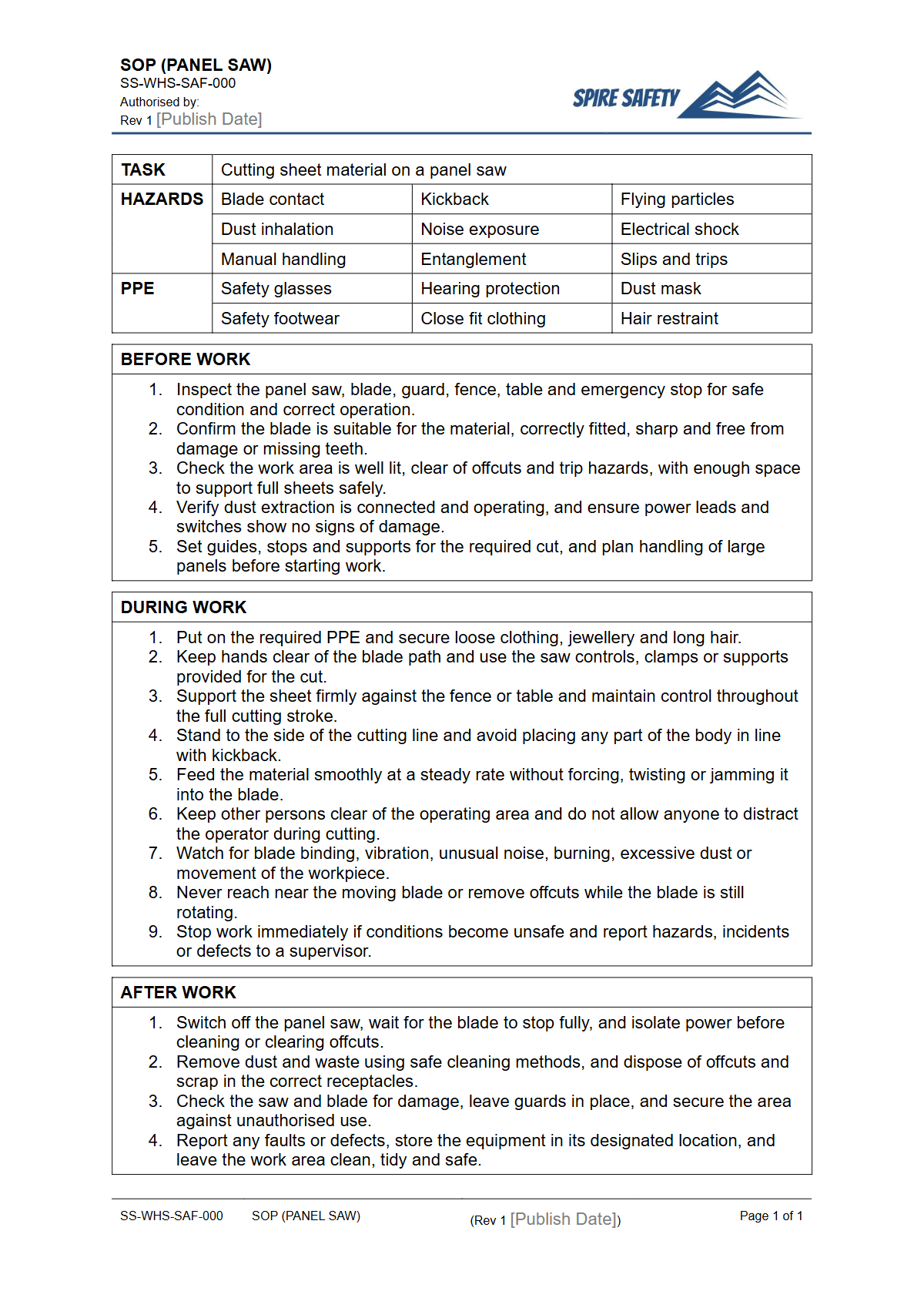
Download our free Safe Operating Procedure (Panel Saw) template to formalise your workshop safety processes. Get started with your customisable DOCX or PDF now.
Free Safe Operating Procedure (Panel Saw) Template
DOCX • 126 KB + PDF
Updated Oct 2026
No signup required
Purpose of the Free Safe Operating Procedure (Panel Saw) Template
Operating a panel saw involves significant risks, including severe cuts, kickback, and exposure to hazardous dust. This Free Safe Operating Procedure (Panel Saw) Template provides a structured framework for documenting the safest way to perform tasks using this powerful equipment.
An SOP is a critical administrative control that formalises your organisation's expectations for safe work, helping to minimise human error and ensure consistent practices across all operators. By clearly outlining pre-operational checks, step-by-step operating instructions, and post-operational duties, this document serves as a vital tool for training, risk management, and demonstrating due diligence in your WHS commitments.
For related machinery, you might also find our free Circular Saw SOP useful.
Video walkthrough
How to use the Free Safe Operating Procedure (Panel Saw) Template
This downloadable template is provided in both DOCX and PDF formats, allowing for easy customisation. To use it effectively, you must adapt its contents to your specific operational context.
This involves detailing the exact make and model of your panel saw, identifying site-specific hazards, and documenting the control measures your workplace has implemented. A generic procedure is not sufficient; effective safety management relies on specificity.
Important: It's crucial to remember that this is a template, not a finished document. We have designed it to be a strong starting point, but you must customise it to reflect the specific panel saw model, tasks, environment, and control measures unique to your workplace.
This process should involve consultation with the workers who actually operate the equipment. Once tailored, the SOP becomes an integral part of your broader WHS management systems.
Key Hazards Associated with Panel Saws
Your customised SOP must identify all foreseeable hazards and specify controls. Key hazards include:
- Cuts and Amputation: Contact with the moving blade during operation, maintenance, or blade changes.
- Kickback: The workpiece being violently thrown back towards the operator. This can be caused by a warped board, a misaligned fence, or the workpiece jamming against the blade.
- Wood Dust Inhalation: Fine wood dust is a known carcinogen and can cause respiratory diseases.
- Noise: Panel saws can operate at noise levels that cause permanent hearing damage with prolonged exposure.
- Manual Handling: Lifting and moving large, heavy sheets of material onto and off the saw presents ergonomic risks.
- Entanglement: Loose clothing, jewellery, or long hair getting caught in the moving blade or other machine parts.
When dealing with the movement of large, heavy materials around the workshop, it's also important to have procedures for mechanical aids. Our FREE Telehandler SOP Template can provide a useful reference for handling large loads safely.
Essential Control Measures
The SOP should detail controls based on the hierarchy of control. For a panel saw, this includes:
- Engineering Controls: Correctly installed and maintained blade guarding, riving knives to prevent kickback, and effective dust extraction systems.
- Administrative Controls: The SOP itself, clear signage, designated work zones, regular maintenance schedules, and comprehensive operator training.
- Personal Protective Equipment (PPE): Mandating the use of safety glasses, hearing protection, and appropriate footwear. Gloves are often not recommended during operation due to entanglement risks.
Integrating these controls into documented procedures is a fundamental part of maintaining a safe workplace. If you require assistance in developing or reviewing your safety documentation, consider seeking professional WHS consulting.
When to use a Panel Saw Safe Operating Procedure
A Safe Operating Procedure for a panel saw is a dynamic document used in various situations. It forms the basis of initial training for new operators and is the primary resource for refresher training.
It should be readily available in the work area for operators to reference at any time. Furthermore, the SOP is a key document during safety investigations after an incident or near-miss, and it serves as crucial evidence during internal or external WHS compliance auditing to demonstrate that safe work processes are defined and communicated.
Who should use it
Multiple roles within an organisation have a responsibility related to the panel saw SOP:
- Operators: Must understand and follow the procedure for every task to ensure their own safety and the safety of others.
- Supervisors: Are responsible for ensuring operators are trained on the SOP, that it is being followed correctly, and that the equipment is maintained as required.
- WHS Managers/Coordinators: Oversee the development, review, and implementation of the SOP as part of the overall safety system.
- Maintenance Personnel: Should refer to the SOP, particularly sections on isolation and lock-out tag-out (LOTO), before performing maintenance or repairs. Many workshops also rely on compressed air for cleaning and tools, making a free Air Compressor SOP another essential document.
By defining these roles and responsibilities, the SOP helps build a strong safety culture. You can explore more templates and guides in our free WHS resources library to support your safety management efforts.
Common mistakes
Common mistakes to avoid
- Using a generic template without customising it for the specific workplace and saw model.
- Failing to train workers on the SOP and confirm their understanding.
- Storing the SOP in an office, making it inaccessible to operators at the point of use.
- Neglecting to include emergency procedures, such as machine shutdown and first aid response.
Legal references
Legal considerations
The following legal requirements may be relevant to this type of work.
- Work Health and Safety Act (Harmonised) — Provides the primary duties for protecting workers and other people from work health and safety risks.
- Work Health and Safety Regulations (Harmonised) — Sets out requirements supporting the management of workplace hazards and risks.
The following codes may be relevant to this type of work.
- Managing WHS Risks Code of Practice — Provides practical guidance on identifying hazards, assessing risks and applying effective controls.
- Work Health and Safety Consultation, Cooperation and Coordination Code of Practice — Provides practical guidance on consulting workers and coordinating with other duty holders.
- Managing the Work Environment and Facilities Code of Practice — Provides practical guidance on safe work environments, workplace facilities and related controls.
Did you know
Kickback Danger
Panel saw kickback occurs when the blade catches the workpiece and throws it back towards the operator at high speed. This is a leading cause of serious injuries and can be prevented by using a riving knife and proper technique.
Dust Classification
Wood dust is classified as a carcinogen. Effective dust extraction systems are not just for cleanliness but are a critical health control measure to prevent long-term respiratory diseases.
FAQ
Frequently asked questions
01Is a Safe Operating Procedure a legal requirement for a panel saw in Australia?
02How often should a panel saw SOP be reviewed?
03What's the difference between an SOP and a SWMS?
04Can this template be used for other types of saws?
Share this resource
Free Safe Operating Procedure (Panel Saw) Template
Browse Categories
How To Use It
- 1Download and open in Word or PDF.
- 2Replace the placeholders with your business details.
- 3Get it reviewed by a WHS specialist before rollout.
Need it customised?
Our WHS consultants can adapt this template to your site, run a gap analysis, or audit what you already have in place.
Book a Free Consultation WHS consulting servicesor call 1300 156 382
Related templates
- Free Safe Operating Procedure (Panini Press) Template
- Free Safe Operating Procedure (Pantry Shelf Cleaning) Template
- Free Safe Operating Procedure (Parcel Cage Handling) Template
- Free Safe Operating Procedure (Parcel Handover) Template
- Free Safe Operating Procedure (Parcel Staging) Template
- Free Safe Operating Procedure (Park Bench Cleaning) Template