
Free Safe Operating Procedure (Parcel Handover) Template
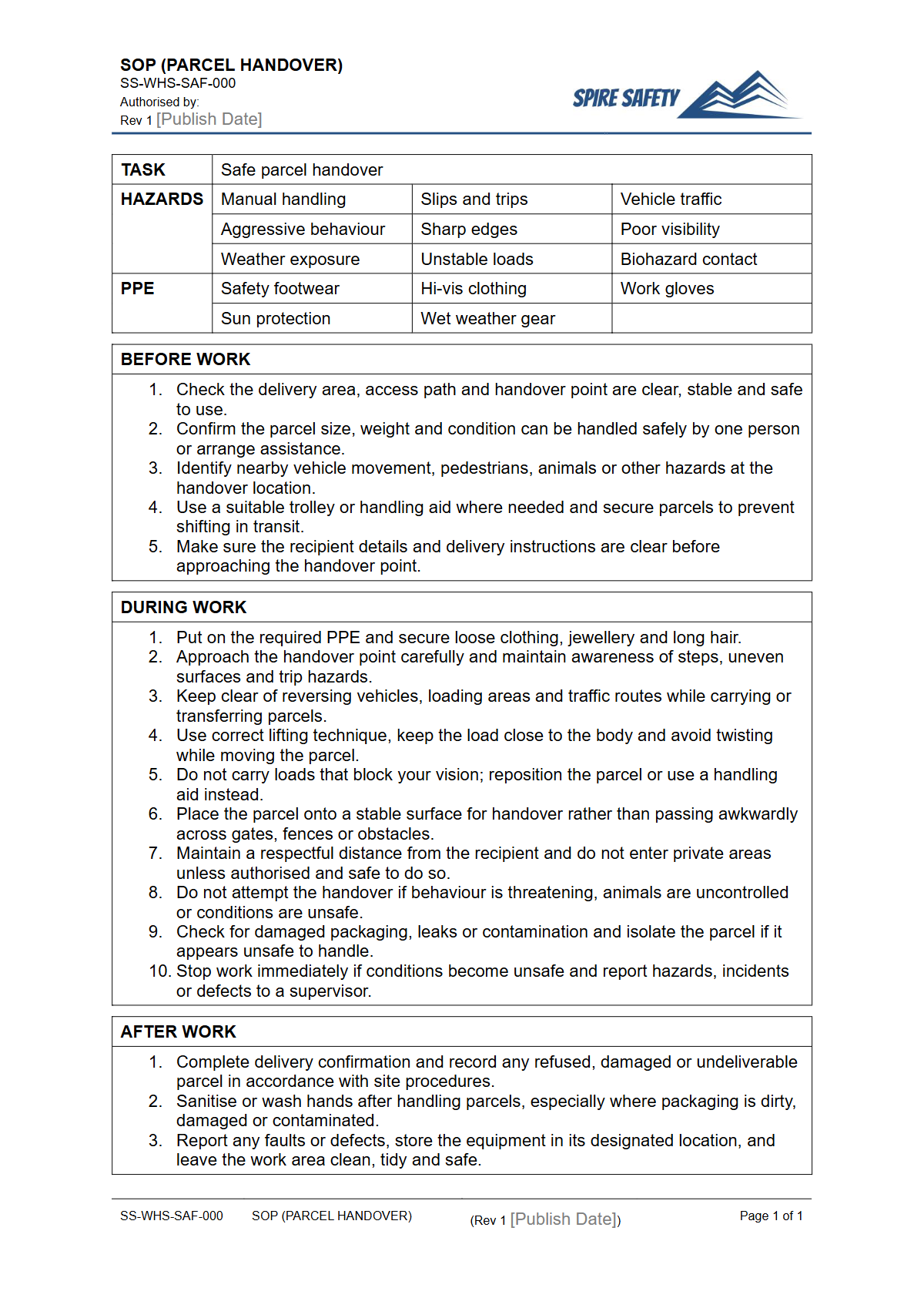
Download our free Safe Operating Procedure for parcel handover to formalise safe work practices in your logistics or retail environment.
Free Safe Operating Procedure (Parcel Handover) Template
DOCX • 126 KB + PDF
Updated Oct 2026
No signup required
Purpose of the Free Safe Operating Procedure (Parcel Handover) Template
This Free Safe Operating Procedure (Parcel Handover) Template provides a structured starting point for businesses to document the risks and control measures associated with transferring parcels between individuals, vehicles, and locations. Parcel handover, while seemingly simple, involves significant risks, primarily related to manual tasks, vehicle movements, and environmental hazards.
Using this SOP helps standardise your process, reduce the likelihood of musculoskeletal injuries, and provide a clear, documented resource for worker training and induction.
A well-defined SOP is a critical component of an effective safety management system. It demonstrates a commitment to meeting Work Health and Safety (WHS) obligations by systematically identifying hazards and outlining safe work methods.
It serves as a practical tool for supervisors to monitor work and for workers to understand the expected safe behaviours for tasks like loading and unloading vans, customer handovers, or internal freight transfers.
Video walkthrough
How to use the Free Safe Operating Procedure (Parcel Handover) Template
This template is provided in both DOCX and PDF formats. The DOCX file is fully editable, allowing you to tailor the content to the specific context of your workplace.
To use it effectively, you must review every section and add details relevant to your unique operational environment, including specific equipment used, depot layouts, types of parcels handled, and emergency contact information.
It is crucial to understand that this document is a template, not a finished safety document. We have designed it to be a comprehensive starting point, but your organisation is responsible for ensuring the final procedure is accurate and sufficient for your needs.
This process should be completed by a competent person in consultation with workers who perform the task. Integrating SOPs like this one is a key part of developing robust WHS management systems.
What is a Safe Operating Procedure?
A Safe Operating Procedure (SOP), sometimes called a Safe Work Procedure (SWP), is a written document that provides step-by-step instructions on how to perform a task safely. It identifies the potential hazards associated with the task and details the control measures that must be implemented to eliminate or minimise the risk of injury or illness.
SOPs are an essential administrative control under the hierarchy of risk control and a fundamental part of Australian WHS practice.
When to use a Parcel Handover SOP
A documented procedure for parcel handover should be used consistently as the standard for the task. It is particularly important in the following situations:
- Worker Training and Induction: When onboarding new employees, couriers, or warehouse staff to ensure they understand the safe process from day one.
- Refresher Training: As a basis for periodic refresher training or toolbox talks to reinforce safe work habits.
- Following an Incident: The SOP should be reviewed and updated as part of any incident investigation involving parcel handling.
- Process Changes: Whenever there is a change in equipment, location, or the type of goods being handled.
- Audits and Reviews: During internal or external safety audits to demonstrate that processes are documented. Regular reviews are a core activity within WHS compliance auditing to ensure procedures remain current.
Who should use this SOP
This procedure is designed for any person conducting a business or undertaking (PCBU) where parcel handover is a routine task. This includes, but is not limited to:
- Logistics and Courier Companies: For drivers, depot sorters, and forklift operators.
- Retail Businesses: For staff receiving inwards goods or preparing customer deliveries.
- Warehouse and Distribution Centres: For all personnel involved in moving stock.
- WHS Managers and Supervisors: As a tool to manage safety, conduct training, and perform workplace inspections.
For organisations with more complex operations, such as automated sorting facilities, this document can be adapted to integrate with other procedures, like our free Conveyer System SOP.
Key Hazards in Parcel Handover
The primary hazards this SOP helps control include:
- Manual Tasks: Lifting, carrying, pushing, and pulling awkward, heavy, or repetitive loads, leading to musculoskeletal disorders (MSDs).
- Slips, Trips, and Falls: Caused by poor housekeeping, uneven surfaces, or weather conditions.
- Vehicle Interaction: The risk of being struck by vehicles, forklifts, or pallet jacks in loading bays and yards. This requires clear traffic management rules.
- Environmental Factors: Working in heat, cold, or wet conditions, which can increase physical strain and other risks.
In many workplaces, other equipment is used in the vicinity of handover tasks. Ensuring all machinery has a documented procedure, such as an Air Compressor SOP for workshop areas, contributes to a safer overall environment.
For broader safety challenges, our WHS consulting services can provide expert guidance. You can also browse our complete free WHS resources library for more templates and guides.
Common mistakes
Common mistakes to avoid
- Using the downloaded template without customising it with site-specific hazards and controls.
- Failing to adequately train workers on the finalised SOP and confirm their understanding.
- Not reviewing or updating the SOP after an incident, near miss, or change in work process.
- Storing the procedure in an office where workers who perform the task cannot easily access it.
Legal references
Legal considerations
The following legal requirements may be relevant to this type of work.
- Work Health and Safety Act (Harmonised) — Provides the primary duties for protecting workers and other people from work health and safety risks.
- Work Health and Safety Regulations (Harmonised) — Sets out requirements supporting the management of workplace hazards and risks.
The following codes may be relevant to this type of work.
- Managing WHS Risks Code of Practice — Provides practical guidance on identifying hazards, assessing risks and applying effective controls.
- Work Health and Safety Consultation, Cooperation and Coordination Code of Practice — Provides practical guidance on consulting workers and coordinating with other duty holders.
- Managing the Work Environment and Facilities Code of Practice — Provides practical guidance on safe work environments, workplace facilities and related controls.
Did you know
Manual Handling Risk
According to Safe Work Australia, manual handling injuries account for a significant portion of serious workers' compensation claims. Body stressing, which includes lifting and handling objects, is a leading cause of workplace injury.
Hierarchy of Control
SOPs are an 'administrative control', which is the fourth level in the hierarchy of risk control. They should always be used in conjunction with higher-level controls like eliminating hazards or using engineering solutions where possible.
FAQ
Frequently asked questions
01What is a Safe Operating Procedure (SOP)?
02Why is an SOP needed for something as simple as parcel handover?
03Does this template meet all Australian WHS legal requirements?
04How often should we review our Parcel Handover SOP?
Share this resource
Free Safe Operating Procedure (Parcel Handover) Template
Browse Categories
How To Use It
- 1Download and open in Word or PDF.
- 2Replace the placeholders with your business details.
- 3Get it reviewed by a WHS specialist before rollout.
Need it customised?
Our WHS consultants can adapt this template to your site, run a gap analysis, or audit what you already have in place.
Book a Free Consultation WHS consulting servicesor call 1300 156 382
Related templates
- Free Safe Operating Procedure (Parcel Staging) Template
- Free Safe Operating Procedure (Park Bench Cleaning) Template
- Free Safe Operating Procedure (Park Furniture Repair) Template
- Free Safe Operating Procedure (Park Gate Maintenance) Template
- Free Safe Operating Procedure (Park Path Cleaning) Template
- Free Safe Operating Procedure (Park Sign Cleaning) Template