
Free Safe Operating Procedure (Park Sign Cleaning) Template
Standardise your park sign cleaning tasks with our structured Safe Operating Procedure. Download this free, customisable template to get started today.
Free Safe Operating Procedure (Park Sign Cleaning) Template
DOCX • 126 KB + PDF
Updated Oct 2026
No signup required
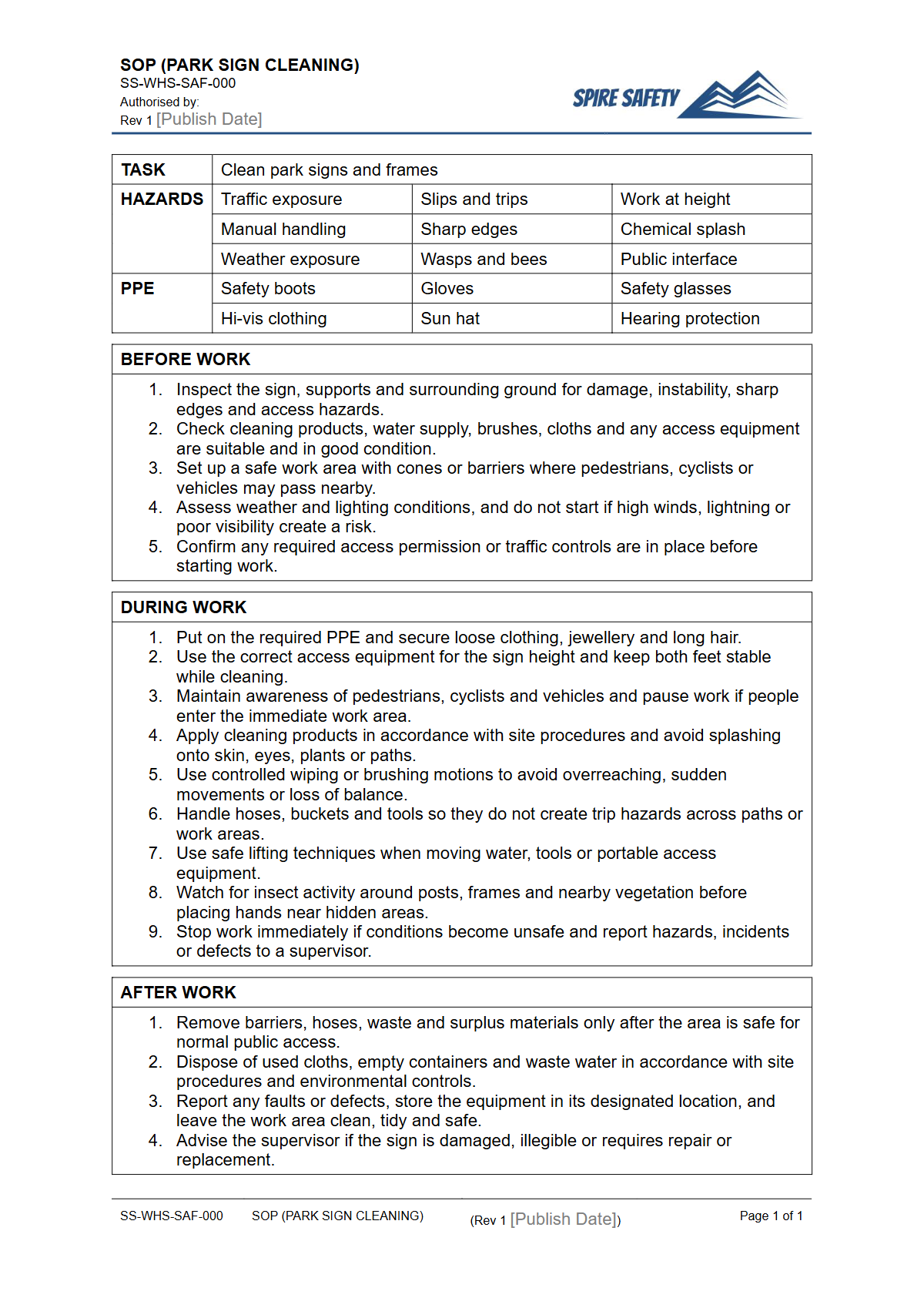
Purpose of the Free Safe Operating Procedure (Park Sign Cleaning) Template
This Free Safe Operating Procedure (Park Sign Cleaning) Template provides a structured framework for documenting the steps required to clean signs in parks, reserves, and public areas safely and efficiently. The task, while seemingly simple, involves several potential hazards, including exposure to cleaning chemicals, manual handling injuries from lifting equipment, working near traffic, and slips, trips, and falls.
Using a formal SOP helps ensure every worker follows the same approved method, minimising risks and promoting consistent, high-quality work.
A well-defined SOP is a fundamental tool for hazard management. It acts as both a training guide and a reference for workers, outlining key safety considerations like required Personal Protective Equipment (PPE), pre-operational checks, and emergency response actions.
Documenting your process helps your organisation meet its primary duty of care under WHS legislation. Just as you would for more complex equipment, having a clear procedure is vital; it establishes a baseline for safe work, similar to how a circular saw SOP outlines critical safety steps for its use.
Video walkthrough
How to use the Free Safe Operating Procedure (Park Sign Cleaning) Template
This SOP template is available for download in both DOCX and PDF formats. The DOCX file is fully editable, allowing you to tailor it to your organisation's specific needs.
To use the template effectively, you must add details relevant to your worksite, including the specific types of signs, approved cleaning chemicals and their Safety Data Sheets (SDS), and the equipment used in the process. For example, if your team uses a pressure washer, you should detail its safe operation, which may draw on principles from a free Air Compressor SOP if an air compressor is involved.
It is critical that you customise this document. We've provided a structured starting point aligned with Australian WHS practice, but you must adapt it to reflect the specific hazards and control measures unique to your workplace and tasks.
This includes filling out sections on site-specific risk controls, emergency contacts, and required training. Integrating customised SOPs into your broader safety framework is a key part of building effective WHS management systems.
When to use it
The Safe Operating Procedure for park sign cleaning should be used as a primary reference document before, during, and after the task. It forms an essential part of worker induction and training, ensuring new team members understand the established safe work method from day one.
It should also be used for regular refresher training to reinforce safe behaviour and communicate any procedural updates.
Furthermore, this SOP serves as a benchmark document during safety observations or performance reviews. Supervisors can use it to verify that work is being conducted as specified.
It is also a critical document to review after any incident or near miss, or when procedures are being assessed during a WHS compliance auditing process to ensure its ongoing suitability.
Who should use it
This SOP is designed for use by all personnel involved in the cleaning of park signs. This includes council employees, grounds maintenance crews, contractors, and any other workers assigned the task.
It provides them with clear, step-by-step instructions to perform their duties safely. Supervisors and team leaders should use the document to train their staff, oversee work, and enforce safety standards.
Work Health and Safety (WHS) managers and coordinators will also find this template valuable for developing and implementing their organisation's safety procedures. It provides a solid foundation that can be integrated into the overall safety management system.
The principles of safely handling and applying substances in this task are transferable, requiring the same level of procedural detail as a FREE Spreader SOP does for its specific function. If you need more expert guidance, explore our range of free WHS resources library for additional templates and guides.
Common mistakes
Common mistakes to avoid
- Using the template without customising it for specific site conditions and chemicals.
- Failing to train workers on the finalised SOP and confirm their understanding.
- Not providing or ensuring the use of the correct PPE listed in the procedure.
- Forgetting to implement controls for risks from nearby vehicle traffic or pedestrians.
Legal references
Legal considerations
The following legal requirements may be relevant to this type of work.
- Work Health and Safety Act (Harmonised) — Provides the primary duties for protecting workers and other people from work health and safety risks.
- Work Health and Safety Regulations (Harmonised) — Sets out requirements supporting the management of workplace hazards and risks.
The following codes may be relevant to this type of work.
- Managing WHS Risks Code of Practice — Provides practical guidance on identifying hazards, assessing risks and applying effective controls.
- Work Health and Safety Consultation, Cooperation and Coordination Code of Practice — Provides practical guidance on consulting workers and coordinating with other duty holders.
- Managing the Work Environment and Facilities Code of Practice — Provides practical guidance on safe work environments, workplace facilities and related controls.
Did you know
Reflective Damage
Many modern road and park signs use retroreflective sheeting. Using abrasive cleaners or harsh scrubbing can permanently damage this surface, reducing its visibility at night and rendering the sign ineffective.
Slips, Trips and Falls
According to Safe Work Australia, slips, trips and falls are a leading cause of serious workplace injuries, making good housekeeping and management of wet work areas a critical part of any cleaning task.
FAQ
Frequently asked questions
01What hazards are involved in cleaning park signs?
02Does this SOP template cover working at heights?
03How often should a Safe Operating Procedure be reviewed?
04What is the difference between an SOP and a SWMS?
Share this resource
Free Safe Operating Procedure (Park Sign Cleaning) Template
Browse Categories
How To Use It
- 1Download and open in Word or PDF.
- 2Replace the placeholders with your business details.
- 3Get it reviewed by a WHS specialist before rollout.
Need it customised?
Our WHS consultants can adapt this template to your site, run a gap analysis, or audit what you already have in place.
Book a Free Consultation WHS consulting servicesor call 1300 156 382
Related templates
- Free Safe Operating Procedure (Parking Bay Cleaning) Template
- Free Safe Operating Procedure (Parts Washer) Template
- Free Safe Operating Procedure (Passenger Lift) Template
- Free Safe Operating Procedure (Passenger Ramp Setup) Template
- Free Safe Operating Procedure (Passenger Stairs) Template
- Free Safe Operating Procedure (Pastry Roller) Template