
Free Safe Operating Procedure (Passenger Stairs) Template
Formalise your procedures for using passenger stairs with our free template. Download this Safe Operating Procedure to help manage risks and guide workers.
Free Safe Operating Procedure (Passenger Stairs) Template
DOCX • 126 KB + PDF
Updated Oct 2026
No signup required
Purpose of the Free Safe Operating Procedure (Passenger Stairs) Template
Passenger stairs, whether motorised or towable, are essential equipment in aviation and transport industries. However, their operation introduces significant risks, including falls from height, slips and trips, equipment failure, and collisions.
This Free Safe Operating Procedure (Passenger Stairs) Template provides a structured framework to document the required steps for safe operation, helping your organisation manage these hazards effectively. Implementing a clear SOP is a fundamental step in protecting workers and passengers from harm.
A documented Safe Operating Procedure demonstrates a commitment to systematic safety management. It provides a reliable reference for training, serves as a standard for performance, and helps standardise work practices across different shifts and teams.
Integrating this procedure into your broader WHS management systems ensures that operational safety is consistently addressed and improved upon, aligning with Australian workplace health and safety expectations.
Video walkthrough
How to use the Free Safe Operating Procedure (Passenger Stairs) Template
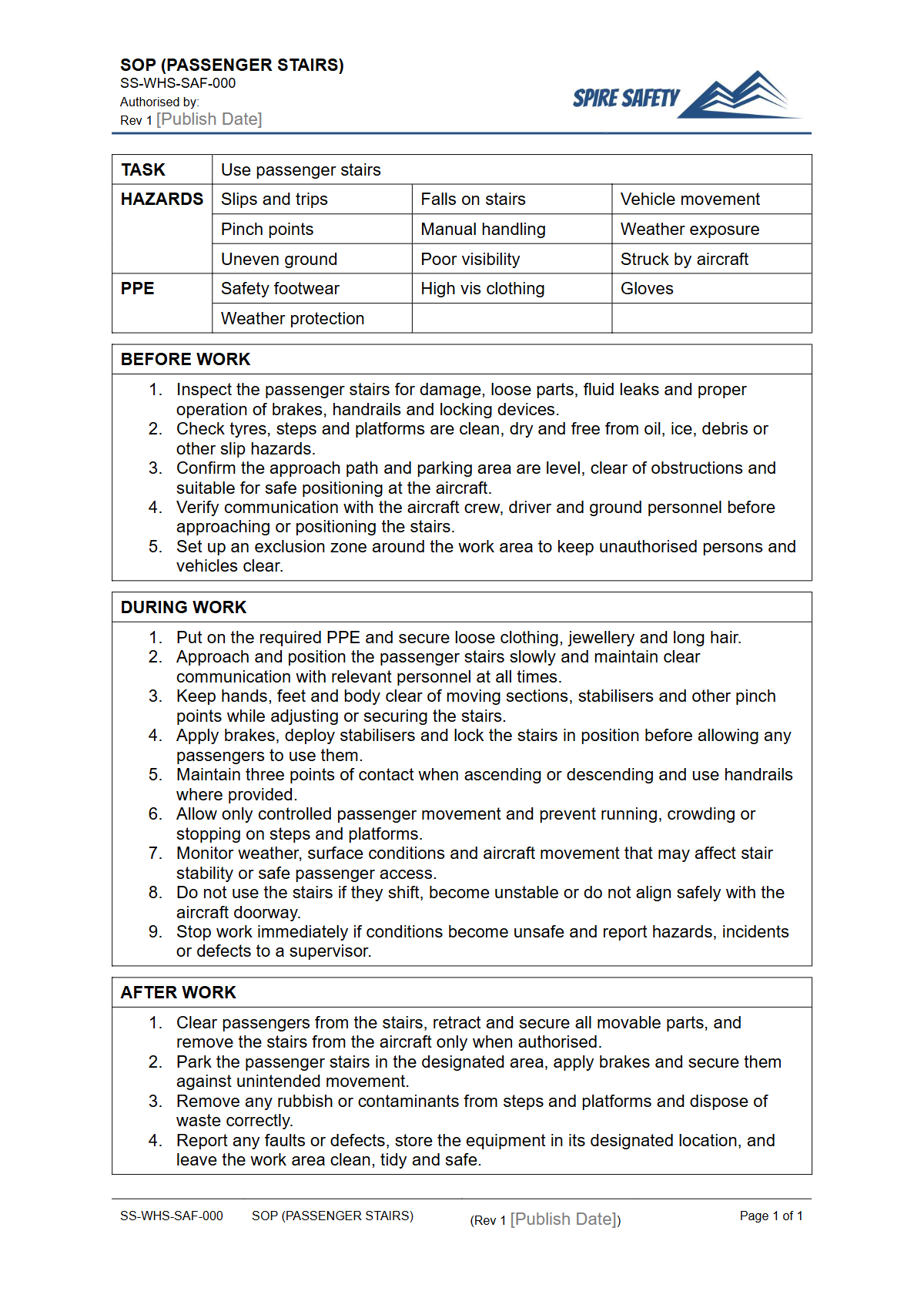
This downloadable DOCX and PDF file is a comprehensive starting point, designed to be adapted to your specific operational context. To use this template effectively, you must identify the unique aspects of your workplace, including the exact models of passenger stairs in use, the environment they are operated in (e.g., tarmac conditions, lighting), and the specific tasks your workers perform.
The document is pre-formatted with key sections that guide you through this customisation process.
Key areas for customisation include:
- PPE Requirements: Specify mandatory personal protective equipment, such as high-visibility clothing, safety footwear, and gloves.
- Risk Assessment Details: Reference your site-specific risk assessment for operating passenger stairs.
- Pre-Operational Checks: Detail the daily inspection checklist for brakes, hydraulics, guardrails, stability jacks, and emergency systems.
- Operating Steps: Outline the step-by-step process for approaching the aircraft, docking, securing, and retracting the stairs.
- Emergency Procedures: Document procedures for equipment malfunction, emergency lowering, and evacuation.
Please note: We have designed this template as a foundational document. You must customise it with your specific site details, machinery models, identified hazards, and control measures to ensure it is relevant and effective for your workplace. Once customised, regular reviews and updates are crucial for maintaining its relevance, a process often verified through WHS compliance auditing.
When to use this Safe Operating Procedure
A Safe Operating Procedure for passenger stairs should be the primary reference document for all related work activities. It is not a document to be filed away; it is an active tool for daily safety.
It should be used during worker inductions, task-specific training, and for refresher courses to ensure ongoing competency. Supervisors can use it to conduct observations and verify that correct procedures are being followed on the ground.
The SOP should also be reviewed and referenced following any incident or near-miss, or when changes occur, such as the introduction of a new type of aircraft or ground support equipment. For businesses that operate various pieces of machinery on the tarmac, consistency in documentation is key; for example, your passenger stairs SOP should complement other procedures like your conveyer system SOP to create a cohesive safety framework for all ground handling tasks.
Who should use it
This Safe Operating Procedure is intended for all personnel involved with passenger stairs. This includes:
- Ground Crew and Ramp Agents: The primary operators who need to understand every step of the procedure, from pre-checks to positioning and removal.
- Maintenance Staff: Personnel responsible for inspecting, servicing, and repairing the equipment according to manufacturer specifications and safety standards.
- Supervisors and Team Leaders: Those responsible for overseeing operations, providing training, and ensuring procedures are consistently followed.
- WHS Managers and Personnel: Individuals who develop, implement, and review safety systems and need to ensure operational procedures align with the organisation's overall WHS policy.
Essentially, anyone whose work requires them to operate, work near, or supervise the use of passenger stairs must be trained and competent in the contents of the finalised SOP. This principle applies to all specialised equipment, and you may find our FREE Telehandler SOP Template useful for other ground support vehicles.
If you require assistance tailoring this document or developing a suite of SOPs for your operations, our team of specialists can provide expert WHS consulting services. For more templates and safety guides, feel free to browse our complete free WHS resources library.
Common mistakes
Common mistakes to avoid
- Failing to conduct and document daily pre-operational checks.
- Incorrectly positioning stairs against the aircraft, creating a dangerous gap or instability.
- Attempting to move the stairs while passengers are on or near them.
- Overlooking worker training on emergency lowering procedures for different equipment models.
Legal references
Legal considerations
The following legal requirements may be relevant to this type of work.
- Work Health and Safety Act (Harmonised) — Provides the primary duties for protecting workers and other people from work health and safety risks.
- Work Health and Safety Regulations (Harmonised) — Sets out requirements supporting the management of workplace hazards and risks.
The following codes may be relevant to this type of work.
- Managing WHS Risks Code of Practice — Provides practical guidance on identifying hazards, assessing risks and applying effective controls.
- Work Health and Safety Consultation, Cooperation and Coordination Code of Practice — Provides practical guidance on consulting workers and coordinating with other duty holders.
- Managing the Work Environment and Facilities Code of Practice — Provides practical guidance on safe work environments, workplace facilities and related controls.
Did you know
Ground Handling Risks
Slips, trips, and falls are among the most common causes of injury for airport ground handling staff, making stable and well-maintained passenger stairs critical for safety.
Weather Impact
Environmental factors like high winds, rain, and ice can significantly increase the risks associated with operating passenger stairs, requiring specific controls and potentially restricting use.
FAQ
Frequently asked questions
01What are the main hazards associated with operating passenger stairs?
02How often should a Safe Operating Procedure for passenger stairs be reviewed?
03Is training required for workers who operate passenger stairs?
04What should be included in pre-operational checks for passenger stairs?
Share this resource
Free Safe Operating Procedure (Passenger Stairs) Template
Browse Categories
How To Use It
- 1Download and open in Word or PDF.
- 2Replace the placeholders with your business details.
- 3Get it reviewed by a WHS specialist before rollout.
Need it customised?
Our WHS consultants can adapt this template to your site, run a gap analysis, or audit what you already have in place.
Book a Free Consultation WHS consulting servicesor call 1300 156 382
Related templates
- Free Safe Operating Procedure (Pastry Roller) Template
- Free Safe Operating Procedure (Path Edge Trimming) Template
- Free Safe Operating Procedure (Patient Bed Cleaning) Template
- Free Safe Operating Procedure (Patient Belongings Move) Template
- Free Safe Operating Procedure (Patient Hoist) Template
- Free Safe Operating Procedure (Patient Locker Cleaning) Template