
Free Safe Operating Procedure (Path Edge Trimming) Template
Download our free Safe Operating Procedure (Path Edge Trimming) template. This document helps you formalise safety steps for your team. Get your DOCX now.
Free Safe Operating Procedure (Path Edge Trimming) Template
DOCX • 126 KB + PDF
Updated Oct 2026
No signup required
Purpose of the Free Safe Operating Procedure (Path Edge Trimming) Template
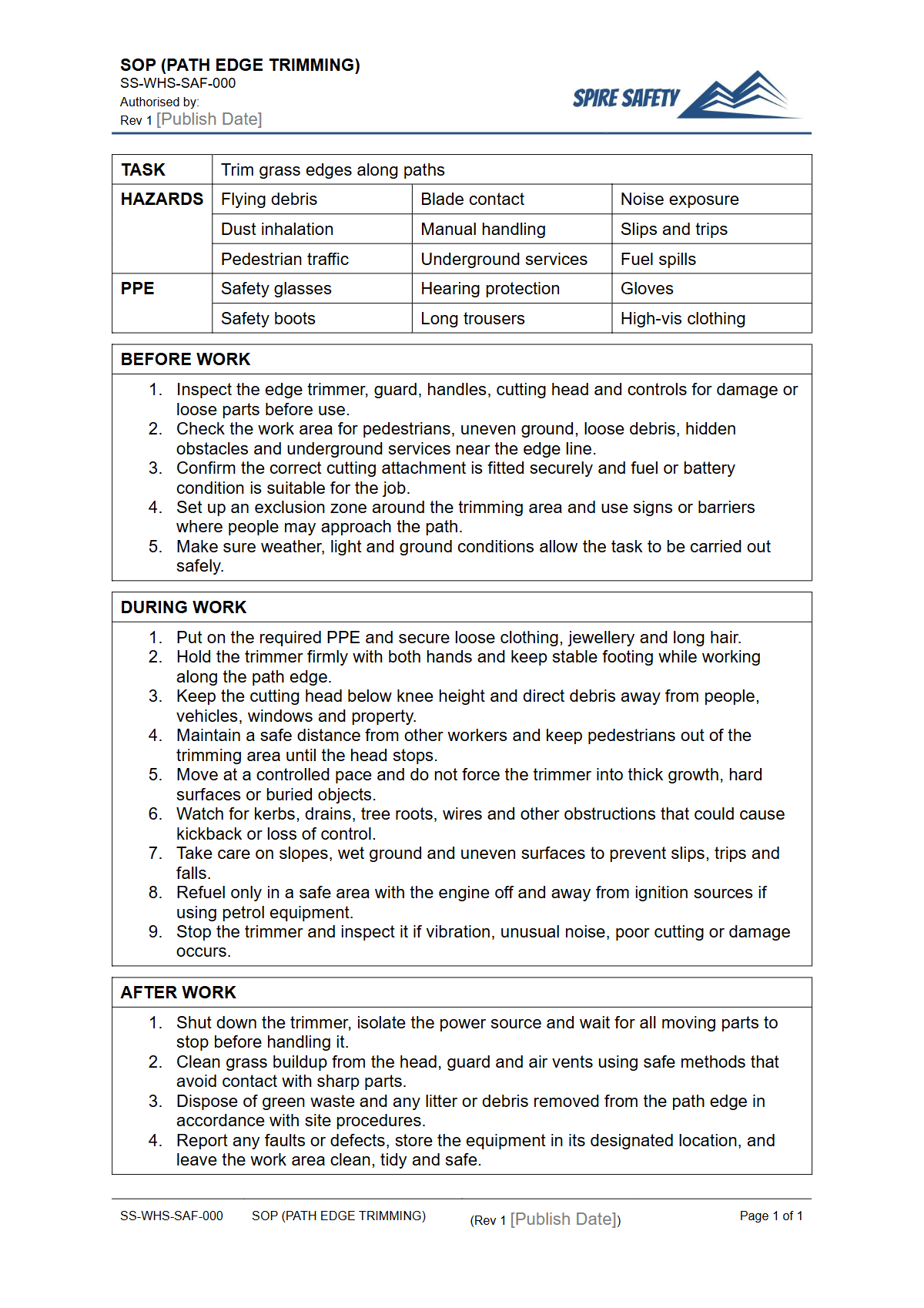
Operating machinery like path edge trimmers, while routine for many landscaping and civil maintenance crews, carries inherent risks. This Free Safe Operating Procedure (Path Edge Trimming) Template provides a structured starting point for documenting the required safety controls for this task.
It helps your organisation formalise the steps for pre-start checks, safe operation, shutdown processes, and maintenance, ensuring a consistent approach to managing hazards. A well-drafted SOP is a critical administrative control that supports your overall safety management system, demonstrating due diligence and a commitment to worker wellbeing.
The procedure guides users to consider specific hazards associated with path edge trimming, including rotating blades, thrown objects (projectiles), noise, vibration, and ergonomic strains. By systematically outlining control measures for these risks, you can reduce the likelihood of incidents and injuries.
Implementing documented procedures is a key part of developing robust WHS management systems that protect both your workers and your business.
Video walkthrough
How to use the Free Safe Operating Procedure (Path Edge Trimming) Template
This resource is available for immediate download in both DOCX and PDF formats. The DOCX file is fully editable, allowing you to adapt the content to your specific operational needs.
The template is structured based on the model WHS framework and common industry practice to give you a comprehensive starting point. It covers sections for personal protective equipment (PPE), hazard identification, risk controls, and emergency response.
Important: This is a template, not a finished document. It is essential that you customise this procedure to reflect the specific model of path edge trimmer used, the unique environmental conditions of your worksite(s), and your organisation's existing policies.
We have provided a structured framework, but you must ensure the final document accurately represents your workplace risks. If you need assistance tailoring this or other documents, our WHS consulting services can provide expert guidance.
When to use a Path Edge Trimming SOP
A Safe Operating Procedure for path edge trimming should be a core document used in several key situations. It is fundamental for training new employees and for conducting refresher training for existing workers, ensuring everyone understands the established safety standards.
The SOP serves as a practical, on-the-job reference for operators to follow. It also becomes an essential piece of evidence during safety inspections or a WHS compliance audit, demonstrating that you have a formal process for managing risks associated with the task.
Furthermore, in the unfortunate event of an incident or near miss involving an edge trimmer, the SOP is a crucial reference for the investigation. It helps determine whether procedures were followed and identifies any gaps that may need to be addressed to prevent a recurrence.
Tasks with similar ground-working risks, such as those covered in our FREE Trencher SOP Template, also benefit from this structured approach.
Who should use this SOP
This SOP is designed for use by any person conducting a business or undertaking (PCBU) whose workers operate path edge trimmers. This includes businesses in landscaping, horticulture, civil construction, grounds maintenance, and local government or council works departments.
Line managers and supervisors are responsible for ensuring the SOP is implemented, understood, and followed by their teams. Workers who operate the equipment are the primary end-users and should be consulted during the customisation process to ensure the procedure is practical and effective.
The responsibility for providing safe systems of work lies with the PCBU. Using standardised procedures for all high-risk equipment, from edge trimmers to larger plant like that covered in our FREE Grader SOP Template, is a fundamental aspect of meeting that duty of care.
These documents ensure that safety isn't left to chance but is instead embedded into your daily operations. You can find more templates like this across our free WHS resources library to build out your safety documentation.
A comprehensive SOP should integrate with other safety documents and risk assessments. For example, if your work involves extensive earthmoving, the principles in this SOP can complement procedures for other equipment, such as those outlined in our FREE Scraper SOP Template. Consistency across all procedural documents strengthens your overall safety framework.
Common mistakes
Common mistakes to avoid
- Using a generic SOP without customising it for the specific model of trimmer and worksite conditions.
- Failing to consult with operators during the drafting process, leading to impractical or ineffective procedures.
- Not providing adequate training on the finalised SOP, treating it as a 'tick-and-flick' exercise.
- Neglecting to review and update the SOP after an incident, or when new equipment or processes are introduced.
Legal references
Legal considerations
The following legal requirements may be relevant to this type of work.
- Work Health and Safety Act (Harmonised) — Provides the primary duties for protecting workers and other people from work health and safety risks.
- Work Health and Safety Regulations (Harmonised) — Sets out requirements supporting the management of workplace hazards and risks.
The following codes may be relevant to this type of work.
- Managing WHS Risks Code of Practice — Provides practical guidance on identifying hazards, assessing risks and applying effective controls.
- Work Health and Safety Consultation, Cooperation and Coordination Code of Practice — Provides practical guidance on consulting workers and coordinating with other duty holders.
- Managing the Work Environment and Facilities Code of Practice — Provides practical guidance on safe work environments, workplace facilities and related controls.
Did you know
Vibration Exposure
Prolonged use of vibrating tools like edge trimmers can lead to Hand-Arm Vibration Syndrome (HAVS). Regular breaks and using low-vibration equipment are key control measures outlined in a thorough SOP.
FAQ
Frequently asked questions
01What is a Safe Operating Procedure (SOP) for path edge trimming?
02Is this path edge trimming SOP template free to use?
03What hazards should be included in a path edge trimming SOP?
04Who is responsible for creating and implementing this SOP?
Share this resource
Free Safe Operating Procedure (Path Edge Trimming) Template
Browse Categories
How To Use It
- 1Download and open in Word or PDF.
- 2Replace the placeholders with your business details.
- 3Get it reviewed by a WHS specialist before rollout.
Need it customised?
Our WHS consultants can adapt this template to your site, run a gap analysis, or audit what you already have in place.
Book a Free Consultation WHS consulting servicesor call 1300 156 382
Related templates
- Free Safe Operating Procedure (Patient Bed Cleaning) Template
- Free Safe Operating Procedure (Patient Belongings Move) Template
- Free Safe Operating Procedure (Patient Hoist) Template
- Free Safe Operating Procedure (Patient Locker Cleaning) Template
- Free Safe Operating Procedure (Payoff Reel) Template
- Free Safe Operating Procedure (Pedestal Drill Operation) Template