
Free Safe Operating Procedure (Payoff Reel) Template
Document the safe use of payoff reels in your workplace with our structured template. Download your free Safe Operating Procedure to get started today.
Free Safe Operating Procedure (Payoff Reel) Template
DOCX • 126 KB + PDF
Updated Oct 2026
No signup required
Purpose of the Free Safe Operating Procedure (Payoff Reel) Template
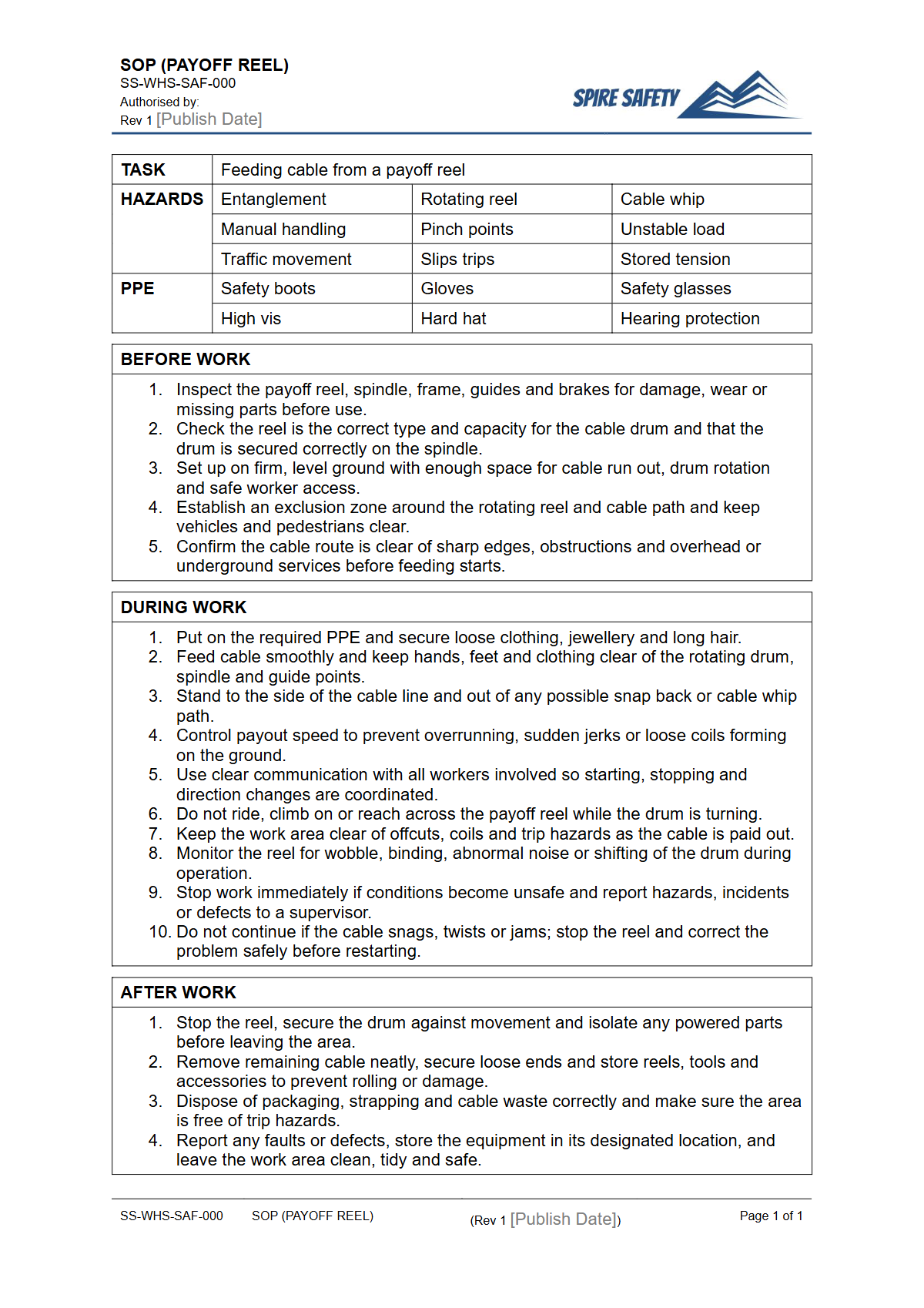
Payoff reels, used for dispensing materials like cable, wire, or hose, introduce specific workplace hazards if not managed correctly. This Free Safe Operating Procedure (Payoff Reel) Template provides a structured framework for documenting the required steps to operate this equipment safely.
A well-developed SOP is a critical tool for managing risks, ensuring consistent operational practices, and providing a clear basis for worker training and supervision. It helps your organisation meet its primary duty of care under Australian WHS law by formalising the safe systems of work you have established.
Key Hazards of Payoff Reel Operation
Before implementing an SOP, it's vital to conduct a risk assessment to identify potential hazards specific to your equipment and work environment. Common hazards associated with payoff reels include:
- Entanglement: Loose clothing, hair, or jewellery getting caught in rotating parts.
- Manual Handling: Strains and sprains from pulling heavy cables, lifting reels, or forceful exertion.
- Stored Energy: Uncontrolled release from spring-loaded or hydraulic retraction mechanisms, causing impact injuries.
- Crush and Pinch Points: Hands or limbs being caught between the reel and its frame, or between the cable and drum.
- Trips and Falls: Hoses or cables creating tripping hazards in the work area.
Integrating these identified hazards and their control measures into your SOP is fundamental to creating an effective document. These procedures form a key part of broader WHS management systems, demonstrating a systematic approach to safety.
Video walkthrough
How to use the Free Safe Operating Procedure (Payoff Reel) Template
This document is a template and must be customised to suit the specific make and model of payoff reel used at your workplace, as well as the unique environment and context of the tasks performed. A generic procedure is not sufficient to ensure safety.
Note: We provide this template as a starting point. To make it effective, you must consult with your workers and adapt the content to reflect your site-specific risk assessment, equipment, and established safety protocols.
Our team cannot know your exact workplace conditions.
To adapt the template:
- Review and Edit: Go through each section, including pre-operational checks, step-by-step operating instructions, and shutdown procedures.
- Incorporate Specifics: Add details about your specific reel model, including its capacity, tensioning system, and any manufacturer warnings.
- Add Emergency Procedures: Clearly outline the steps to take in case of an emergency, such as uncontrolled payout/retraction, equipment failure, or injury.
- Consult and Train: Discuss the draft SOP with operators and supervisors to ensure it is practical and clear. Once finalised, use it as a basis for training.
Documenting procedures for plant like this is similar to the process for other mechanical equipment. For comparison, you can review the structure of our free Conveyer System SOP template.
When to use it
A Safe Operating Procedure for a payoff reel is not a document that should be filed away and forgotten. It is a live document used in daily operations to guide safe work practices. Its primary uses include:
- Worker Training: As a core training document for new operators to ensure they understand the correct, safe method of operation from the start.
- Refresher Training: For periodic refresher courses to prevent complacency and reinforce safe behaviour.
- Daily Operations: As a quick reference for operators before starting a task, particularly for non-routine operations.
- Incident Investigation: To assess whether correct procedure was followed and to identify areas for improvement after a near miss or incident.
- Audits and Inspections: To demonstrate established safe work methods during internal or external audits. Effective SOPs are a key piece of evidence reviewed during WHS compliance auditing.
Who should use it
Various roles within an organisation have a responsibility related to the development, implementation, and use of a payoff reel SOP:
- Operators: The primary users who must follow the procedure for every task involving the payoff reel. They are also vital for providing feedback on the procedure's practicality.
- Supervisors and Managers: Responsible for ensuring operators are trained on the SOP and follow it consistently. They must enforce its use and initiate reviews or updates when necessary.
- Maintenance Personnel: Use the SOP to understand safe shutdown, isolation, and de-energisation procedures before conducting maintenance or repairs.
- WHS Personnel: Oversee the development and review process, ensuring the SOP is based on a thorough risk assessment and aligns with relevant safety standards. Their expertise is also valuable for other common equipment like air compressors, which also require clear procedural guidance as seen in our Air Compressor SOP.
Organisations that use a wide range of plant and equipment will find that a consistent approach to SOP development is beneficial. Standardising your procedures for items like payoff reels and other mobile plant helps streamline training and safety management, such as with a free Telehandler SOP template.
This document is just one of many tools available to help build a safer workplace. For more templates, checklists, and guides, browse our complete free WHS resources library.
Common mistakes
Common mistakes to avoid
- Failing to customise the template for the specific reel model and workplace conditions.
- Neglecting to include pre-operational checks for wear, damage, or correct tension.
- Not training workers on the finalised SOP or verifying their understanding of the procedures.
- Forgetting to schedule and document regular maintenance and inspections as outlined in the SOP.
Legal references
Legal considerations
The following legal requirements may be relevant to this type of work.
- Work Health and Safety Act (Harmonised) — Provides the primary duties for protecting workers and other people from work health and safety risks.
- Work Health and Safety Regulations (Harmonised) — Sets out requirements supporting the management of workplace hazards and risks.
The following codes may be relevant to this type of work.
- Managing WHS Risks Code of Practice — Provides practical guidance on identifying hazards, assessing risks and applying effective controls.
- Work Health and Safety Consultation, Cooperation and Coordination Code of Practice — Provides practical guidance on consulting workers and coordinating with other duty holders.
- Managing the Work Environment and Facilities Code of Practice — Provides practical guidance on safe work environments, workplace facilities and related controls.
Did you know
Stored Energy Risks
Many payoff reels use powerful springs or hydraulic systems for retraction. These can store significant kinetic energy, posing a serious hazard if released uncontrollably during maintenance or due to failure.
Manual Handling Focus
The repetitive pulling of heavy cables or hoses from payoff reels is a leading cause of musculoskeletal disorders. A good SOP includes techniques and controls, such as maintaining proper posture, to minimise strain.
FAQ
Frequently asked questions
01What should be included in a payoff reel SOP?
02How often should a Safe Operating Procedure for a payoff reel be reviewed?
03Is a Safe Operating Procedure a legal requirement in Australia for payoff reels?
04Can this SOP template be used for different types of payoff reels?
Share this resource
Free Safe Operating Procedure (Payoff Reel) Template
Browse Categories
How To Use It
- 1Download and open in Word or PDF.
- 2Replace the placeholders with your business details.
- 3Get it reviewed by a WHS specialist before rollout.
Need it customised?
Our WHS consultants can adapt this template to your site, run a gap analysis, or audit what you already have in place.
Book a Free Consultation WHS consulting servicesor call 1300 156 382
Related templates
- Free Safe Operating Procedure (Pedestal Drill Operation) Template
- Free Safe Operating Procedure (Pedestrian Route Setup) Template
- Free Safe Operating Procedure (Penetrometer) Template
- Free Safe Operating Procedure (Peristaltic Pump) Template
- Free Safe Operating Procedure (Personal Alarm Testing) Template
- Free Safe Operating Procedure (Personnel Hoist) Template