
Free Safe Operating Procedure (Penetrometer) Template
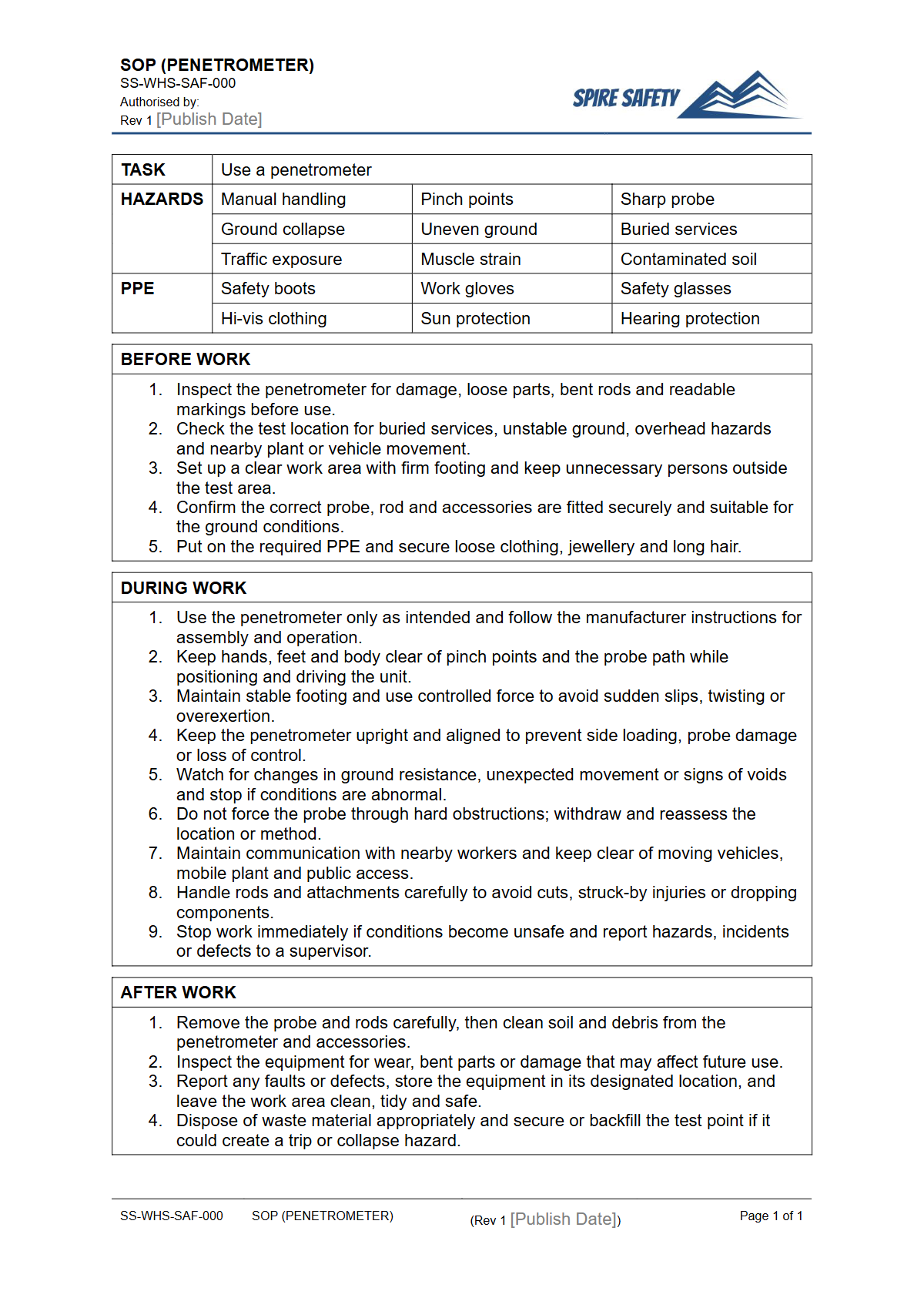
Download our free Safe Operating Procedure for penetrometers to formalise your safety processes. This template helps you outline operational steps and controls.
Free Safe Operating Procedure (Penetrometer) Template
DOCX • 126 KB + PDF
Updated Oct 2026
No signup required
Purpose of the Free Safe Operating Procedure (Penetrometer) Template
A penetrometer is a common tool in geotechnical engineering, construction, and agriculture for assessing soil strength and compaction. While seemingly simple, its use involves specific risks that must be managed.
Our Free Safe Operating Procedure (Penetrometer) Template provides a structured framework for documenting the safe use of this equipment, helping you to standardise your processes and meet your Work Health and Safety (WHS) obligations.
The purpose of this Safe Operating Procedure is to provide clear, step-by-step instructions to workers, ensuring tasks are performed safely and consistently. It details potential hazards, outlines necessary personal protective equipment (PPE), and establishes emergency procedures.
Formalising these steps helps minimise the risk of incidents such as musculoskeletal injuries from manual handling, striking underground services, or errors in data collection. This document is a fundamental component of your overall WHS management systems, acting as both a training tool and an auditable record of your safety protocols.
Video walkthrough
How to use the Free Safe Operating Procedure (Penetrometer) Template
This template is available in both DOCX and PDF formats for your convenience. The DOCX file is fully editable, allowing you to tailor the content directly to your operational needs.
It is crucial to adapt the procedure to the specific type of penetrometer in use (e.g., Dynamic Cone Penetrometer (DCP), static cone, or pocket penetrometer), the site conditions, and your organisation's existing safety policies.
To effectively use this template, you should:
- Conduct a risk assessment for the task of using a penetrometer in your specific work environment.
- Insert the outcomes of your risk assessment, including identified hazards and control measures, into the relevant sections.
- Specify the exact model of equipment, required PPE (e.g., steel-capped boots, gloves, eye protection), and pre-operational checks.
- Detail the step-by-step process for operation, transport, and maintenance.
- Review the procedure with all relevant workers to ensure it is understood and practical.
Remember, this document is a template and must be customised for your specific workplace. We are not responsible for its application. You must ensure it reflects your unique operational risks and legal obligations.
For an example of how procedures are structured for other ground-engaging equipment, our FREE Trencher SOP Template provides a useful comparison.
When to use a Safe Operating Procedure
An SOP for penetrometer use should be integrated into your daily operations. It is not a document to be filed away and forgotten.
It serves as a primary reference during several key phases of work. It should be used to formally induct and train new operators, ensuring they understand the approved method before they begin work.
It also functions as a valuable tool for refresher training for experienced personnel.
Before commencing any soil testing task, operators and supervisors should review the SOP as part of their pre-start meeting or toolbox talk. This reinforces critical safety checks, such as verifying site plans for underground services.
The document also provides a standard against which work practices can be measured during safety observations or inspections. Finally, maintaining and regularly reviewing your SOPs is a core activity within any internal or external WHS compliance auditing program, demonstrating proactive safety management.
Who should use this Safe Operating Procedure
This Safe Operating Procedure is intended for use by multiple people within an organisation to foster a comprehensive approach to safety. Its primary users are the equipment operators themselves, who must follow the procedure to ensure their own safety and the safety of others.
Supervisors and site managers use the SOP to oversee work, enforce safety standards, and lead pre-start discussions. The process for managing worksite tasks shares principles with other heavy equipment operations, as seen in our FREE Scraper SOP Template.
WHS Managers and Advisors will use this template as a foundation for developing and implementing risk controls across the business. It is a key document for demonstrating compliance and managing the company's risk profile.
If you need expert help in adapting this template or developing other safety documentation to fit the complexities of your operations, our WHS consulting team can provide tailored support. Finally, Persons Conducting a Business or Undertaking (PCBUs) are ultimately responsible for ensuring a safe work environment, and a well-implemented SOP is a practical way to discharge that duty.
Common mistakes
Common mistakes to avoid
- Failing to conduct a "Dial Before You Dig" search before starting work.
- Using incorrect manual handling techniques, leading to back or shoulder strain.
- Not wearing appropriate PPE, particularly safety glasses and steel-capped boots.
- Continuing to use the equipment when it shows signs of damage or wear.
Legal references
Legal considerations
The following legal requirements may be relevant to this type of work.
- Work Health and Safety Act (Harmonised) — Provides the primary duties for protecting workers and other people from work health and safety risks.
- Work Health and Safety Regulations (Harmonised) — Sets out requirements supporting the management of workplace hazards and risks.
The following codes may be relevant to this type of work.
- Managing WHS Risks Code of Practice — Provides practical guidance on identifying hazards, assessing risks and applying effective controls.
- Work Health and Safety Consultation, Cooperation and Coordination Code of Practice — Provides practical guidance on consulting workers and coordinating with other duty holders.
- Managing the Work Environment and Facilities Code of Practice — Provides practical guidance on safe work environments, workplace facilities and related controls.
Did you know
Soil Testing History
The cone penetration test (CPT) was first developed in the 1930s in the Netherlands for assessing soft soils. It has since become a globally recognised method for geotechnical investigation.
FAQ
Frequently asked questions
01What are the main hazards of using a penetrometer?
02Is an SOP legally required for a penetrometer in Australia?
03How often should a Safe Operating Procedure be reviewed?
04What is a Dynamic Cone Penetrometer (DCP)?
Share this resource
Free Safe Operating Procedure (Penetrometer) Template
Browse Categories
How To Use It
- 1Download and open in Word or PDF.
- 2Replace the placeholders with your business details.
- 3Get it reviewed by a WHS specialist before rollout.
Need it customised?
Our WHS consultants can adapt this template to your site, run a gap analysis, or audit what you already have in place.
Book a Free Consultation WHS consulting servicesor call 1300 156 382
Related templates
- Free Safe Operating Procedure (Peristaltic Pump) Template
- Free Safe Operating Procedure (Personal Alarm Testing) Template
- Free Safe Operating Procedure (Personnel Hoist) Template
- Free Safe Operating Procedure (Pesticide Mixing) Template
- Free Safe Operating Procedure (Pet Bedding Cleaning) Template
- Free Safe Operating Procedure (Pet Cage Cleaning) Template