
Free Safe Operating Procedure (Peristaltic Pump) Template
Download our free Safe Operating Procedure (Peristaltic Pump) template to establish a consistent safety process for your team. Get your DOCX and PDF now.
Free Safe Operating Procedure (Peristaltic Pump) Template
DOCX • 126 KB + PDF
Updated Oct 2026
No signup required
Purpose of the Free Safe Operating Procedure (Peristaltic Pump) Template
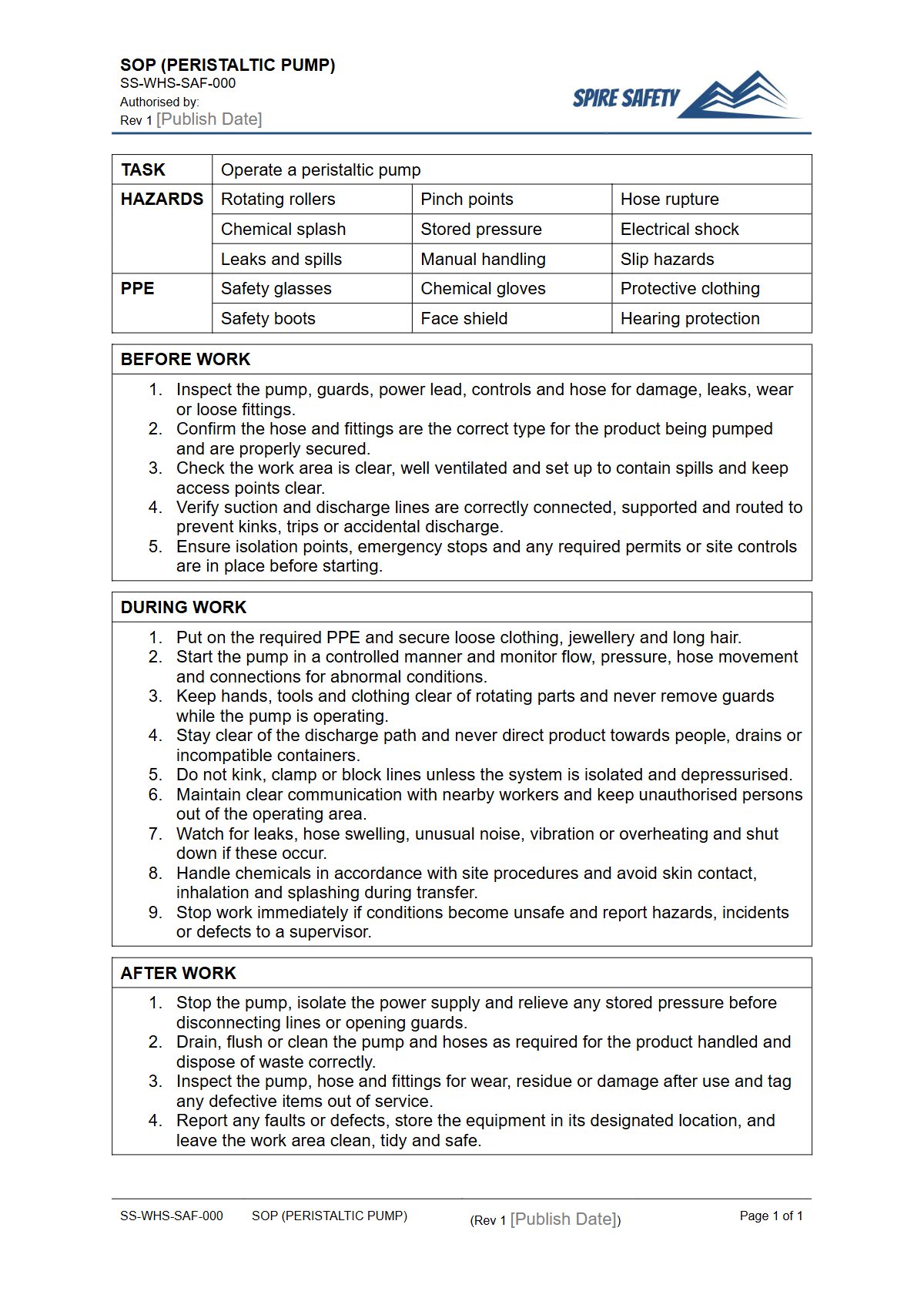
A Safe Operating Procedure (SOP) is a foundational document that provides step-by-step instructions on how to perform a task safely. This free Safe Operating Procedure (Peristaltic Pump) template helps your organisation outline the recognised hazards and control measures required for the setup, operation, and maintenance of peristaltic pumps.
Using this template helps standardise procedures, train workers effectively, and demonstrate a commitment to managing workplace risks. A well-drafted SOP is a critical element within broader WHS management systems, ensuring that safety is integrated into daily operations.
Peristaltic pumps are used across various industries, including chemical processing, food and beverage, and water treatment, to move a wide range of fluids. While they offer benefits like sterile pumping and handling abrasive or sensitive media, they also present specific risks.
These include mechanical entanglement in the rotating rollers, chemical exposure from tubing failure, and pressure-related hazards. This SOP template provides a structured format to document your specific control measures, such as selecting correct tubing, conducting pre-start checks, and defining emergency shutdown processes.
It acts as a clear guide for operators, reducing the likelihood of incidents and injuries. The principles outlined are similar to those in other plant-specific procedures, such as our free Boom Pump SOP.
Video walkthrough
How to use the Free Safe Operating Procedure (Peristaltic Pump) Template
This template is provided in both DOCX and PDF formats for your convenience. The DOCX file is fully editable, allowing you to tailor the content to the specific models of peristaltic pumps used at your site, the chemicals being handled, and your unique operational environment.
To use it effectively, download the document and work through each section with key stakeholders, including operators, supervisors, and safety personnel. Fill in the required details, such as site information, required Personal Protective Equipment (PPE), and emergency contacts. The goal is to create a practical document that reflects your actual work practices, much like you would for a Conveyer System SOP.
It's crucial to remember that this template is a starting point. We've designed it to be comprehensive, but you must customise it to reflect the specific hazards, controls, and operational context of your own workplace.
This involves conducting a task-specific risk assessment to identify all potential dangers and implementing the most effective control measures according to the hierarchy of controls. Your final document should be a true representation of the safe work method for your specific machinery, whether it's a simple pump or a complex piece of equipment like an Injection Molding Machine SOP.
When to use a Safe Operating Procedure
An SOP for a peristaltic pump should be a living document, integrated into several key business processes. It should be used as the primary training document for any new worker tasked with operating the pump.
Experienced operators should also use it as a reference to refresh their knowledge, especially before performing non-routine tasks or after a prolonged break from using the equipment. Furthermore, the SOP is an essential tool during incident investigations, helping to determine if procedural deviations contributed to the event.
Regular reviews and updates, often prompted by WHS compliance audits or changes in equipment or processes, ensure the document remains relevant and effective.
Who should use this Safe Operating Procedure
This SOP is intended for a range of personnel within an organisation. Primarily, operators and technicians who directly set up, run, and maintain the peristaltic pumps must be trained on and follow the procedure.
Supervisors and line managers are responsible for ensuring their team members understand and adhere to the SOP, providing adequate supervision and correcting unsafe behaviours. WHS managers or coordinators will typically oversee the development, review, and management of all SOPs, ensuring they align with the organisation's overall safety framework.
For complex environments or for organisations seeking to overhaul their safety documentation, engaging expert WHS consultants can help ensure procedures are robust and practical. You can find more templates like this one in our free WHS resources library.
Common mistakes
Common mistakes to avoid
- Using incorrect or worn-out tubing for the specific fluid being pumped, leading to rapid degradation and failure.
- Failing to check the direction of fluid flow before starting the pump, potentially causing back-pressure or misdirection of chemicals.
- Neglecting to secure the pump head cover or guard before operation, creating an entanglement hazard.
- Not having appropriate spill kits and emergency shutdown knowledge ready when handling hazardous substances.
Legal references
Legal considerations
The following legal requirements may be relevant to this type of work.
- Work Health and Safety Act (Harmonised) — Provides the primary duties for protecting workers and other people from work health and safety risks.
- Work Health and Safety Regulations (Harmonised) — Sets out requirements supporting the management of workplace hazards and risks.
The following codes may be relevant to this type of work.
- Managing WHS Risks Code of Practice — Provides practical guidance on identifying hazards, assessing risks and applying effective controls.
- Work Health and Safety Consultation, Cooperation and Coordination Code of Practice — Provides practical guidance on consulting workers and coordinating with other duty holders.
- Managing the Work Environment and Facilities Code of Practice — Provides practical guidance on safe work environments, workplace facilities and related controls.
Did you know
The 'Stomach' Pump
The design of the peristaltic pump was inspired by the way the human oesophagus and intestines move food, a biological process called peristalsis.
Tubing is Critical
The single most common failure point in a peristaltic pump system is the tubing. Correct material selection for chemical compatibility and regular inspection are vital for preventing spills and exposure.
FAQ
Frequently asked questions
01What should be included in a peristaltic pump SOP?
02How often should a Safe Operating Procedure for a peristaltic pump be reviewed?
03Is training required in addition to having an SOP for a peristaltic pump?
04What are the main hazards of operating a peristaltic pump?
Share this resource
Free Safe Operating Procedure (Peristaltic Pump) Template
Browse Categories
How To Use It
- 1Download and open in Word or PDF.
- 2Replace the placeholders with your business details.
- 3Get it reviewed by a WHS specialist before rollout.
Need it customised?
Our WHS consultants can adapt this template to your site, run a gap analysis, or audit what you already have in place.
Book a Free Consultation WHS consulting servicesor call 1300 156 382
Related templates
- Free Safe Operating Procedure (Personal Alarm Testing) Template
- Free Safe Operating Procedure (Personnel Hoist) Template
- Free Safe Operating Procedure (Pesticide Mixing) Template
- Free Safe Operating Procedure (Pet Bedding Cleaning) Template
- Free Safe Operating Procedure (Pet Cage Cleaning) Template
- Free Safe Operating Procedure (Pet Food Storage) Template