
Free Safe Operating Procedure (Personal Alarm Testing) Template
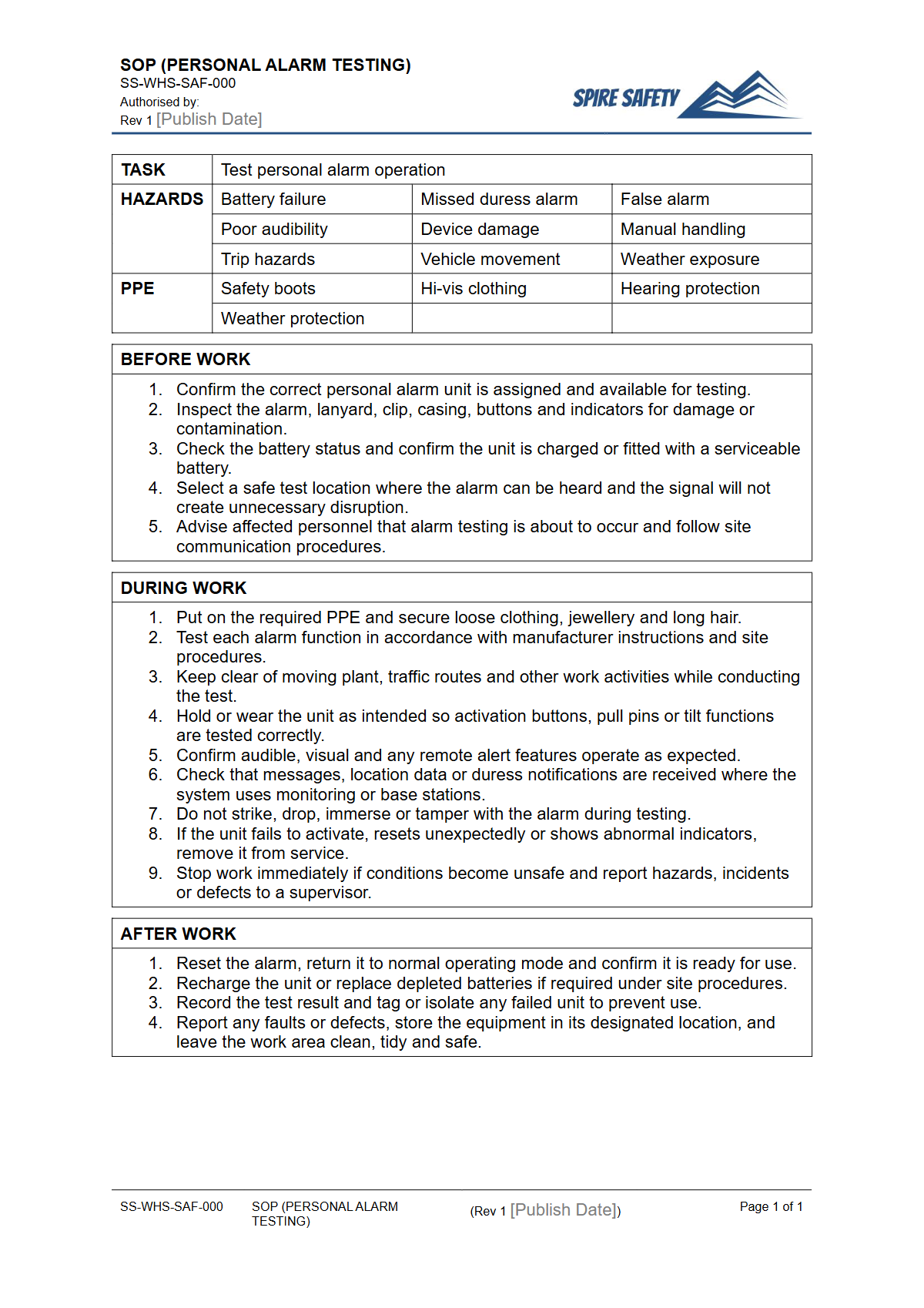
Download our free Safe Operating Procedure for Personal Alarm Testing. This customisable template helps you establish clear, step-by-step safety instructions.
Free Safe Operating Procedure (Personal Alarm Testing) Template
DOCX • 126 KB + PDF
Updated Oct 2026
No signup required
Purpose of the Free Safe Operating Procedure (Personal Alarm Testing) Template
Personal alarms are a critical control measure for protecting workers in remote or isolated environments, or those who face the risk of sudden medical emergencies or workplace violence. However, a device is only effective if it functions correctly when needed.
This Free Safe Operating Procedure (Personal Alarm Testing) Template provides a structured framework for documenting and standardising the process for regularly testing these devices. A formal SOP ensures that tests are conducted consistently, records are maintained, and any faults are identified and rectified promptly.
Implementing robust procedures like this is a fundamental part of a comprehensive WHS management system, demonstrating a commitment to worker safety and due diligence.
Video walkthrough
How to use the Free Safe Operating Procedure (Personal Alarm Testing) Template
This template is designed as a starting point. To use it effectively, download the DOCX file and adapt it to the specific requirements of your workplace.
Your procedure should reflect the exact make and model of the personal alarms in use, your organisation's emergency response plan, and the personnel involved.
Customisation Steps:
- Review and Edit: Read through the entire document. Identify sections that need to be changed to match your specific alarm features (e.g., GPS tracking, fall detection, 'man-down' functions) and testing protocols.
- Specify Roles: Clearly define who is responsible for performing the test, who receives the test alert, and who is responsible for maintenance and record-keeping.
- Integrate Emergency Contacts: Ensure the procedure lists the correct monitoring centre or internal contact numbers to be used during a scheduled test.
- Train Your Team: Once finalised, the SOP must be communicated to all relevant workers. Training should cover not only how to test the device but also how to operate it in a real emergency.
Important: This is a template and not a complete document. We provide this as a starting point.
You must customise this document with your own information, including site-specific details, alarm models, and company procedures. Regular WHS compliance auditing can help verify that your customised procedures are being followed correctly in practice.
When to Conduct Personal Alarm Testing
A personal alarm testing schedule should be established based on a risk assessment and the manufacturer's recommendations. This SOP should be used to guide testing activities at regular intervals, which typically include:
- Pre-start Checks: A quick function test (e.g., checking battery life, status lights) before a worker begins a shift in a remote or isolated area.
- Weekly or Monthly Functional Tests: A complete test of the alarm's functionality, including triggering an alert and confirming it is received by the designated monitoring party. This ensures the entire system, not just the device, is working.
- Post-Maintenance or Repair: A full functional test is essential after any device has been serviced or repaired to ensure it is back in working order.
- After a System Update: If the monitoring software or communications network is updated, all associated devices should be tested.
For workers operating equipment alone, such as those covered by our FREE Telehandler SOP Template, these tests provide critical assurance that help can be summoned if an incident occurs.
Who Should Use This Safe Operating Procedure
This SOP is intended for use by several key roles within an organisation to ensure a cohesive and effective testing program:
- Workers: Individuals assigned personal alarms, particularly lone or remote workers, should use the procedure to conduct pre-start and regular functional tests on their own devices.
- Supervisors and Managers: Responsible for ensuring their team members are trained on and adhere to the testing procedure. They may also be involved in verifying that tests are logged correctly.
- WHS/Safety Officers: Responsible for developing, implementing, and reviewing the SOP. They oversee the entire personal alarm program, including record-keeping, maintenance scheduling, and incident review.
- Maintenance Personnel: Use the SOP to confirm functionality after performing any repairs or battery replacements on a device.
Standardising procedures is crucial across all high-risk tasks, whether it involves emergency equipment or complex machinery like that detailed in our FREE Trencher SOP Template.
By clearly defining the steps for testing, you minimise the chance of equipment failure during a real emergency. For more procedural documents and safety checklists, feel free to browse our complete free WHS resources library for tools that can support your safety management efforts.
Common mistakes
Common mistakes to avoid
- Testing only the device button without confirming the alert was received by the monitoring station or supervisor.
- Using a generic procedure that doesn't account for the specific features and testing requirements of the alarm model.
- Failing to keep accurate and consistent records of all tests, making it difficult to prove due diligence or track faulty devices.
- Forgetting to test the alarm's location services (GPS) to ensure it reports an accurate position.
Legal references
Legal considerations
The following legal requirements may be relevant to this type of work.
- Work Health and Safety Act (Harmonised) — Provides the primary duties for protecting workers and other people from work health and safety risks.
- Work Health and Safety Regulations (Harmonised) — Sets out requirements supporting the management of workplace hazards and risks.
The following codes may be relevant to this type of work.
- Managing WHS Risks Code of Practice — Provides practical guidance on identifying hazards, assessing risks and applying effective controls.
- Work Health and Safety Consultation, Cooperation and Coordination Code of Practice — Provides practical guidance on consulting workers and coordinating with other duty holders.
- Managing the Work Environment and Facilities Code of Practice — Provides practical guidance on safe work environments, workplace facilities and related controls.
Did you know
Lone Worker Safety
In Australia, a significant number of serious workers' compensation claims are attributed to falls, trips, and slips. For lone workers, a functioning personal alarm with fall detection can drastically reduce response times and improve outcomes.
The 'Man-Down' Feature
Many modern personal alarms include an accelerometer for a 'man-down' function. It automatically triggers an alert if the device detects a sudden impact followed by a period of motionlessness, protecting workers who may be incapacitated and unable to press the button.
FAQ
Frequently asked questions
01How often should personal duress alarms be tested?
02What should be included in a personal alarm test record?
03Is this SOP template suitable for all types of personal alarms?
04Who is responsible for ensuring personal alarm tests are conducted?
Share this resource
Free Safe Operating Procedure (Personal Alarm Testing) Template
Browse Categories
How To Use It
- 1Download and open in Word or PDF.
- 2Replace the placeholders with your business details.
- 3Get it reviewed by a WHS specialist before rollout.
Need it customised?
Our WHS consultants can adapt this template to your site, run a gap analysis, or audit what you already have in place.
Book a Free Consultation WHS consulting servicesor call 1300 156 382
Related templates
- Free Safe Operating Procedure (Personnel Hoist) Template
- Free Safe Operating Procedure (Pesticide Mixing) Template
- Free Safe Operating Procedure (Pet Bedding Cleaning) Template
- Free Safe Operating Procedure (Pet Cage Cleaning) Template
- Free Safe Operating Procedure (Pet Food Storage) Template
- Free Safe Operating Procedure (Pet Grooming Area Clean) Template