
Free Safe Operating Procedure (Pet Grooming Area Clean) Template
Document the cleaning process for your pet grooming area with our structured procedure. Download this free SOP template to help manage hygiene and chemical risks.
Free Safe Operating Procedure (Pet Grooming Area Clean) Template
DOCX • 126 KB + PDF
Updated Oct 2026
No signup required
Purpose of the Free Safe Operating Procedure (Pet Grooming Area Clean) Template
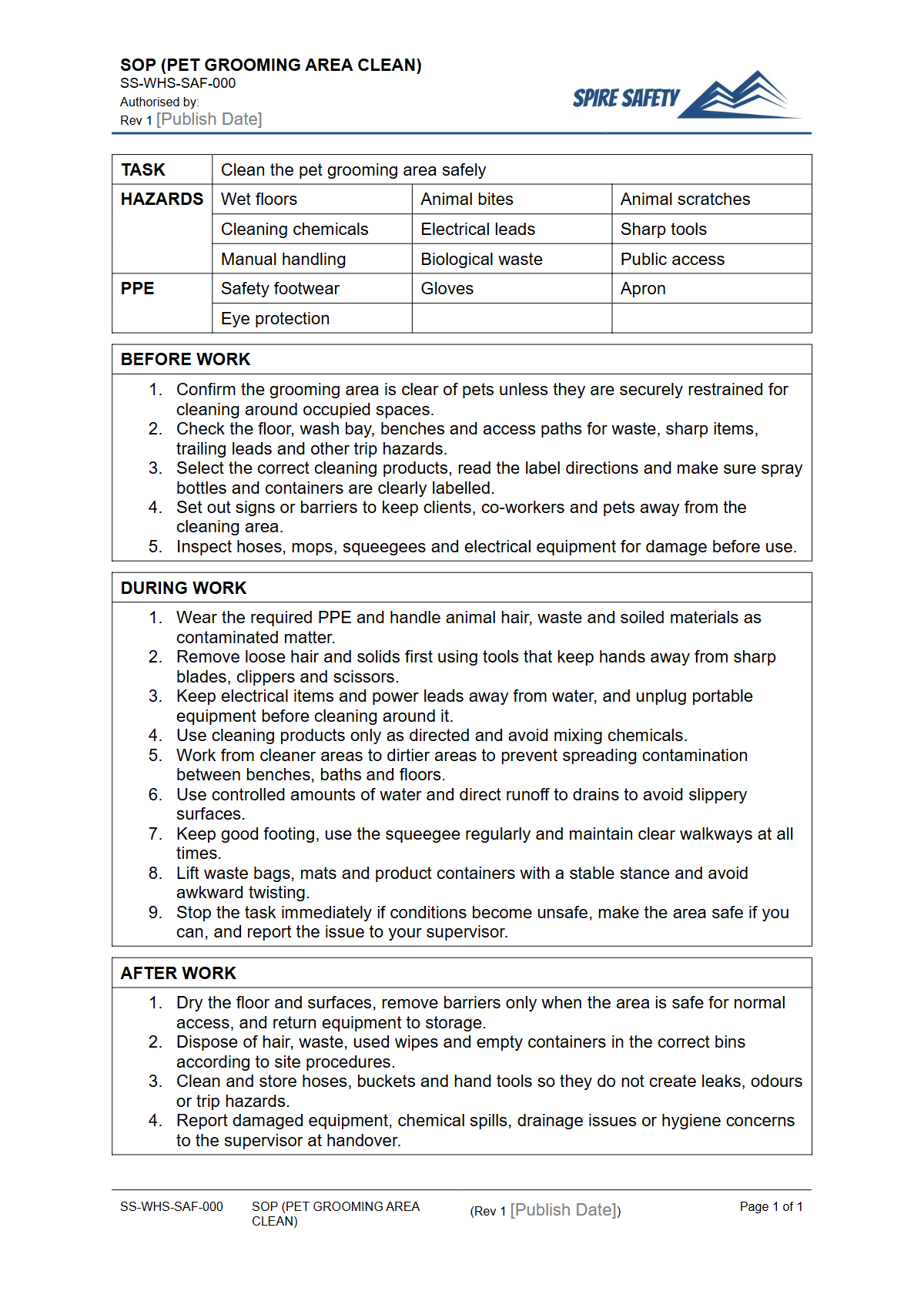
Maintaining a clean and hygienic pet grooming area is essential for the health and safety of both animals and staff. This Free Safe Operating Procedure (Pet Grooming Area Clean) Template provides a structured framework for documenting the specific steps, hazards, and controls associated with your cleaning tasks.
A well-defined SOP helps prevent slips and falls on wet floors, manage exposure to cleaning chemicals, control biological hazards like fur and dander, and ensures a consistent standard of hygiene is maintained across all shifts and staff members.
Using a standardised procedure is a fundamental part of workplace safety. Integrating this SOP into a broader safety framework is a key step towards building robust WHS management systems that protect your workers and business.
It serves as a reliable foundation for staff training, inductions, and performance monitoring, formalising your commitment to a safe work environment.
Video walkthrough
How to use the Free Safe Operating Procedure (Pet Grooming Area Clean) Template
To effectively use the Free Safe Operating Procedure (Pet Grooming Area Clean) Template, you should treat it as a master document to be adapted for your specific salon environment. The template is designed to guide you through the process of creating a comprehensive and site-specific procedure.
Important: This is a template only. You must customise it to reflect the unique cleaning agents, equipment, layout, and risks present in your workplace.
We cannot guarantee its suitability for your specific circumstances without a thorough review.
Follow these steps to implement the SOP:
- Download the DOCX file and save it as your business's master document.
- Conduct a risk assessment for the cleaning process. Identify hazards such as specific chemicals, electrical equipment used near water, manual handling risks (lifting buckets), and potential for wet, slippery floors.
- Customise each section of the template. Detail the required PPE (e.g., nitrile gloves, safety glasses), the names of cleaning agents and their correct dilution rates, and step-by-step instructions for the entire process, from preparation and pre-cleaning to disinfecting and final waste disposal.
- Include emergency procedures for chemical spills, accidental exposure, or slips.
- Consult with your staff. The workers who perform the task have valuable insights and their feedback is crucial for creating a practical and effective procedure.
- Once finalised, have the SOP approved by management. Ensure it is easily accessible to all relevant employees during their work shifts.
- Train all staff on the finalised SOP to ensure they understand every step and the reasons behind it.
If your grooming facility uses compressed air for drying pets or cleaning equipment, you should also document the procedures for its safe use with our free Air Compressor SOP.
When to use the Safe Operating Procedure
This Safe Operating Procedure should be integrated into the daily and periodic routines of the pet grooming salon. It is not a document to be filed away but a live tool used to guide work practices.
Use this SOP for:
- Daily Cleaning: As a checklist for end-of-day cleaning to ensure all stations, floors, and tools are properly sanitised.
- Periodic Deep Cleaning: To guide less frequent but more intensive cleaning tasks, such as descaling bathing tubs or cleaning ventilation filters.
- Staff Training and Induction: As a core training document for new employees to teach them the correct and safe way to perform cleaning duties from day one.
- Refresher Training: For existing staff, especially when new chemicals or equipment are introduced.
- Incident Investigations: As a reference point to determine if procedural deviations contributed to an incident or near miss.
Similar to how a commercial kitchen requires a documented process for equipment cleaning, such as a safe operating procedure for a deep fryer, pet grooming areas need formalised hygiene protocols to manage their unique risks.
Who should use it
Different roles within a pet grooming business will interact with this SOP in different ways, all contributing to a safer workplace.
- Pet Groomers and Salon Assistants: As the primary users, they must follow the step-by-step instructions during every cleaning task. They are responsible for understanding the hazards and applying the specified control measures, such as wearing the correct PPE.
- Business Owners and Managers: They are responsible for the development, implementation, and review of the SOP. Their role is to ensure the procedure is accurate, that staff are adequately trained, and that all necessary resources (like PPE and correct cleaning agents) are provided.
- Work Health and Safety (WHS) Representatives: They can use the SOP as a benchmark during workplace inspections and consultations to ensure safety practices are being followed correctly.
For small business owners needing guidance on developing these and other safety documents, engaging professional WHS consulting services can provide clarity and direction.
Broader Safety Considerations
This cleaning SOP is one component of your overall safety management. It should work in conjunction with other safety practices.
Ensure you have readily accessible Safety Data Sheets (SDS) for all cleaning chemicals and that staff understand how to read them. Address manual handling risks associated with lifting water containers, moving equipment, and adopting awkward postures during cleaning.
Furthermore, manage electrical risks by ensuring equipment is tested and tagged and that procedures are in place to prevent water from contacting power outlets. If your business undertakes minor repairs or fit-out modifications, it's also wise to have procedures for common tools, and you can find a free Circular Saw SOP Template in our library.
You can explore a wide range of other document templates in our free WHS resources library to support your safety management system.
Common mistakes
Common mistakes to avoid
- Using a generic template without customising it for specific chemicals and equipment.
- Failing to train all relevant staff on the finalised procedure and its importance.
- Not providing or enforcing the use of the Personal Protective Equipment (PPE) specified in the SOP.
- Forgetting to review and update the SOP after changing cleaning products or processes.
Legal references
Legal considerations
The following legal requirements may be relevant to this type of work.
- Work Health and Safety Act (Harmonised) — Provides the primary duties for protecting workers and other people from work health and safety risks.
- Work Health and Safety Regulations (Harmonised) — Sets out requirements supporting the management of workplace hazards and risks.
The following codes may be relevant to this type of work.
- Managing WHS Risks Code of Practice — Provides practical guidance on identifying hazards, assessing risks and applying effective controls.
- Work Health and Safety Consultation, Cooperation and Coordination Code of Practice — Provides practical guidance on consulting workers and coordinating with other duty holders.
- Managing the Work Environment and Facilities Code of Practice — Provides practical guidance on safe work environments, workplace facilities and related controls.
Did you know
Chemical Safety Data
Under model WHS laws, you must have a Safety Data Sheet (SDS) readily accessible for every hazardous chemical used in your workplace, including industrial-strength cleaning agents.
Zoonotic Disease Risk
Proper cleaning and disinfection protocols are a primary control measure against zoonotic diseases—illnesses that can be transmitted from animals to humans in the salon environment.
FAQ
Frequently asked questions
01What is a Safe Operating Procedure (SOP) for cleaning a pet grooming area?
02Why do I need an SOP for something as simple as cleaning?
03What should be included in a Pet Grooming Area Clean SOP?
04How often should I review my cleaning SOP?
Share this resource
Free Safe Operating Procedure (Pet Grooming Area Clean) Template
Browse Categories
How To Use It
- 1Download and open in Word or PDF.
- 2Replace the placeholders with your business details.
- 3Get it reviewed by a WHS specialist before rollout.
Need it customised?
Our WHS consultants can adapt this template to your site, run a gap analysis, or audit what you already have in place.
Book a Free Consultation WHS consulting servicesor call 1300 156 382
Related templates
- Free Safe Operating Procedure (Pet Waste Cleanup) Template
- Free Safe Operating Procedure (Petrol Decanting) Template
- Free Safe Operating Procedure (pH Meter) Template
- Free Safe Operating Procedure (Phase Rotation Test) Template
- Free Safe Operating Procedure (Pick and Pack) Template
- Free Safe Operating Procedure (Pick and Place Robot) Template