
Free Safe Operating Procedure (Petrol Decanting) Template
Handling petrol requires strict safety protocols to prevent fires, explosions, and health hazards. Download our customisable template to get started.
Free Safe Operating Procedure (Petrol Decanting) Template
DOCX • 126 KB + PDF
Updated Oct 2026
No signup required
Purpose of the Free Safe Operating Procedure (Petrol Decanting) Template
Decanting petrol is a high-risk activity that requires strict controls to prevent fire, explosion, vapour inhalation, and skin contact. This Free Safe Operating Procedure (Petrol Decanting) Template provides a structured starting point for organisations to document the step-by-step process for safely transferring petrol from one container to another.
It helps businesses fulfil their duty of care by identifying hazards, assessing risks, and implementing control measures. Using a clear and consistent SOP ensures workers understand the required safety precautions, personal protective equipment (PPE), and emergency response actions, significantly reducing the likelihood of a serious incident.
Video walkthrough
How to use the Free Safe Operating Procedure (Petrol Decanting) Template
This template is designed to be a comprehensive foundation for your site-specific procedure. To use it effectively, download the DOCX file and adapt it to the unique context of your workplace.
This involves identifying the specific equipment used, the storage locations, and the environmental conditions at your site. Consultation with workers who perform the task is essential for creating a practical and effective document.
Remember that this is a template, not a finished document. We are not WHS consultants for your business and this template must be customised to your specific workplace, equipment, and processes. Its use does not supports your compliance efforts. A robust safety framework often integrates individual SOPs into broader WHS management systems.
When to use a Safe Operating Procedure for Petrol Decanting
An SOP for petrol decanting should be developed and implemented before any worker is permitted to perform the task. It is a critical training tool for new employees and a vital refresher for experienced staff.
The SOP should be readily accessible at or near the location where decanting takes place. It must be reviewed regularly—typically annually, or whenever there is a change in equipment, process, or legislation.
It should also be reviewed after any incident or near-miss to incorporate lessons learned and prevent recurrence. This proactive approach to documentation is a cornerstone of effective workplace safety, similar to the structured processes outlined in our Air Compressor SOP (Safe Operating Procedure) Template.
Who should use this SOP
This Safe Operating Procedure is intended for any person conducting a business or undertaking (PCBU) where petrol is handled. This includes supervisors, managers, and WHS personnel responsible for developing and implementing safety systems.
Critically, it is for the workers who actually perform the decanting task. They must be trained on the final, customised SOP and demonstrate competency before working unsupervised.
This process ensures everyone involved understands their responsibilities, from preparation and execution to clean-up and emergency response. In complex industrial settings, this SOP may be one of many critical documents, alongside procedures for heavy equipment like our Telehandler SOP Template.
Key Steps in Safe Petrol Decanting
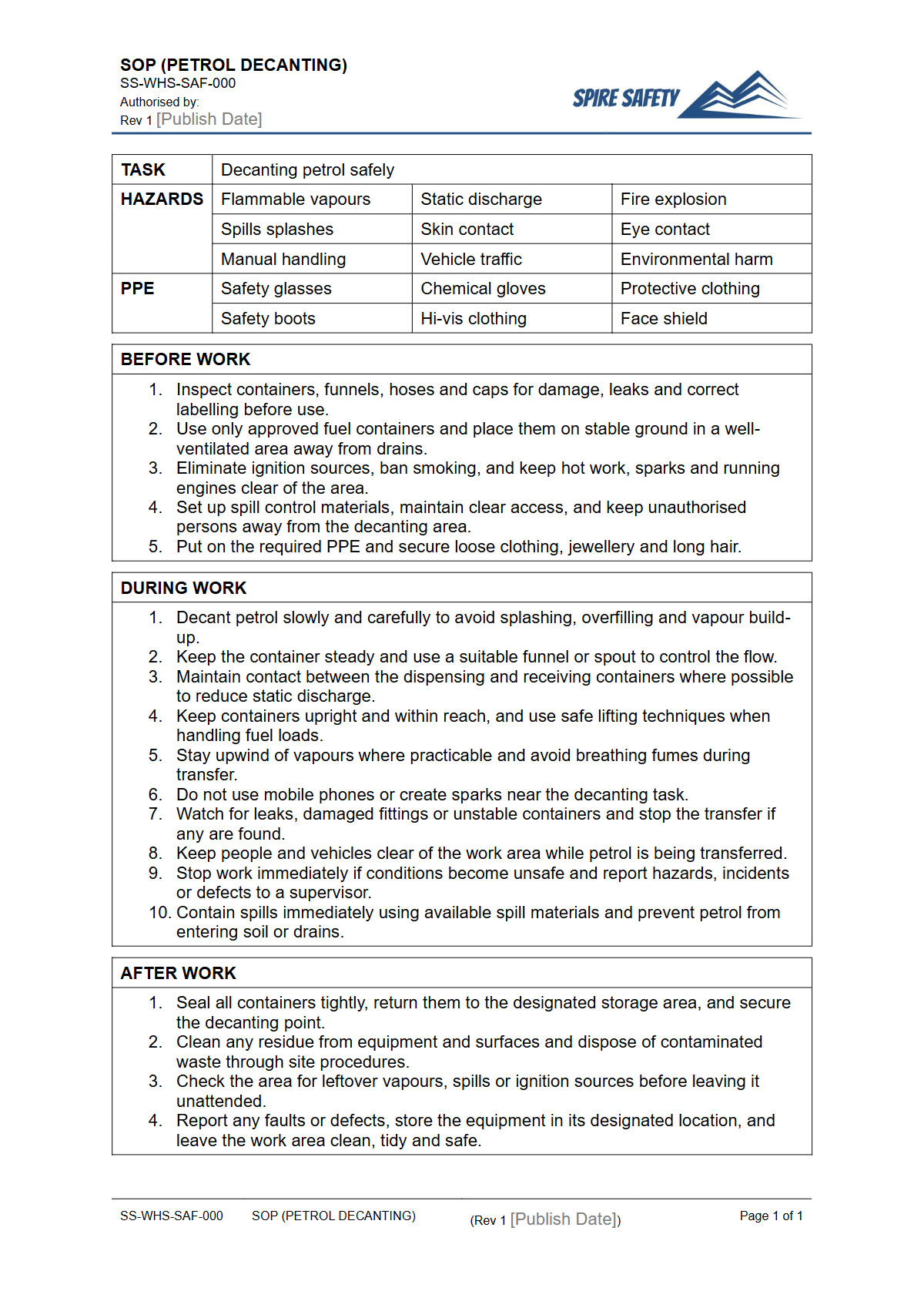
A comprehensive SOP for petrol decanting will typically cover the following stages, which are outlined in our downloadable template:
- Preparation: Ensuring the area is well-ventilated, free from ignition sources (like static electricity, open flames, or sparks), and that the correct, approved containers are being used. This also includes gathering all necessary PPE.
- Decanting Process: The step-by-step method for transferring the fuel, including techniques for bonding and grounding containers to prevent static discharge, using a funnel, and avoiding overfilling.
- Spill Response: Procedures for containing and cleaning up small spills immediately using appropriate absorbent materials. For more significant incidents, your procedure should align with your site's overall emergency plan. Having a clear process is a key part of any good safety document, including our FREE Circular Saw SOP (Safe Operating Procedure) Template.
- Storage and Waste Disposal: Guidelines for correctly sealing and storing petrol containers and the proper disposal of any contaminated materials, such as rags or absorbents, in accordance with local environmental regulations.
Regular reviews and updates are crucial to keeping your SOPs effective. A periodic WHS compliance auditing process can help identify gaps in your procedures and ensure they align with current best practices and legislative requirements.
Integrating SOPs into Your Safety Culture
A document alone does not create a safe workplace. This SOP template is a tool that supports a broader safety culture.
It must be supported by visible management commitment, adequate resources (like correct PPE and spill kits), and ongoing worker training and consultation. By embedding these procedures into daily operations, organisations demonstrate a genuine commitment to health and safety.
For tailored support in developing your safety framework, consider engaging professional general WHS consulting services.
This template is one of many documents available to help improve your workplace safety. For more downloadable procedures and checklists, browse our complete free WHS resources library.
Common mistakes
Common mistakes to avoid
- Using unapproved or damaged containers (e.g., glass jars or milk bottles) that can break or build up static.
- Decanting in poorly ventilated or enclosed spaces, allowing flammable vapours to accumulate.
- Failing to eliminate all potential ignition sources, including mobile phones, pilot lights, or static electricity.
- Not having a suitable fire extinguisher (e.g., a dry chemical or CO2 type) and a spill kit immediately available.
Legal references
Legal considerations
The following legal requirements may be relevant to this type of work.
- Work Health and Safety Act (Harmonised) — Provides the primary duties for protecting workers and other people from work health and safety risks.
- Work Health and Safety Regulations (Harmonised) — Sets out requirements supporting the management of workplace hazards and risks.
The following codes may be relevant to this type of work.
- Managing WHS Risks Code of Practice — Provides practical guidance on identifying hazards, assessing risks and applying effective controls.
- Work Health and Safety Consultation, Cooperation and Coordination Code of Practice — Provides practical guidance on consulting workers and coordinating with other duty holders.
- Managing the Work Environment and Facilities Code of Practice — Provides practical guidance on safe work environments, workplace facilities and related controls.
Did you know
Static Ignition
A static spark as small as 0.2 millijoules—less than what you feel touching a doorknob—can ignite petrol vapours. This is why bonding and grounding containers during decanting is critical.
Vapour Density
Petrol vapour is three to four times heavier than air. It can accumulate in low-lying areas like pits or drains, creating a hidden and highly flammable atmosphere far from the source.
FAQ
Frequently asked questions
01What are the main hazards of decanting petrol?
02Is a Safe Operating Procedure for petrol decanting legally required in Australia?
03What PPE is needed for decanting petrol?
04How should petrol waste and spills be handled?
Share this resource
Free Safe Operating Procedure (Petrol Decanting) Template
Browse Categories
How To Use It
- 1Download and open in Word or PDF.
- 2Replace the placeholders with your business details.
- 3Get it reviewed by a WHS specialist before rollout.
Need it customised?
Our WHS consultants can adapt this template to your site, run a gap analysis, or audit what you already have in place.
Book a Free Consultation WHS consulting servicesor call 1300 156 382
Related templates
- Free Safe Operating Procedure (pH Meter) Template
- Free Safe Operating Procedure (Phase Rotation Test) Template
- Free Safe Operating Procedure (Pick and Pack) Template
- Free Safe Operating Procedure (Pick and Place Robot) Template
- Free Safe Operating Procedure (Picnic Area Cleaning) Template
- Free Safe Operating Procedure (Picnic Table Cleaning) Template