
Free Safe Operating Procedure (Picnic Table Cleaning) Template
Standardise your cleaning processes and manage risks with our free Safe Operating Procedure for picnic table cleaning.
Free Safe Operating Procedure (Picnic Table Cleaning) Template
DOCX • 126 KB + PDF
Updated Oct 2026
No signup required
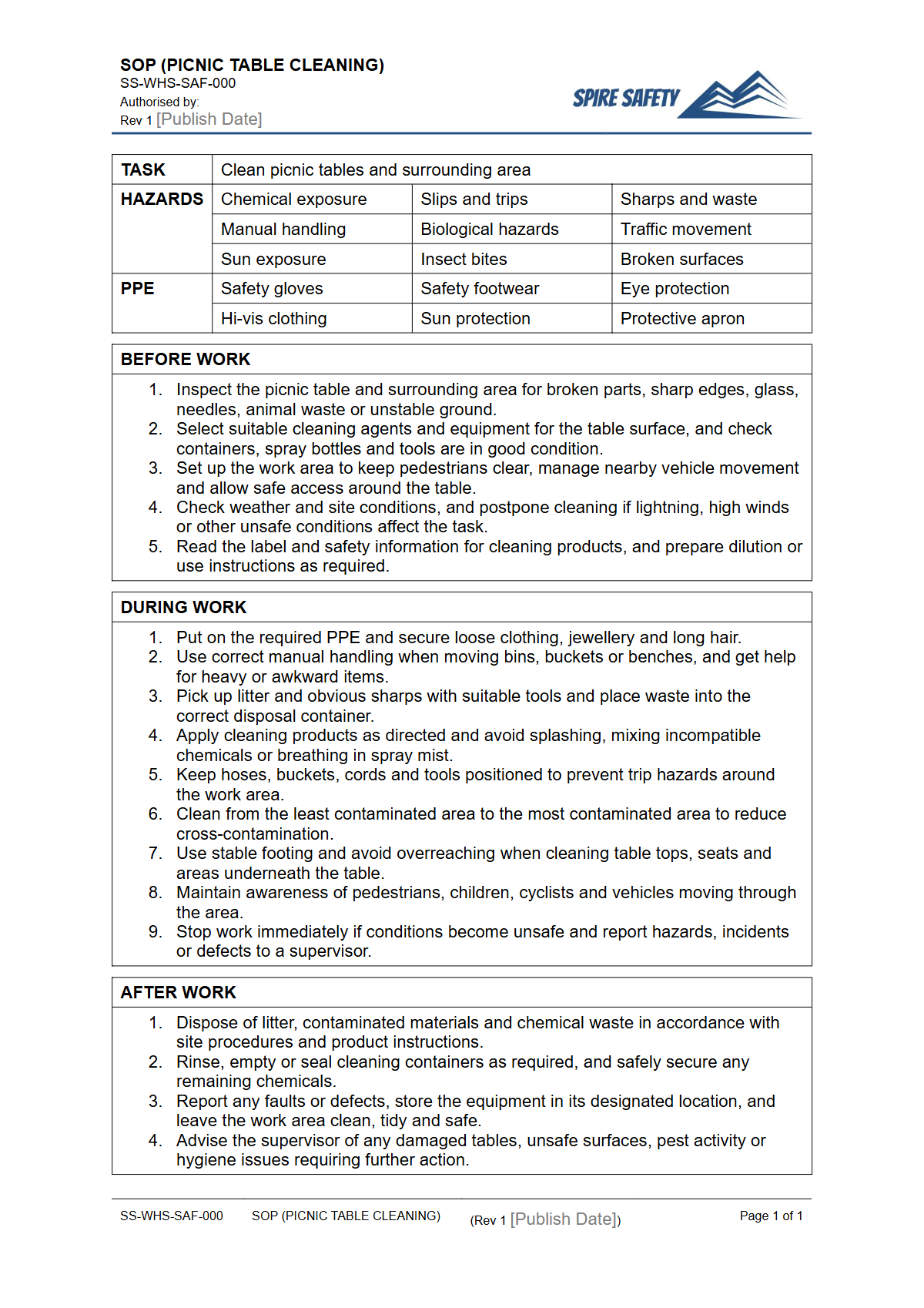
Purpose of the Free Safe Operating Procedure (Picnic Table Cleaning) Template
Effectively managing hygiene and safety in public or workplace amenities is crucial. This Free Safe Operating Procedure (Picnic Table Cleaning) Template provides a structured framework for ensuring picnic tables are cleaned safely and consistently.
The document helps you standardise the process, control hazards, and meet your work health and safety obligations. A formal procedure demonstrates a commitment to safety, minimising risks such as chemical exposure, manual handling injuries, and slip hazards.
Using a documented SOP for cleaning tasks is a fundamental part of good safety and hygiene practice, particularly in hospitality or public-facing environments. It ensures that every step, from preparing the cleaning solution to storing equipment, is performed correctly every time. This level of process control is just as important for cleaning as it is for food preparation, as demonstrated in our Safe Operating Procedure (Deep Fryer) template.
Key Hazards Addressed:
- Hazardous Chemicals: Incorrect handling, dilution, or storage of cleaning agents.
- Manual Handling: Lifting and moving heavy tables or benches, and repetitive motions during cleaning.
- Slips, Trips, and Falls: Wet surfaces during and after cleaning, and hazards from cleaning equipment.
- Ergonomics: Awkward postures while scrubbing or reaching across large tables.
- Biological Hazards: Contact with food waste, bodily fluids, or other contaminants.
Video walkthrough
How to use the Free Safe Operating Procedure (Picnic Table Cleaning) Template
This Safe Operating Procedure for picnic table cleaning is provided as a user-friendly template in both DOCX and PDF formats. Download the DOCX file to edit and tailor the content to your specific workplace, equipment, and chemicals.
The procedure should be developed in consultation with the workers who will be performing the task to ensure it is practical and reflects the realities of the job. It's a critical component of a broader safety framework.
Important: This document is a template and not a complete safety solution. You must customise it to reflect the specific hazards and control measures relevant to your site.
We have included common steps and hazards, but your own risk assessment should guide the final document. The effectiveness of this SOP relies on its correct implementation within your overall WHS management system.
When to use it
This SOP should be used every time a worker is required to clean picnic tables. The frequency of the task itself will depend on your operational needs—it could be daily, after each use, or following a specific event.
The procedure acts as a guide and a training tool, ensuring consistency and safety regardless of who performs the task. It should be readily accessible to staff in the work area.
The SOP itself should be reviewed regularly—at least annually, or whenever there is a change to the task, equipment, chemicals, or after an incident occurs.
Who should use it
This procedure is designed for any personnel responsible for cleaning and maintenance duties in environments with picnic tables. This includes cleaners, groundskeepers, maintenance staff, and hospitality workers in parks, council facilities, construction site break areas, schools, and event venues.
Supervisors and WHS managers should also use the document to train staff, induct new employees, and conduct workplace inspections or observations. It ensures that everyone, from management to the frontline worker, understands the established safe method for the task.
A well-trained workforce is a safe workforce. Ensuring staff are competent to perform all their required duties is a key responsibility. This might involve training them on various procedures, from cleaning tables to using specific site equipment covered by resources like a Free Air Compressor SOP.
For organisations looking to develop a suite of safety documents or require assistance in implementing them, professional guidance can be invaluable. Expert WHS consulting can help streamline your processes and ensure your safety systems are practical and effective.
This document is one of many tools available to help you build a safer workplace. You can explore a wide range of similar templates and checklists in our free WHS resources library to support your safety management efforts.
Common mistakes
Common mistakes to avoid
- Using a generic template without customising it for site-specific chemicals and equipment.
- Failing to make the Safety Data Sheet (SDS) for each cleaning chemical readily accessible to workers.
- Not providing practical training to workers on how to follow the SOP correctly.
- Forgetting to review and update the SOP after an incident or change in process.
Legal references
Legal considerations
The following legal requirements may be relevant to this type of work.
- Work Health and Safety Act (Harmonised) — Provides the primary duties for protecting workers and other people from work health and safety risks.
- Work Health and Safety Regulations (Harmonised) — Sets out requirements supporting the management of workplace hazards and risks.
The following codes may be relevant to this type of work.
- Managing WHS Risks Code of Practice — Provides practical guidance on identifying hazards, assessing risks and applying effective controls.
- Work Health and Safety Consultation, Cooperation and Coordination Code of Practice — Provides practical guidance on consulting workers and coordinating with other duty holders.
- Managing the Work Environment and Facilities Code of Practice — Provides practical guidance on safe work environments, workplace facilities and related controls.
Did you know
Slips and Trips
According to Safe Work Australia, slips, trips and falls are the second leading cause of serious workers' compensation claims, highlighting the importance of managing wet surfaces during cleaning.
FAQ
Frequently asked questions
01What hazards are involved in cleaning picnic tables?
02Does our business need an SOP for a simple task like cleaning?
03How often should we review our Safe Operating Procedures?
04What is the difference between an SOP and a SWMS?
Share this resource
Free Safe Operating Procedure (Picnic Table Cleaning) Template
Browse Categories
How To Use It
- 1Download and open in Word or PDF.
- 2Replace the placeholders with your business details.
- 3Get it reviewed by a WHS specialist before rollout.
Need it customised?
Our WHS consultants can adapt this template to your site, run a gap analysis, or audit what you already have in place.
Book a Free Consultation WHS consulting servicesor call 1300 156 382
Related templates
- Free Safe Operating Procedure (Pie Warmer) Template
- Free Safe Operating Procedure (Piezometer) Template
- Free Safe Operating Procedure (Pile Cropper) Template
- Free Safe Operating Procedure (Piling Hammer) Template
- Free Safe Operating Procedure (Pipe Bender) Template
- Free Safe Operating Procedure (Pipe Beveler) Template