
Free Safe Operating Procedure (Pipe Beveler) Template
Define safe work practices for operating a pipe beveler with our structured template. Download this free Safe Operating Procedure to get started today.
Free Safe Operating Procedure (Pipe Beveler) Template
DOCX • 126 KB + PDF
Updated Oct 2026
No signup required
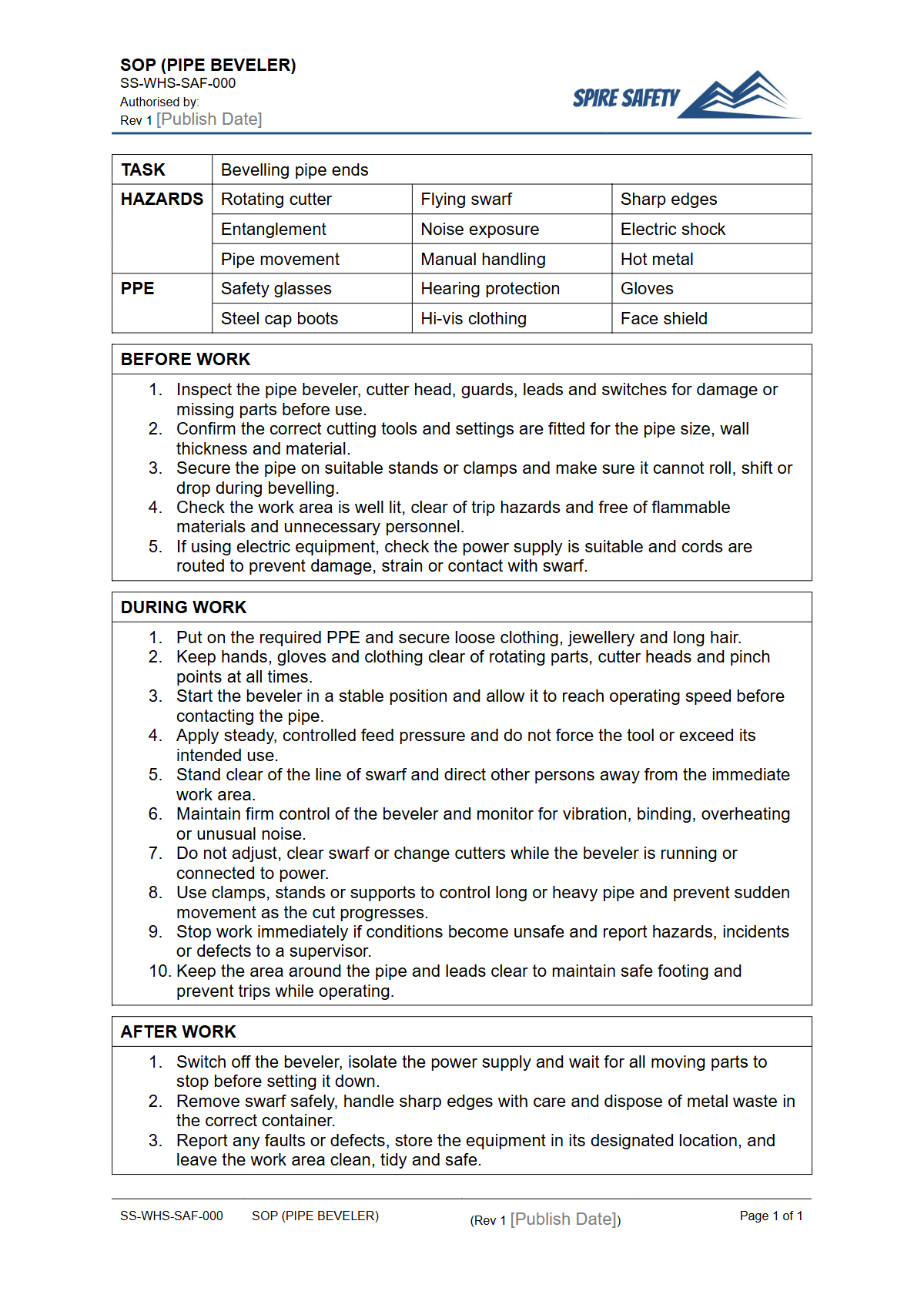
Purpose of the Free Safe Operating Procedure (Pipe Beveler) Template
This Free Safe Operating Procedure (Pipe Beveler) Template provides a structured framework for documenting the safe use of portable or stationary pipe beveling equipment in your workplace. An SOP is a fundamental administrative control that outlines a step-by-step process to perform a task safely, helping to minimise the risk of injury to personnel or damage to equipment.
Operating a pipe beveler introduces significant hazards, including entanglement with rotating parts, lacerations from sharp cutting bits, eye injuries from ejected metal shavings, burns from hot surfaces, and electrical or pneumatic energy risks.
Key Elements Covered in the Template
Our template is designed as a comprehensive starting point, guiding you to address critical safety aspects associated with pipe beveler operation. It includes sections for:
- Personal Protective Equipment (PPE): Defining the required PPE based on a risk assessment.
- Pre-Operational Checks: A checklist of inspections to perform before starting work, such as checking guards, cutting bits, and power cords.
- Step-by-Step Operating Procedure: A logical sequence for safely setting up the machine, securing the pipe, performing the bevel, and monitoring the operation.
- Shutdown and Cleaning: Instructions for powering down the equipment, isolating energy sources, and cleaning the work area.
- Emergency Procedures: Steps to take in case of an emergency, such as equipment malfunction or operator injury.
By formally documenting these steps, your organisation can ensure that all operators follow a consistent, pre-approved method. This formalisation is a key component of a proactive safety culture and is just as important for specialised tools like bevelers as it is for more common equipment, which is why we also provide resources like our circular saw SOP.
Video walkthrough
How to use the Free Safe Operating Procedure (Pipe Beveler) Template
This resource is available as a DOCX file, which is fully editable in Microsoft Word or other compatible programs, and a PDF for easy distribution and viewing. The purpose of the template is to provide a solid foundation, not a finished document.
It is crucial to remember that this template is a starting point. We have designed it to be customised to reflect the specific equipment, environment, and organisational procedures of your workplace.
To effectively adapt this template, you should consult with the workers and supervisors who operate the machinery daily. Their hands-on experience is invaluable for creating a practical and effective procedure.
Always cross-reference the manufacturer's operating manual for your specific model of pipe beveler, as it contains essential safety warnings and technical specifications. If your beveler is pneumatic, your procedures should also integrate with the safe use of its power source, as detailed in an air compressor SOP.
When to use it
A Safe Operating Procedure for a pipe beveler should be a living document integrated into your daily operations. It is used during the induction and training of new operators to ensure they learn the correct, safe method from the beginning.
It also serves as a critical reference tool for experienced workers, who can consult it before starting a non-routine task or as a regular refresher.
Furthermore, the SOP is a key piece of documentation during safety activities. It provides a benchmark for behavioural observations, workplace inspections, and formal WHS compliance auditing. In the unfortunate event of an incident or near-miss, the SOP serves as a reference point for the investigation to determine if procedures were followed and whether they need to be improved.
Who should use it
This SOP is relevant to several roles within an organisation. Primarily, it is for the operators of the pipe beveler, who must understand and follow the procedure to ensure their own safety and the safety of those around them.
Supervisors and team leaders are responsible for enforcing the SOP, ensuring workers are trained on it, and confirming it is being followed correctly in the workshop or on-site.
WHS managers and safety officers will use this SOP as part of the broader safety framework. They are often responsible for developing, reviewing, and updating procedures in consultation with the workforce.
The principles of defining safe procedures for specific plant items apply across all equipment, and this document can function alongside others like a Telehandler SOP template to build a comprehensive library of task-specific controls. Ensuring these individual procedures are integrated is a core part of implementing robust WHS management systems.
Explore our complete free WHS resources library for more templates and guides to support your safety and compliance efforts.
Common mistakes
Common mistakes to avoid
- Failing to inspect the cutting bits for wear, chips, or damage before use.
- Using the tool without securely clamping the pipe, leading to vibration, poor cut quality, or kickback.
- Neglecting to wear appropriate PPE, especially high-impact eye and face protection from flying metal shavings.
- Operating in an area with poor ventilation, allowing fumes from pipe coatings or cutting fluids to accumulate.
Legal references
Legal considerations
The following legal requirements may be relevant to this type of work.
- Work Health and Safety Act (Harmonised) — Provides the primary duties for protecting workers and other people from work health and safety risks.
- Work Health and Safety Regulations (Harmonised) — Sets out requirements supporting the management of workplace hazards and risks.
The following codes may be relevant to this type of work.
- Managing WHS Risks Code of Practice — Provides practical guidance on identifying hazards, assessing risks and applying effective controls.
- Work Health and Safety Consultation, Cooperation and Coordination Code of Practice — Provides practical guidance on consulting workers and coordinating with other duty holders.
- Managing the Work Environment and Facilities Code of Practice — Provides practical guidance on safe work environments, workplace facilities and related controls.
Did you know
Beveling Basics
Pipe beveling creates a specific angled surface on the end of a pipe. This is essential for achieving a strong, full-penetration weld when joining two pipes together, a critical process in industries like oil and gas, construction, and manufacturing.
Friction and Heat
The process can generate significant heat and sparks, classifying it as 'hot work' in many WHS frameworks. This requires specific controls like fire watches and clearing flammable materials, especially when working on pipes that have contained hydrocarbons.
FAQ
Frequently asked questions
01What are the main hazards of using a pipe beveler?
02Is specific training required to operate a pipe beveler?
03Can this SOP template be used for any type of pipe beveler?
04What PPE is generally required for pipe beveling?
Share this resource
Free Safe Operating Procedure (Pipe Beveler) Template
Browse Categories
How To Use It
- 1Download and open in Word or PDF.
- 2Replace the placeholders with your business details.
- 3Get it reviewed by a WHS specialist before rollout.
Need it customised?
Our WHS consultants can adapt this template to your site, run a gap analysis, or audit what you already have in place.
Book a Free Consultation WHS consulting servicesor call 1300 156 382
Related templates
- Free Safe Operating Procedure (Pipe Camera) Template
- Free Safe Operating Procedure (Pipe Cutter) Template
- Free Safe Operating Procedure (Pipe Expander) Template
- Free Safe Operating Procedure (Pipe Facing Machine) Template
- Free Safe Operating Procedure (Pipe Freezer) Template
- Free Safe Operating Procedure (Pipe Groover) Template