
Free Safe Operating Procedure (Pipe Expander) Template
Download our free Safe Operating Procedure (Pipe Expander) template to formalise safe work practices. Get your customisable DOCX and PDF template now.
Free Safe Operating Procedure (Pipe Expander) Template
DOCX • 126 KB + PDF
Updated Oct 2026
No signup required
Purpose of the Free Safe Operating Procedure (Pipe Expander) Template
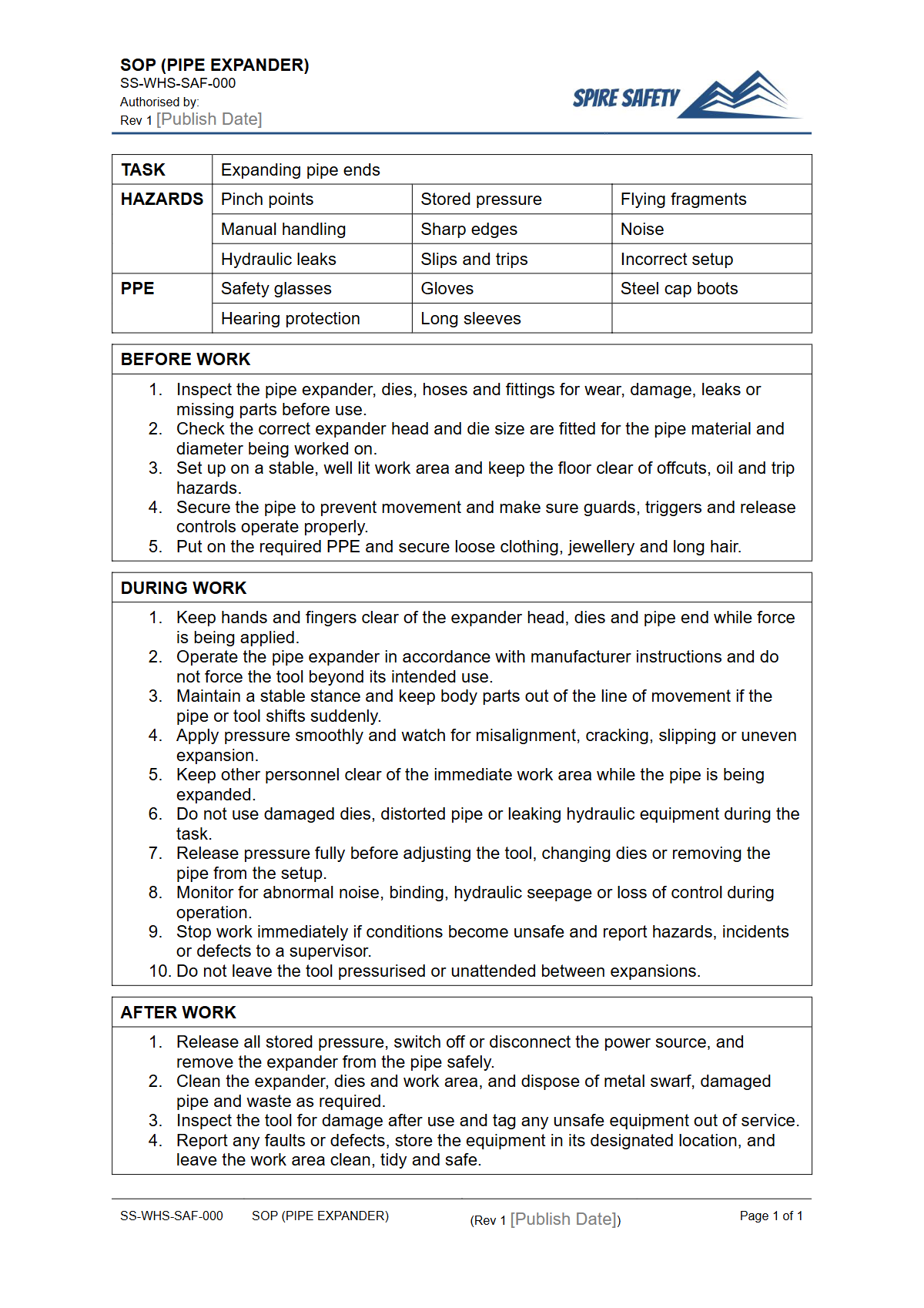
Operating a pipe expander, whether hydraulic or pneumatic, involves significant force and potential hazards. This free Safe Operating Procedure (Pipe Expander) template provides a structured starting point for documenting the key steps, safety controls, and responsibilities for using this equipment in your workplace.
A well-drafted SOP is a critical tool for ensuring tasks are performed consistently and safely, reducing the risk of injuries from high-pressure fluid injection, flying debris, or mechanical failure. By formalising your process, you help meet your primary duty of care under WHS legislation and build a stronger safety culture.
This template is designed to be adapted to your specific equipment and operational context. It guides you through outlining pre-start checks, operational steps, shutdown procedures, and required personal protective equipment (PPE).
Implementing clear SOPs is a fundamental part of robust WHS management systems, providing clarity for workers and a basis for effective training and supervision.
Video walkthrough
How to use the Free Safe Operating Procedure (Pipe Expander) Template
Our Safe Operating Procedure (Pipe Expander) template is available for immediate download in both DOCX and PDF formats. The DOCX version is fully editable, allowing you to tailor the content to match your organisation's specific pipe expander models, work environment, and existing safety protocols.
The PDF version serves as a handy, non-editable reference for quick viewing.
Important: This is a template, not a finished document. To be effective and support your safety obligations, you must customise it with details specific to your workplace.
We recommend a competent person, such as a supervisor or WHS advisor, works with experienced operators to review, edit, and approve the final document before it is implemented. This collaborative process ensures the SOP is practical, accurate, and reflects the real-world risks of the task.
When to use it
A Safe Operating Procedure for a pipe expander should be used as a central reference document in several key situations. It is essential during the induction and training of new operators, providing a clear, step-by-step guide to safe operation.
Experienced workers should use it as a refresher and a baseline for correct procedure, especially for non-routine tasks or when using unfamiliar models. The SOP also serves as a checklist for pre-operational inspections and a standard against which workplace activities can be supervised and audited.
In many workplaces, operating equipment like a pipe expander without a formalised SOP is a significant gap in risk management.
Similar principles of documented procedures apply to other workshop equipment. For instance, our FREE Circular Saw SOP Template provides a comparable framework for managing the risks of handheld power tools, reinforcing the importance of consistent safety documentation across all plant and equipment.
Who should use it
This SOP template is designed for use by multiple roles within an organisation. Primarily, operators of pipe expanders will use the finalised document as their guide for safe work.
Supervisors and team leaders are responsible for ensuring operators are trained on the SOP and adhere to its procedures during day-to-day work. WHS managers and safety officers will use this template as a tool to standardise safety documentation across the business, often as part of broader safety initiatives.
A comprehensive SOP can also be invaluable during a WHS compliance auditing process, demonstrating how risks associated with specific plant have been systematically addressed.
The process of creating and reviewing SOPs is a collaborative effort. By involving the people who use the equipment, you ensure the procedure is practical and relevant.
This same collaborative approach applies to documenting procedures for other machinery, such as the high-pressure systems detailed in our FREE Injection Molding Machine SOP Template, which shares similar risk management principles.
Many pipe expanders are powered by compressed air, which carries its own set of hazards including noise, air-blast injuries, and hose whip. It is crucial to manage these risks in conjunction with the tool itself.
Our Free Air Compressor SOP (Safe Operating Procedure) Template can help you document safe practices for the power source, complementing the pipe expander procedure.
For a broader range of safety documents covering various plant and equipment, feel free to browse our complete free WHS resources library. Each template is developed to provide a solid foundation for your workplace-specific safety documentation.
Common mistakes
Common mistakes to avoid
- Using the incorrect size or type of expander head for the pipe diameter and material.
- Failing to inspect hydraulic or pneumatic hoses and fittings for wear, cracks, or leaks before use.
- Neglecting to wear appropriate PPE, particularly safety glasses or a face shield.
- Not fully depressurising the system before performing maintenance, adjustments, or changing heads.
Legal references
Legal considerations
The following legal requirements may be relevant to this type of work.
- Work Health and Safety Act (Harmonised) — Provides the primary duties for protecting workers and other people from work health and safety risks.
- Work Health and Safety Regulations (Harmonised) — Sets out requirements supporting the management of workplace hazards and risks.
The following codes may be relevant to this type of work.
- Managing WHS Risks Code of Practice — Provides practical guidance on identifying hazards, assessing risks and applying effective controls.
- Work Health and Safety Consultation, Cooperation and Coordination Code of Practice — Provides practical guidance on consulting workers and coordinating with other duty holders.
- Managing the Work Environment and Facilities Code of Practice — Provides practical guidance on safe work environments, workplace facilities and related controls.
Did you know
Hydraulic Injection Injury
A high-pressure fluid injection injury from a pinhole leak in a hydraulic line can be catastrophic. The initial wound may appear minor, but the injected fluid can cause severe tissue damage, gangrene, and may require amputation if not treated immediately by a specialist.
Noise Exposure
Pneumatic tools, including some pipe expanders, can operate at noise levels exceeding 85 decibels (dB), the exposure standard for noise in Australian workplaces. Consistent exposure without hearing protection can lead to permanent hearing loss.
FAQ
Frequently asked questions
01What are the main hazards associated with using a pipe expander?
02Does a Safe Operating Procedure replace the manufacturer's instruction manual?
03How often should an SOP for a pipe expander be reviewed?
04Is competency training required in addition to having an SOP?
Share this resource
Free Safe Operating Procedure (Pipe Expander) Template
Browse Categories
How To Use It
- 1Download and open in Word or PDF.
- 2Replace the placeholders with your business details.
- 3Get it reviewed by a WHS specialist before rollout.
Need it customised?
Our WHS consultants can adapt this template to your site, run a gap analysis, or audit what you already have in place.
Book a Free Consultation WHS consulting servicesor call 1300 156 382
Related templates
- Free Safe Operating Procedure (Pipe Facing Machine) Template
- Free Safe Operating Procedure (Pipe Freezer) Template
- Free Safe Operating Procedure (Pipe Groover) Template
- Free Safe Operating Procedure (Pipe Locator) Template
- Free Safe Operating Procedure (Pipe Pressure Test) Template
- Free Safe Operating Procedure (Pipe Reamer) Template