
Free Safe Operating Procedure (Pipe Pressure Test) Template
Establish clear, safe work methods for conducting pipe pressure tests with our structured SOP template. Download your free DOCX and PDF file today.
Free Safe Operating Procedure (Pipe Pressure Test) Template
DOCX • 126 KB + PDF
Updated Oct 2026
No signup required
Purpose of the Free Safe Operating Procedure (Pipe Pressure Test) Template
Pipe pressure testing is a high-risk activity essential for verifying the integrity of new and existing pipework in plumbing, construction, and industrial settings. This task involves significant hazards, primarily from the uncontrolled release of stored energy.
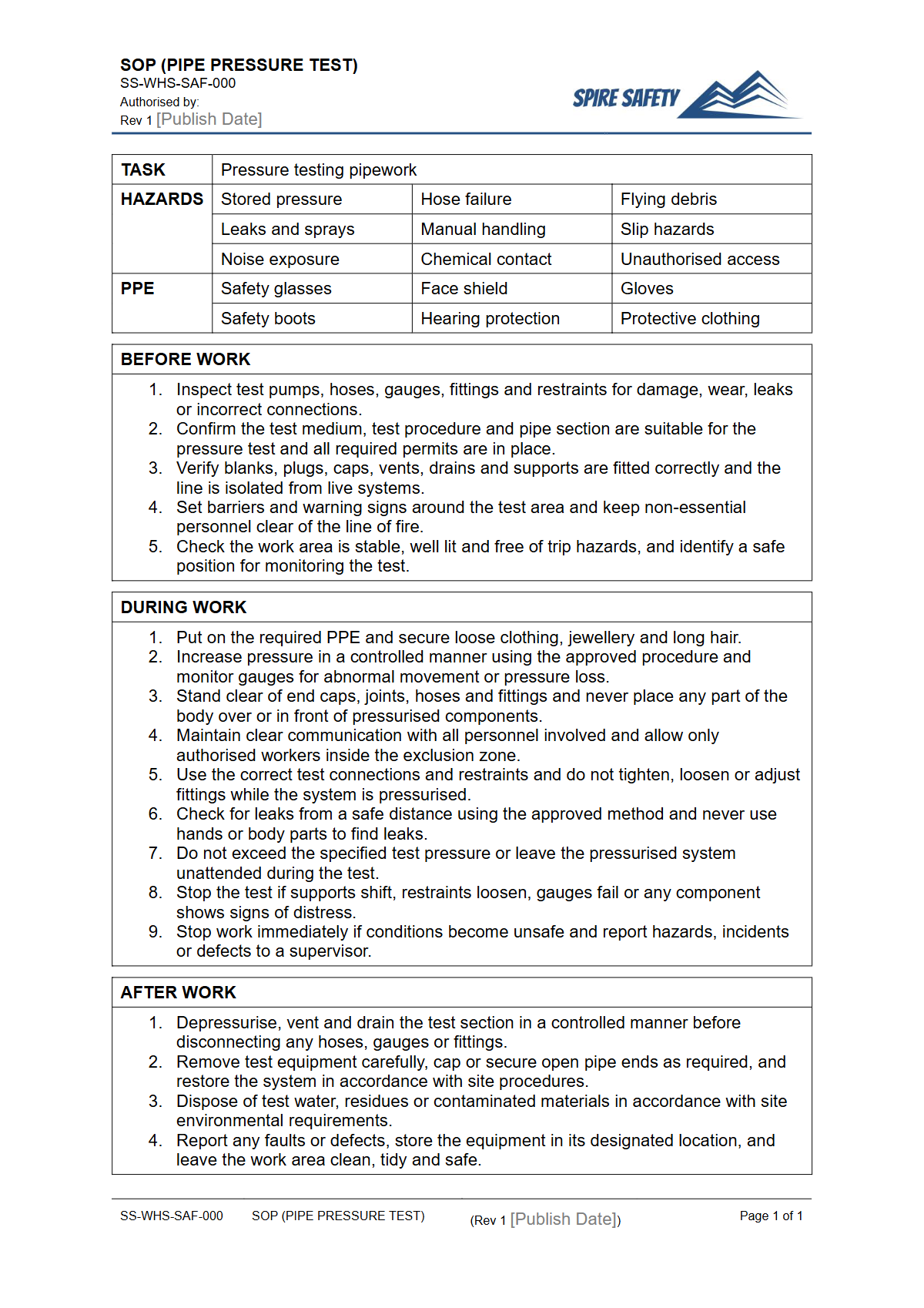
Our Free Safe Operating Procedure (Pipe Pressure Test) Template provides a structured framework to document the specific steps, risks, and controls required to perform this task safely. Using a standardised procedure helps organisations to train workers, meet their WHS duties, and ensure a consistent approach to managing high-risk work.
This Safe Operating Procedure template is designed to be adapted to your specific site requirements, equipment, and testing medium (e.g., water, air, or nitrogen). It guides you through documenting pre-operational checks, sequencing the work, and defining emergency responses.
Whether you are conducting a hydrostatic or pneumatic test, this document forms a critical part of your safe system of work. For related tasks involving pressurised equipment, our Free Air Compressor SOP provides additional guidance on managing the risks associated with stored energy sources.
Video walkthrough
How to use the Free Safe Operating Procedure (Pipe Pressure Test) Template
This template is provided in both an editable DOCX format and a print-ready PDF. After downloading, you must customise the document to align with your workplace's specific context.
A generic procedure is not sufficient to control risks effectively; it needs to reflect the actual equipment, personnel, and environment where the pressure test will occur.
We recommend a collaborative approach to customisation. Consult with the workers who will perform the task, their supervisors, and any relevant technical experts. Your final SOP should include details such as:
- Required Personal Protective Equipment (PPE).
- Qualifications and training needed for operators.
- Specific pre-start checks for the pump, gauges, hoses, and test manifold.
- A clear, step-by-step process for isolating the system, filling, pressurising, monitoring, and depressurising.
- The size and management of the exclusion zone.
- Emergency procedures, including shutdown and first aid response.
For projects where pressure testing is part of a larger construction or excavation activity, integrating procedures is crucial for safety. For example, if the work involves newly laid pipes, your risk management plan should also consider the safety of trenches, which can be documented using our free Trencher SOP.
When to use it
A Safe Operating Procedure for pipe pressure testing should be used whenever a pipeline or pressure vessel is subjected to pressure to test for leaks or strength. This is a mandatory step in many commissioning and maintenance processes across various industries.
Common applications include verifying the integrity of new plumbing installations, gas lines, fire sprinkler systems, industrial process piping, and water mains before they enter service. It is also used after repairs or modifications to ensure the system remains safe and leak-free.
This SOP should be used in conjunction with a comprehensive risk assessment and, where applicable, a safe work method statement (SWMS). It serves as a practical instruction guide for workers, ensuring that the controls identified in the risk assessment are consistently applied.
Formalising this process is a key part of developing a robust WHS management system, demonstrating that your organisation has planned the work and provided clear instructions to manage foreseeable hazards.
Who should use it
This Safe Operating Procedure should be used by personnel who are trained, competent, and authorised to conduct or supervise pipe pressure testing. This includes roles such as licensed plumbers, pipefitters, site engineers, and specialist testing technicians.
It is not a substitute for formal training and competency, but rather a tool to ensure qualified workers follow a safe and approved method.
Supervisors and managers should use this document as a tool for training, worksite inductions, and performance monitoring. It provides a clear benchmark for correct procedure, which is invaluable during safety observations or incident investigations.
WHS professionals can use this template to establish a baseline standard across projects, ensuring that key safety elements like exclusion zones, calibrated equipment, and gradual pressurisation are consistently addressed. These documented procedures often form part of the evidence reviewed during internal or external WHS compliance audits.
On a busy site, multiple types of equipment are often in use simultaneously. Having clear SOPs for all high-risk plant, such as those covered by our Telehandler SOP template, helps to coordinate activity and prevent conflicting work tasks from creating new hazards.
For more tools to help manage your workplace safety, you can browse our free WHS resources library for a wide range of templates, checklists, and guides.
Common mistakes
Common mistakes to avoid
- Failing to establish and enforce a large enough exclusion zone around the test area.
- Using pressure gauges that are not calibrated or have an inappropriate pressure range for the test.
- Pressurising the system too quickly, which can induce 'shock' and cause premature failure.
- Not properly bleeding all air from a system before starting a hydrostatic test, creating a more hazardous situation.
Legal references
Legal considerations
The following legal requirements may be relevant to this type of work.
- Work Health and Safety Act (Harmonised) — Provides the primary duties for protecting workers and other people from work health and safety risks.
- Work Health and Safety Regulations (Harmonised) — Sets out requirements supporting the management of workplace hazards and risks.
The following codes may be relevant to this type of work.
- Managing WHS Risks Code of Practice — Provides practical guidance on identifying hazards, assessing risks and applying effective controls.
- Work Health and Safety Consultation, Cooperation and Coordination Code of Practice — Provides practical guidance on consulting workers and coordinating with other duty holders.
- Managing the Work Environment and Facilities Code of Practice — Provides practical guidance on safe work environments, workplace facilities and related controls.
Did you know
Energy in a Bottle
A pneumatic (air) pressure test stores significantly more energy than a hydrostatic (water) test at the same pressure. A failure during a pneumatic test can be explosive, which is why hydrostatic testing is preferred wherever possible.
The 'Whip' Effect
If a pressurised hose or pipe fitting fails, it can whip around with incredible force, causing severe or fatal injuries. This is why securing all components and establishing large exclusion zones is critical.
FAQ
Frequently asked questions
01What is the difference between a hydrostatic and pneumatic pressure test?
02What are the main hazards of pipe pressure testing?
03How do I determine the correct test pressure for a pipe?
04Is a Safe Operating Procedure a legal requirement in Australia?
Share this resource
Free Safe Operating Procedure (Pipe Pressure Test) Template
Browse Categories
How To Use It
- 1Download and open in Word or PDF.
- 2Replace the placeholders with your business details.
- 3Get it reviewed by a WHS specialist before rollout.
Need it customised?
Our WHS consultants can adapt this template to your site, run a gap analysis, or audit what you already have in place.
Book a Free Consultation WHS consulting servicesor call 1300 156 382
Related templates
- Free Safe Operating Procedure (Pipe Reamer) Template
- Free Safe Operating Procedure (Pipe Saw) Template
- Free Safe Operating Procedure (Pipe Stand) Template
- Free Safe Operating Procedure (Pipe Threader) Template
- Free Safe Operating Procedure (Pipe Vice) Template
- Free Safe Operating Procedure (Pipette Use) Template