
Free Safe Operating Procedure (Pipette Use) Template
Download our free Safe Operating Procedure (Pipette Use) Template to ensure consistent and safe laboratory practices.
Free Safe Operating Procedure (Pipette Use) Template
DOCX • 126 KB + PDF
Updated Oct 2026
No signup required
Purpose of the Free Safe Operating Procedure (Pipette Use) Template
Using laboratory equipment like pipettes requires precision, consistency, and a strong focus on safety. Our free Safe Operating Procedure (Pipette Use) Template provides a structured framework for documenting the correct, safe, and efficient method for operating pipettes in your workplace.
Establishing a clear SOP helps minimise risks such as Repetitive Strain Injury (RSI), exposure to hazardous chemicals or biological agents, and cross-contamination of samples. A well-defined procedure is a cornerstone of laboratory safety, ensuring that all personnel, regardless of experience level, adhere to the same high standards.
This template serves as a critical tool for risk management. By formally documenting the process, you create a reference point for training, supervision, and incident investigation.
It encourages a proactive approach to safety, moving beyond mere compliance to foster a culture where safe work practices are intuitive and consistent. If you need assistance developing comprehensive risk assessments for your lab, our WHS consulting services can provide expert guidance.
Video walkthrough
How to use the Free Safe Operating Procedure (Pipette Use) Template
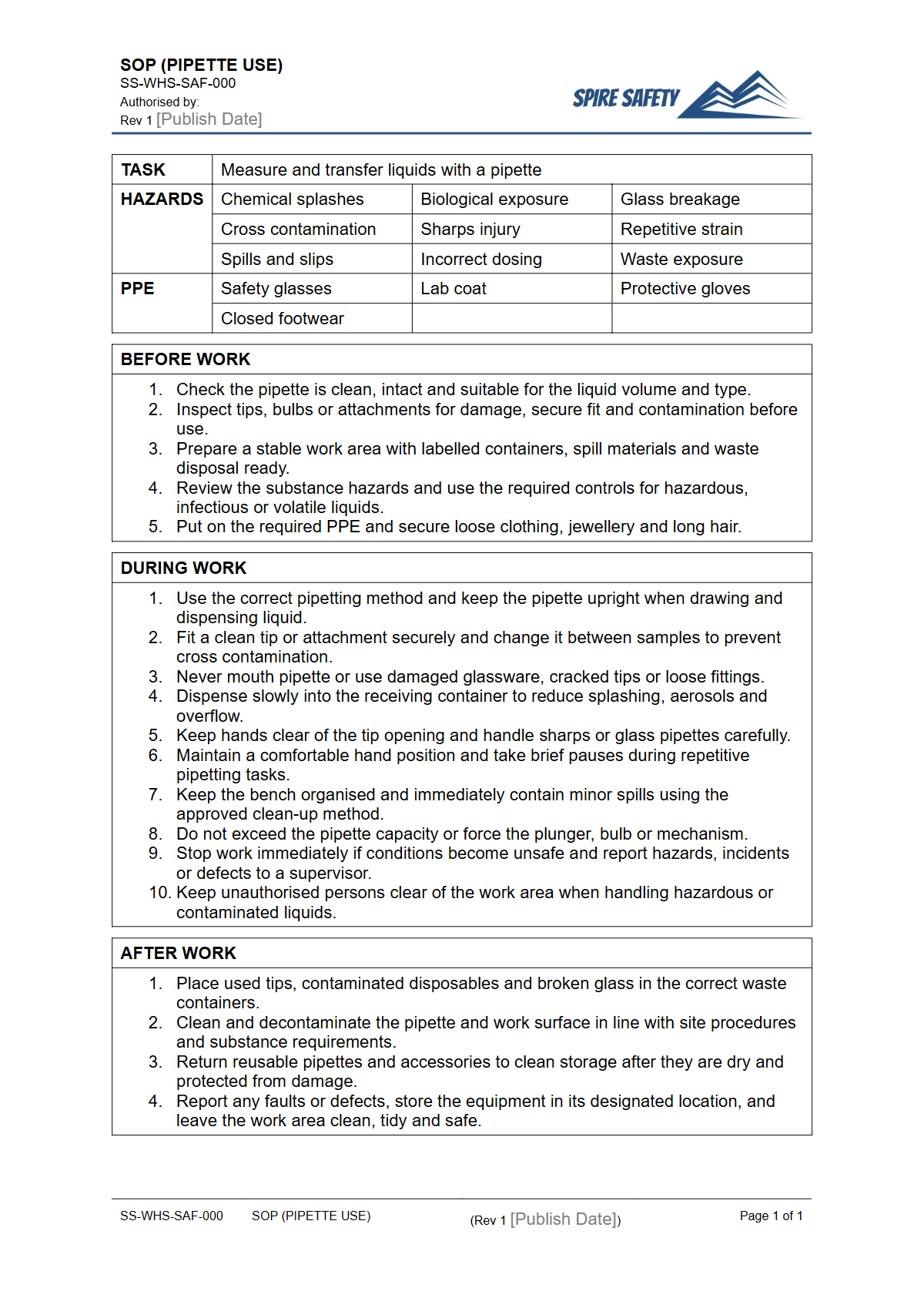
This Safe Operating Procedure template is designed for immediate use and customisation. Available in both DOCX and PDF formats, it allows you to adapt the content to the specific types of pipettes (e.g., single-channel, multi-channel, electronic), substances handled, and unique environmental conditions of your laboratory.
Simply download the file and edit the sections to reflect your operational requirements. Key areas for customisation include specifying the required Personal Protective Equipment (PPE), outlining pre-use checks like calibration and cleanliness, detailing the step-by-step pipetting technique, and documenting decontamination and storage protocols.
Please note: this document is a template and must be customised to your specific workplace, equipment, chemicals, and personnel. We recommend a competent person reviews and approves the final document before implementation.
An effective SOP is a vital component of a holistic safety framework, integrating seamlessly into your broader WHS management systems to ensure a safe and organised work environment.
Key Components of a Pipette Use Safe Operating Procedure
A comprehensive SOP for pipette use should cover several critical areas to be effective. When customising the template, ensure you address:
- Hazard Identification: List all potential hazards, including ergonomic (RSI), chemical (exposure to acids, solvents), biological (pathogens), and physical (glass breakage).
- Personal Protective Equipment (PPE): Specify the exact PPE required, such as safety glasses, lab coats, and appropriate gloves (e.g., nitrile, latex) based on the substances being handled.
- Ergonomics: Include instructions on correct posture, grip, and the use of low-force pipettes or automated systems to prevent musculoskeletal disorders. Taking regular breaks is also a key control measure.
- Procedure Steps: Detail the entire process from pre-use inspection and tip selection to aspiration, dispensing, and tip ejection. For different techniques like forward and reverse pipetting, provide separate, clear instructions.
- Decontamination and Cleaning: Provide explicit instructions for cleaning and decontaminating pipettes after use, specifying the correct cleaning agents for the substances handled to prevent carryover and corrosion.
- Emergency Procedures: Outline the immediate actions to take in case of a spill, personal exposure, or equipment malfunction.
When to use a Safe Operating Procedure
A Safe Operating Procedure for pipette use should be a 'living document' used consistently throughout your operations. It is essential during the induction and training of new laboratory staff, researchers, or students to establish correct habits from the outset.
It should also be used for annual refresher training to reinforce best practices and communicate any procedural updates. Furthermore, the SOP must be reviewed and updated whenever a new type of pipette is introduced, a new hazardous substance is used, or following any incident or near miss.
Having documented procedures for various tasks, such as our Free Safe Operating Procedure (Deep Fryer) Template, creates a foundation of safety across all business activities.
Who should use it
This SOP is intended for all personnel who operate, supervise, or manage the use of pipettes. This includes laboratory technicians, research scientists, quality control analysts, and students.
Supervisors and lab managers are responsible for ensuring the SOP is understood, followed, and enforced. They should also use it as a tool for conducting competency assessments.
WHS managers and committees can use the SOP as part of their safety management system to demonstrate that risks associated with laboratory tasks are being systematically controlled. Regular reviews of its implementation are crucial, and this process can be supported by formal WHS compliance auditing to verify its effectiveness in practice.
While this template is for a specific lab task, establishing SOPs for all critical equipment is best practice. You can find other examples, such as our Free Air Compressor SOP Template, in our extensive library of safety documents. For a complete list of available downloads, browse our free WHS resources library.
Common mistakes
Common mistakes to avoid
- Failing to customise the template for specific chemicals or biological agents used.
- Neglecting ergonomic considerations, leading to Repetitive Strain Injuries (RSI).
- Inadequate training on proper pipette use, calibration, and maintenance procedures.
- Storing the SOP in an inaccessible office instead of making it available at the point of work.
Legal references
Legal considerations
The following legal requirements may be relevant to this type of work.
- Work Health and Safety Act (Harmonised) — Provides the primary duties for protecting workers and other people from work health and safety risks.
- Work Health and Safety Regulations (Harmonised) — Sets out requirements supporting the management of workplace hazards and risks.
The following codes may be relevant to this type of work.
- Managing WHS Risks Code of Practice — Provides practical guidance on identifying hazards, assessing risks and applying effective controls.
- Work Health and Safety Consultation, Cooperation and Coordination Code of Practice — Provides practical guidance on consulting workers and coordinating with other duty holders.
- Managing the Work Environment and Facilities Code of Practice — Provides practical guidance on safe work environments, workplace facilities and related controls.
Did you know
Pipettor's Thumb
Repetitive Strain Injury (RSI) from manual pipetting is a recognised ergonomic hazard in laboratories, commonly referred to as "pipettor's thumb" or "pipette elbow".
A Revolutionary Invention
The first adjustable micropipette was developed in 1957 by Dr. Heinrich Schnitger in Germany, an invention that revolutionised molecular biology by enabling precise handling of micro-litre fluid volumes.
FAQ
Frequently asked questions
01What are the main risks associated with using pipettes?
02How often should a pipette SOP be reviewed?
03Is this pipette use SOP template suitable for all types of pipettes?
04Why is documenting decontamination procedures important in an SOP?
Share this resource
Free Safe Operating Procedure (Pipette Use) Template
Browse Categories
How To Use It
- 1Download and open in Word or PDF.
- 2Replace the placeholders with your business details.
- 3Get it reviewed by a WHS specialist before rollout.
Need it customised?
Our WHS consultants can adapt this template to your site, run a gap analysis, or audit what you already have in place.
Book a Free Consultation WHS consulting servicesor call 1300 156 382
Related templates
- Free Safe Operating Procedure (Pizza Cutter) Template
- Free Safe Operating Procedure (Pizza Paddle Use) Template
- Free Safe Operating Procedure (Plant Division) Template
- Free Safe Operating Procedure (Plant Hardening) Template
- Free Safe Operating Procedure (Plant Labelling) Template
- Free Safe Operating Procedure (Plant Propagation) Template