
Free Safe Operating Procedure (Plant Propagation) Template
Our Free Safe Operating Procedure for plant propagation provides a structured starting point for managing horticultural hazards. Download the template today.
Free Safe Operating Procedure (Plant Propagation) Template
DOCX • 126 KB + PDF
Updated Oct 2026
No signup required
Purpose of the Free Safe Operating Procedure (Plant Propagation) Template
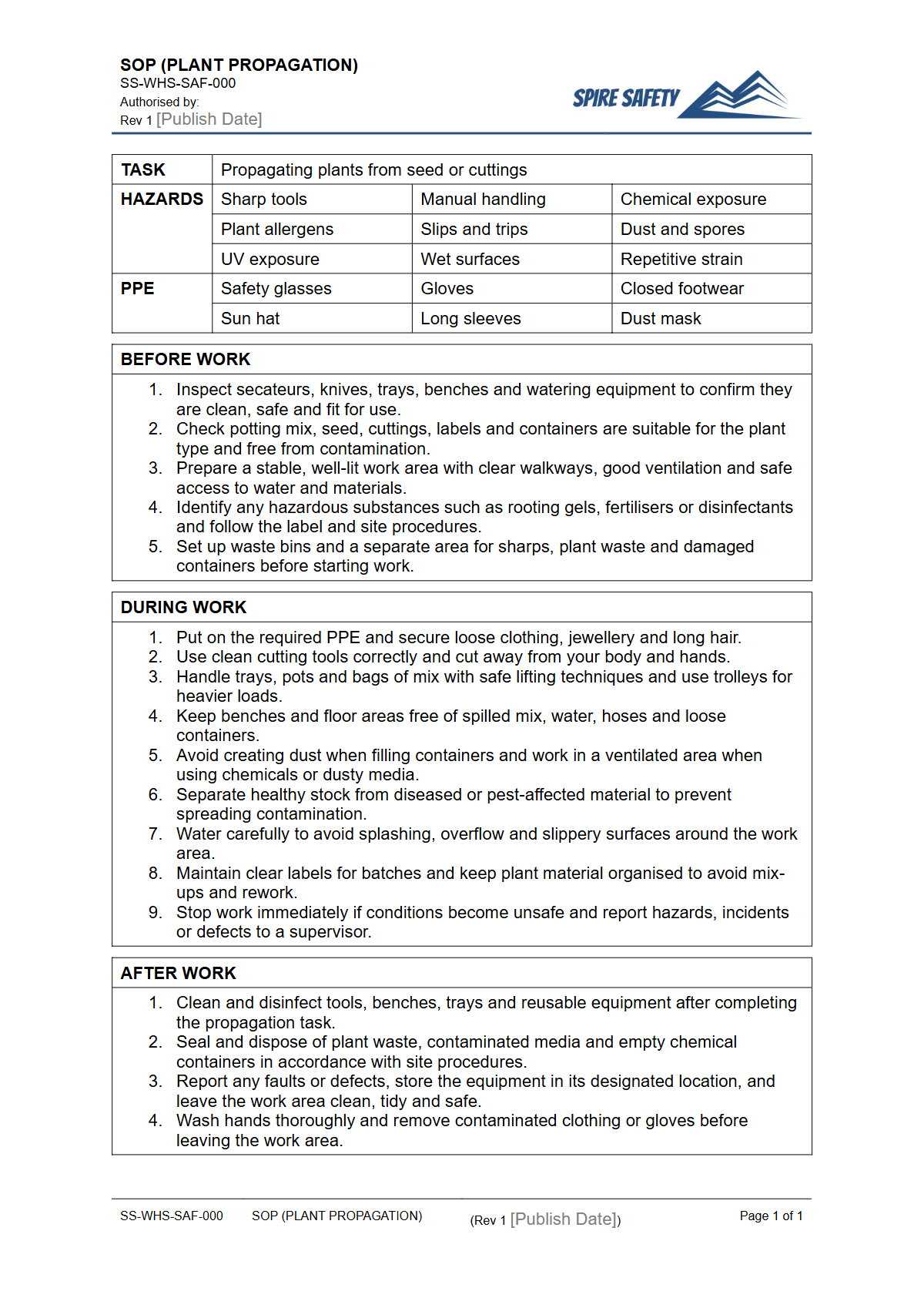
This Free Safe Operating Procedure (Plant Propagation) Template provides a comprehensive framework for outlining the safety requirements for horticultural propagation tasks. It is designed to help your organisation document controls for identified hazards and establish a clear, repeatable process for workers to follow.
Properly implemented, this SOP helps manage common risks such as ergonomic stress from repetitive actions, manual handling of soil and pots, exposure to hazardous chemicals, and the use of sharp tools.
The goal is to minimise the risk of injury by ensuring every person involved understands the potential hazards and the steps required to perform their work safely. Using this template helps standardise your approach to safety, supports worker training, and demonstrates a commitment to meeting WHS obligations.
For large-scale mechanised operations, a specific planter SOP template should be developed alongside this procedure to cover machinery-specific risks.
Video walkthrough
How to use the Free Safe Operating Procedure (Plant Propagation) Template
This Safe Operating Procedure for plant propagation is provided as a user-friendly DOCX file, making it easy to edit and adapt. A PDF version is also available for straightforward printing and distribution.
To use the template effectively, you should systematically review each section and populate it with information that is specific to your tasks, tools, chemicals, and work environment. This includes listing the required Personal Protective Equipment (PPE), detailing step-by-step instructions, and outlining emergency procedures.
Important: Customise to Your Workplace
This document is a template and must be customised to reflect the specific hazards and control measures relevant to your site. We recommend consulting with workers who perform the tasks, as well as a WHS professional, to ensure all risks are adequately addressed.
A generic procedure is not sufficient for compliance; it must be a true reflection of your unique operational context.
Integrating this SOP into your broader safety framework is crucial for its effectiveness. A robust WHS management system ensures that procedures like this are consistently implemented, reviewed, and improved as part of a continuous cycle of safety management.
Key Hazards in Plant Propagation
Plant propagation activities, whether in a nursery, glasshouse, or field, involve several key hazards that must be managed. This SOP provides a structure to document your controls for these risks.
- Manual Tasks: Repetitive actions like filling trays, seeding, and transplanting can lead to musculoskeletal disorders. Heavy lifting of soil bags, compost, or large pots also presents a significant risk of sprains and strains.
- Hazardous Chemicals: Workers may be exposed to fertilisers, pesticides, herbicides, and rooting hormones. It is vital to have Safety Data Sheets (SDS) available and follow all handling, storage, and disposal requirements. For tasks involving the mechanical application of materials, a spreader SOP template can provide specific guidance.
- Sharp Tools & Equipment: The use of knives, secateurs, and grafting tools introduces risks of cuts and lacerations. For larger landscaping or soil preparation tasks, equipment like trenchers may be used, which require their own specific procedures, such as a dedicated trencher SOP.
- Biological & Environmental Hazards: Contact with soil-borne bacteria, fungi, and insect bites are inherent risks. Additionally, working in glasshouses can lead to heat stress, while outdoor work carries risks of UV radiation exposure and adverse weather.
When to use a Safe Operating Procedure
A Safe Operating Procedure for plant propagation should be a core part of your daily safety management. It is a critical tool for worker induction and training, ensuring new employees understand the safe way to perform tasks from their first day.
It should also be used as a reference for pre-start meetings or toolbox talks to refresh knowledge on specific hazards before work begins.
Furthermore, this document serves as a benchmark for workplace inspections and observations. Regular WHS compliance audits can help verify that the procedures outlined in the SOP are being followed correctly in practice and remain effective at controlling risk.
Who should use it
This Safe Operating Procedure is intended for all personnel involved in plant propagation activities. This includes:
- Nursery Workers and Horticulturalists: To guide their day-to-day tasks and ensure they are aware of the safety controls.
- Team Leaders and Supervisors: To assist in training, supervising work, and enforcing safety standards.
- WHS Managers and Officers: As a foundational document within the overall safety management system to ensure risks are systematically addressed.
For complex horticultural operations or where specialist advice is needed to manage unique risks, engaging external WHS consulting services can provide valuable expertise. By systematically addressing the risks involved in plant propagation, your organisation can create a safer working environment for all personnel.
Explore our complete free WHS resources library for more templates and guides to support your safety management efforts.
Common mistakes
Common mistakes to avoid
- Using a generic, non-customised template without a site-specific risk assessment.
- Failing to train workers on the finalised SOP and confirm their understanding.
- Neglecting to review and update the SOP after an incident or when new equipment or chemicals are introduced.
- Not involving the workers who actually perform the tasks in the development of the procedure.
Legal references
Legal considerations
The following legal requirements may be relevant to this type of work.
- Work Health and Safety Act (Harmonised) — Provides the primary duties for protecting workers and other people from work health and safety risks.
- Work Health and Safety Regulations (Harmonised) — Sets out requirements supporting the management of workplace hazards and risks.
The following codes may be relevant to this type of work.
- Managing WHS Risks Code of Practice — Provides practical guidance on identifying hazards, assessing risks and applying effective controls.
- Work Health and Safety Consultation, Cooperation and Coordination Code of Practice — Provides practical guidance on consulting workers and coordinating with other duty holders.
- Managing the Work Environment and Facilities Code of Practice — Provides practical guidance on safe work environments, workplace facilities and related controls.
Did you know
Manual Task Injuries
The agriculture, forestry, and fishing industry has one of the highest rates of serious claims for work-related injuries, with manual tasks being a leading cause of musculoskeletal disorders.
Hierarchy of Control
An effective SOP is built on the hierarchy of control, prioritising the elimination or substitution of hazards over lower-level controls like administrative actions or PPE.
FAQ
Frequently asked questions
01What should be included in a plant propagation SOP?
02Are pesticides and fertilisers considered hazardous substances?
03How do SOPs help with WHS training in horticulture?
04Why is it important to customise this plant propagation SOP template?
Share this resource
Free Safe Operating Procedure (Plant Propagation) Template
Browse Categories
How To Use It
- 1Download and open in Word or PDF.
- 2Replace the placeholders with your business details.
- 3Get it reviewed by a WHS specialist before rollout.
Need it customised?
Our WHS consultants can adapt this template to your site, run a gap analysis, or audit what you already have in place.
Book a Free Consultation WHS consulting servicesor call 1300 156 382
Related templates
- Free Safe Operating Procedure (Plant Repotting) Template
- Free Safe Operating Procedure (Plant Room Cleaning) Template
- Free Safe Operating Procedure (Plant Room Housekeeping) Template
- Free Safe Operating Procedure (Plant Stake Installation) Template
- Free Safe Operating Procedure (Plant Tie Installation) Template
- Free Safe Operating Procedure (Plant Tray Handling) Template