
Free Safe Operating Procedure (Plant Tie Installation) Template
Develop a clear process for the safe installation of plant ties with our free template. Download this customisable Safe Operating Procedure to get started.
Free Safe Operating Procedure (Plant Tie Installation) Template
DOCX • 126 KB + PDF
Updated Oct 2026
No signup required
Purpose of the Free Safe Operating Procedure (Plant Tie Installation) Template
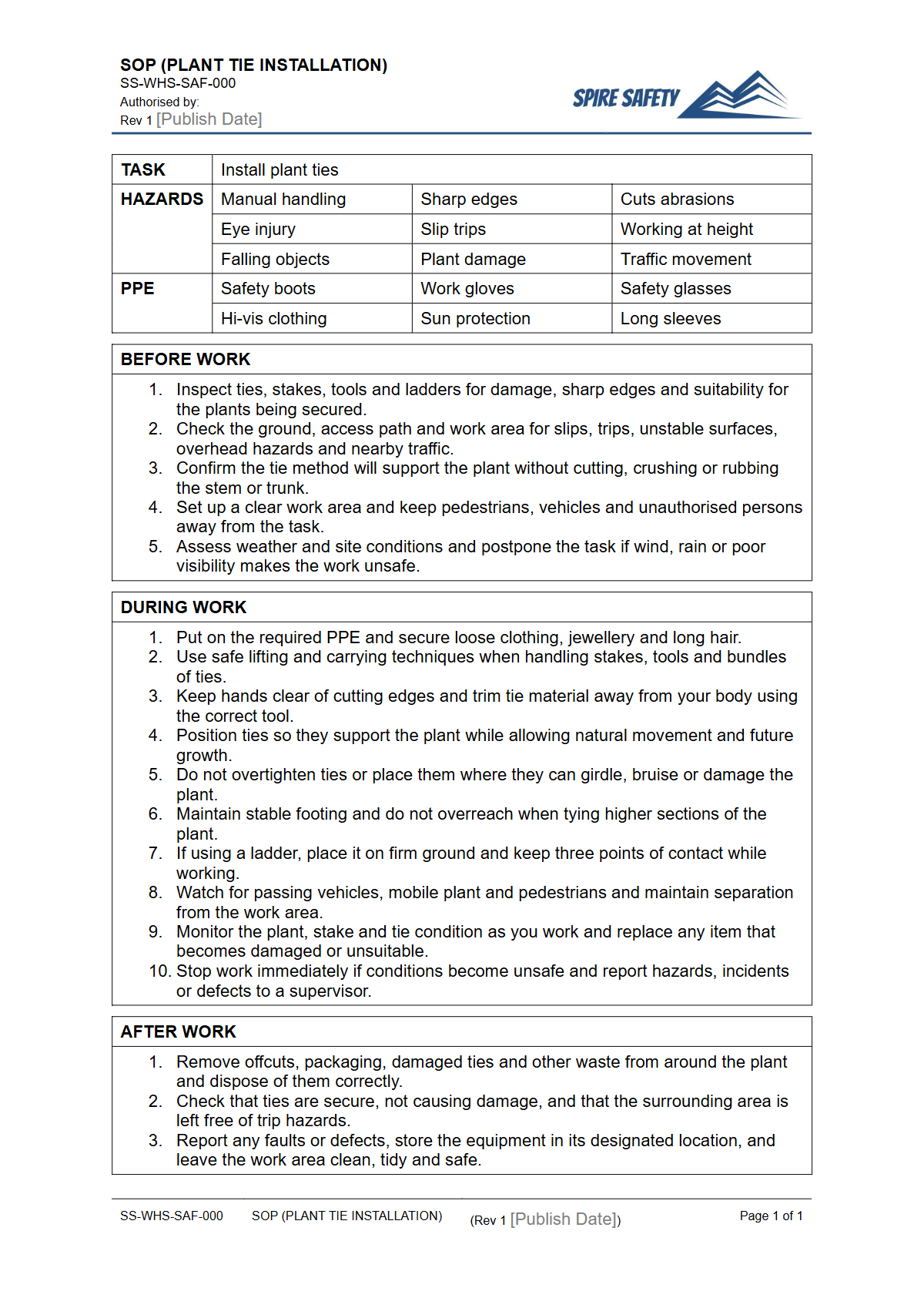
This Safe Operating Procedure (SOP) provides a structured framework for safely performing plant tie installation tasks in agricultural, horticultural, and landscaping environments. The purpose of this free template is to help your organisation manage risks and establish a consistent, safe method for workers securing plants, vines, or saplings.
It addresses common hazards such as manual handling injuries, strains from repetitive motions, and lacerations from tools or tying materials. Implementing a formal SOP is a critical step in developing robust WHS management systems that protect your team.
By outlining required Personal Protective Equipment (PPE), pre-operational checks, and a step-by-step process, the SOP helps standardise safe work practices. This is essential for preventing incidents and ensuring all personnel, including new or temporary workers, understand the expected safety standards.
A documented procedure also serves as a valuable tool for training and competency assessments.
Video walkthrough
How to use the Free Safe Operating Procedure (Plant Tie Installation) Template
Our template is provided in both DOCX and PDF formats for your convenience. The DOCX file is fully editable, allowing you to tailor the content to the specific conditions of your workplace.
To use it effectively, download the document and begin by adding your company branding and details. Then, methodically work through each section, customising the steps and safety controls to align with your unique equipment, site conditions, and risk profile.
This might include specifying the types of ties used, the tools required, and the specific plant varieties being worked on.
Important: This document is a template and must be customised to reflect your specific workplace, equipment, and operational risks. We strongly recommend that a competent person, such as a supervisor or WHS manager, reviews and approves the final document before it is implemented. Your process should also consider tasks that occur before tying, such as ground preparation, which may be covered by documents like our FREE Trencher SOP Template.
When to use a Safe Operating Procedure
A Safe Operating Procedure for plant tie installation should be used as a primary reference document before any related work commences. It is a vital resource during the induction and training of new employees, ensuring they learn the correct, safe method from the outset.
The SOP should also be readily accessible in the work area for workers to consult as needed.
Furthermore, this procedure should be reviewed during toolbox talks, especially when there are changes to the process, equipment, or environment. It is also a key document to consult when conducting a risk assessment or investigating an incident or near miss related to the task.
Regular reviews help keep the procedure relevant and effective. For related agricultural tasks, you might also use our FREE Spreader SOP (Safe Operating Procedure) Template to ensure all site activities are documented.
Who should use this template
This template is designed for a range of personnel within an organisation. WHS Managers and Supervisors will find it an excellent starting point for formalising safety protocols and meeting their duty of care obligations.
They can use it to create a master document that standardises the procedure across different teams or sites.
Team Leaders and experienced workers should be involved in the customisation process to ensure the SOP reflects the practical realities of the job. For workers performing the task, the finalised SOP is their guide to working safely and efficiently.
If you need assistance adapting this template or developing more complex safety documentation, our WHS consulting services can provide expert guidance. You can also explore our full free WHS resources library for other useful templates.
Common mistakes
Common mistakes to avoid
- Using incorrect tying materials that can damage the plant stem or girdle it as it grows.
- Adopting awkward postures (e.g., prolonged bending or reaching) instead of adjusting position, leading to back and shoulder strain.
- Failing to wear appropriate PPE, particularly gloves, resulting in cuts and abrasions from wire ties or thorny plants.
- Applying ties too tightly, which restricts plant growth and nutrient flow, or too loosely, which fails to provide adequate support.
Legal references
Legal considerations
The following legal requirements may be relevant to this type of work.
- Work Health and Safety Act (Harmonised) — Provides the primary duties for protecting workers and other people from work health and safety risks.
- Work Health and Safety Regulations (Harmonised) — Sets out requirements supporting the management of workplace hazards and risks.
The following codes may be relevant to this type of work.
- Managing WHS Risks Code of Practice — Provides practical guidance on identifying hazards, assessing risks and applying effective controls.
- Work Health and Safety Consultation, Cooperation and Coordination Code of Practice — Provides practical guidance on consulting workers and coordinating with other duty holders.
- Managing the Work Environment and Facilities Code of Practice — Provides practical guidance on safe work environments, workplace facilities and related controls.
Did you know
Ergonomic Risk
Agricultural work has one of the highest rates of musculoskeletal disorders. Using an SOP that promotes good posture and technique during tasks like plant tying can significantly reduce the risk of long-term sprain and strain injuries.
FAQ
Frequently asked questions
01What are the main hazards involved in plant tie installation?
02Is an SOP legally required for installing plant ties?
03How often should a plant tie installation SOP be reviewed?
04Can I use this template for automated plant tying machinery?
Share this resource
Free Safe Operating Procedure (Plant Tie Installation) Template
Browse Categories
How To Use It
- 1Download and open in Word or PDF.
- 2Replace the placeholders with your business details.
- 3Get it reviewed by a WHS specialist before rollout.
Need it customised?
Our WHS consultants can adapt this template to your site, run a gap analysis, or audit what you already have in place.
Book a Free Consultation WHS consulting servicesor call 1300 156 382
Related templates
- Free Safe Operating Procedure (Plant Tray Handling) Template
- Free Safe Operating Procedure (Plate Clamp) Template
- Free Safe Operating Procedure (Plate Load Test) Template
- Free Safe Operating Procedure (Plate Rack Handling) Template
- Free Safe Operating Procedure (Plate Warmer) Template
- Free Safe Operating Procedure (Platform Trolley) Template