
Free Safe Operating Procedure (Plate Load Test) Template
Formalise safety protocols for geotechnical testing with our free Safe Operating Procedure (Plate Load Test) template. Download the customisable DOCX and PDF.
Free Safe Operating Procedure (Plate Load Test) Template
DOCX • 126 KB + PDF
Updated Oct 2026
No signup required
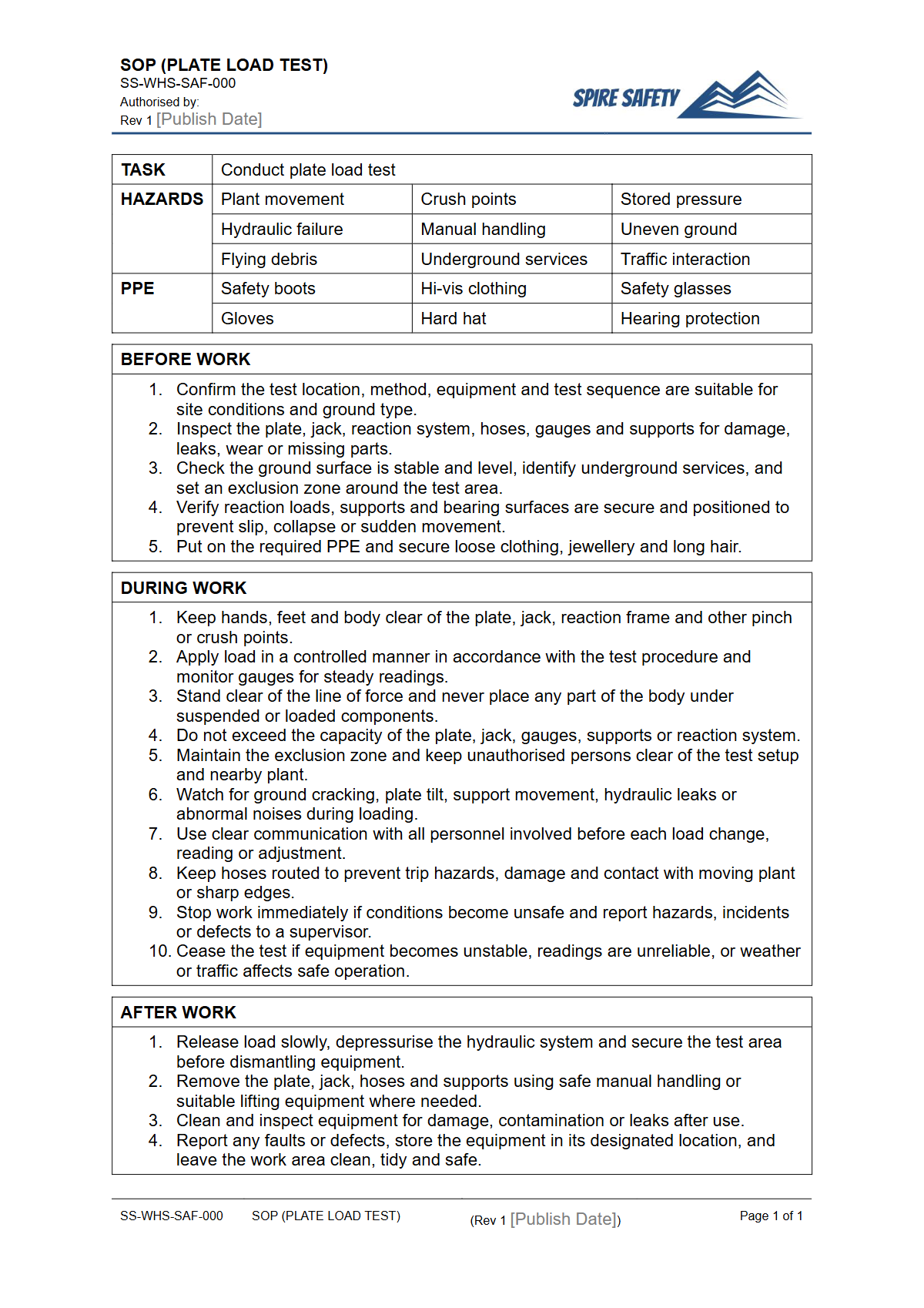
Purpose of the Free Safe Operating Procedure (Plate Load Test) Template
This Safe Operating Procedure (Plate Load Test) template provides a structured framework for documenting the safety requirements to perform geotechnical plate load tests. Plate load testing is a critical field test used to determine the ultimate bearing capacity of soil and the likely settlement under a specific load.
Our free template helps you outline the hazards and control measures associated with this task, ensuring it's conducted safely and consistently.
By using this document, you can systematically address risks such as equipment instability, unintended movement of the reaction load (kentledge), manual handling injuries during setup, and environmental hazards. Formalising these steps is a fundamental component of building robust and effective WHS management systems on any construction or civil engineering site.
Video walkthrough
How to use the Free Safe Operating Procedure (Plate Load Test) Template
This Safe Operating Procedure template is provided in both DOCX and PDF formats for your convenience. The DOCX file is fully editable, allowing you to tailor it to the specific context of your workplace.
To effectively use this resource, you should consult with the workers who will be performing the task, including site engineers, technicians, and plant operators. Their direct experience is invaluable for identifying all relevant hazards.
It is crucial to understand that this template is a starting point. You must customise it to reflect the specific equipment (hydraulic jacks, load cells, kentledge/reaction frame), site conditions, personnel competencies, and risk controls unique to your organisation. This process ensures the final SOP is a practical and relevant tool for your team, much like our other task-specific documents such as the free Trencher SOP Template.
To complete the Safe Operating Procedure:
- Download the DOCX file.
- Conduct a site-specific risk assessment for the plate load test activity.
- Fill in the required details, including site information, responsibilities, personal protective equipment (PPE), and emergency procedures.
- Clearly document the step-by-step procedure, from site preparation and equipment setup to applying load increments and decommissioning the test area.
- Have the completed SOP reviewed and approved by a competent person, such as a project manager or WHS advisor.
- Train all relevant personnel on the contents of the finalised SOP and ensure they have easy access to it.
When to use it
A Safe Operating Procedure for plate load testing should be implemented before any such testing occurs on a worksite. It is an essential planning document that forms part of the overall project safety plan for civil, construction, or geotechnical investigation projects.
This SOP should be used when training new personnel, inducting contractors onto a site, or providing refresher training for existing staff.
Furthermore, this procedure is a key piece of evidence during safety reviews and audits. It demonstrates that a systematic approach to managing operational risks has been established, which is a core requirement of any WHS compliance auditing program.
Keep the SOP accessible in the site office and with the testing team for easy reference during operations.
Who should use it
This Safe Operating Procedure is designed for use by a range of personnel involved in construction, earthworks, and geotechnical engineering. Key users include:
- Geotechnical and Civil Engineers: To ensure testing parameters are met safely.
- Site Supervisors and Project Managers: To oversee and verify that safety protocols are being followed.
- WHS/OHS Advisors: To integrate the procedure into the broader site safety management system.
- Plant Operators and Technicians: As a practical guide for safely setting up, conducting, and dismantling the test equipment.
The principles of safe equipment setup and ground preparation outlined here are relevant to many site tasks. For instance, teams involved in surface preparation may also benefit from our free Grader SOP Template to standardise their operational safety.
Similarly, projects involving significant earthmoving require clear procedures for all machinery. If your project involves bulk earthworks, you might find our free Scraper SOP Template to be a useful companion document.
By implementing task-specific SOPs, organisations create a safer work environment and a more consistent operational standard. You can explore our complete free WHS resources library for more templates to support your safety management efforts.
Common mistakes
Common mistakes to avoid
- Using an inadequately sized reaction load (kentledge or anchor) that cannot provide the required resistance.
- Failing to properly seat the bearing plate on the ground surface, leading to inaccurate settlement readings.
- Not allowing sufficient time for settlement to stabilise at each load increment, skewing the final results.
- Poor documentation of load and settlement readings, or failing to record environmental conditions (like rain) during the test.
Legal references
Legal considerations
The following legal requirements may be relevant to this type of work.
- Work Health and Safety Act (Harmonised) — Provides the primary duties for protecting workers and other people from work health and safety risks.
- Work Health and Safety Regulations (Harmonised) — Sets out requirements supporting the management of workplace hazards and risks.
The following codes may be relevant to this type of work.
- Managing WHS Risks Code of Practice — Provides practical guidance on identifying hazards, assessing risks and applying effective controls.
- Work Health and Safety Consultation, Cooperation and Coordination Code of Practice — Provides practical guidance on consulting workers and coordinating with other duty holders.
- Managing the Work Environment and Facilities Code of Practice — Provides practical guidance on safe work environments, workplace facilities and related controls.
Did you know
Bearing Capacity
The plate load test is a direct method used to determine the ultimate bearing capacity of the ground and predict its settlement under a given structural load.
Standard Plate Sizes
Standard plate diameters used in testing are typically 300 mm, 450 mm, 600 mm, and 750 mm. The choice of plate size depends on the soil type and the required depth of investigation.
FAQ
Frequently asked questions
01What is a plate load test and why does it need an SOP?
02Who is responsible for developing a Safe Operating Procedure for a plate load test?
03How often should a plate load test SOP be reviewed?
04Does this template cover all types of ground conditions?
Share this resource
Free Safe Operating Procedure (Plate Load Test) Template
Browse Categories
How To Use It
- 1Download and open in Word or PDF.
- 2Replace the placeholders with your business details.
- 3Get it reviewed by a WHS specialist before rollout.
Need it customised?
Our WHS consultants can adapt this template to your site, run a gap analysis, or audit what you already have in place.
Book a Free Consultation WHS consulting servicesor call 1300 156 382
Related templates
- Free Safe Operating Procedure (Plate Rack Handling) Template
- Free Safe Operating Procedure (Plate Warmer) Template
- Free Safe Operating Procedure (Platform Trolley) Template
- Free Safe Operating Procedure (Playground Rake Over) Template
- Free Safe Operating Procedure (Playground Sand Raking) Template
- Free Safe Operating Procedure (Playing Surface Check) Template