
Free Safe Operating Procedure (Plate Rack Handling) Template
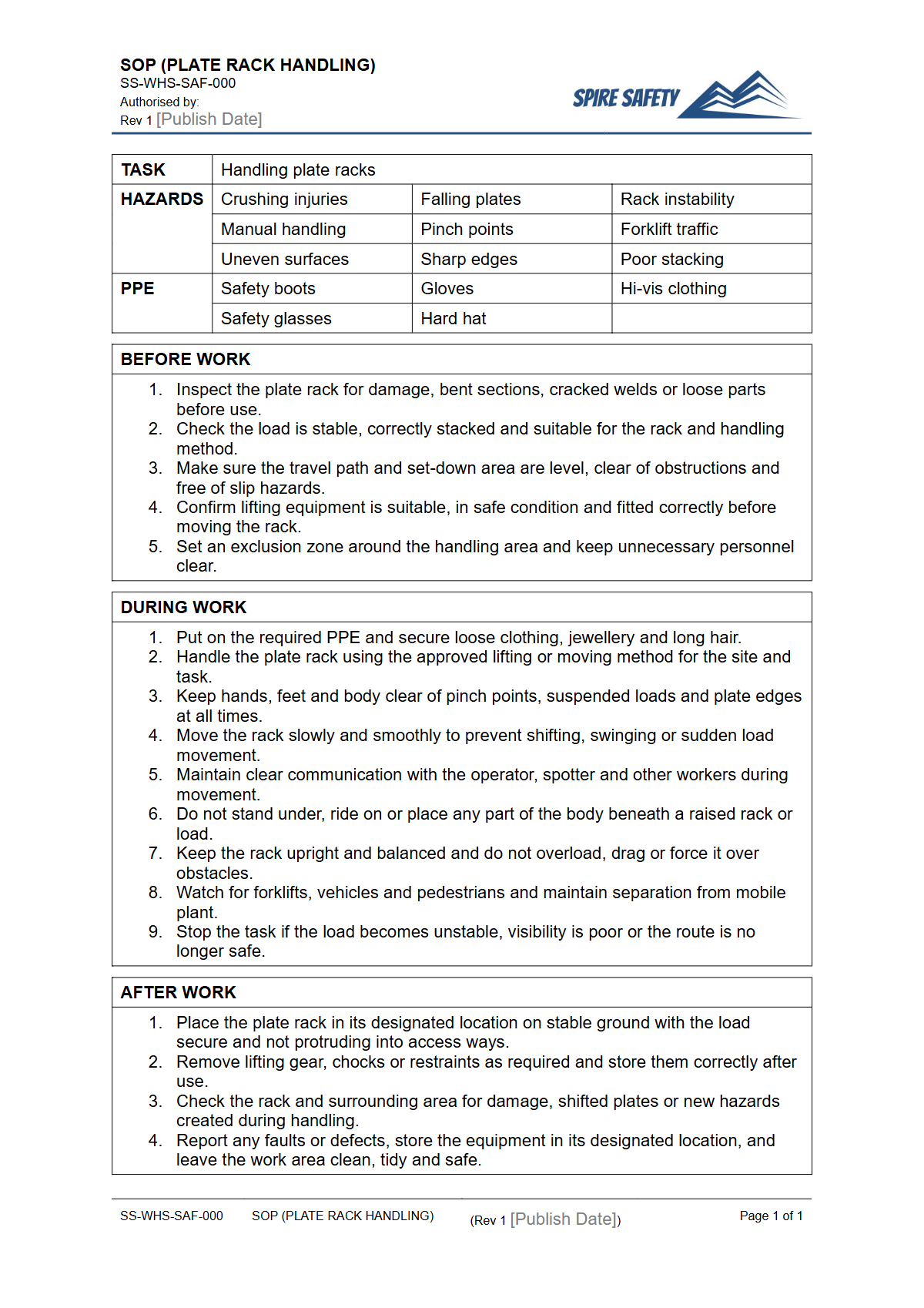
Effectively manage risks associated with moving and storing plate racks in commercial kitchens or manufacturing.
Free Safe Operating Procedure (Plate Rack Handling) Template
DOCX • 126 KB + PDF
Updated Oct 2026
No signup required
Purpose of the Free Safe Operating Procedure (Plate Rack Handling) Template
Handling plate racks, whether in a bustling commercial kitchen, a catering facility, or a manufacturing setting, presents significant risks if not managed correctly. Our free Safe Operating Procedure (Plate Rack Handling) Template provides a structured framework to document and standardise the process for safely moving, loading, and unloading these racks.
This document helps your organisation identify hazards such as musculoskeletal injuries from awkward lifts, crush injuries from unstable racks, and slips or trips from spilt contents. By establishing clear, step-by-step instructions, you can train workers effectively, reduce the likelihood of incidents, and demonstrate a commitment to workplace health and safety.
Key elements of this Safe Operating Procedure:
- A section for listing required Personal Protective Equipment (PPE), such as non-slip footwear and gloves.
- Pre-operational checks to ensure the rack is in good condition and safe to use.
- A detailed breakdown of the task into sequential steps, from loading to transport and unloading.
- A list of potential hazards and their corresponding control measures.
- Emergency shutdown and response procedures.
Video walkthrough
How to use the Free Safe Operating Procedure (Plate Rack Handling) Template
This template is available as a fully editable DOCX file and a print-ready PDF. To use it, simply download the file and open it in your preferred word processing software.
The document is designed as a starting point, aligned with Australian WHS principles, but it is not a complete, off-the-shelf solution. It is crucial to adapt this template to the specific types of plate racks, handling equipment (e.g., trolleys), workplace environment, and personnel at your site.
A generic procedure is never as effective as one that is tailored to your unique operations. Integrating specific SOPs like this one is a fundamental component of effective WHS management systems.
Important Note: We have created this template as a guide to assist your organisation. It MUST be customised to reflect the specific hazards and controls in your workplace.
A competent person should review, approve, and regularly update the final document to ensure its ongoing relevance and effectiveness.
When to use a Plate Rack Handling SOP
A Safe Operating Procedure for plate rack handling should be a core part of your safety documentation. It is used in several key situations: to train new employees during their induction, for regular refresher training with existing staff, and as a reference tool for infrequent users.
It is also invaluable after an incident or near-miss occurs, serving as a basis for investigation and procedural review. Furthermore, it should be consulted and updated whenever a new type of rack is introduced or the workflow is significantly changed.
Using consistent documentation across similar tasks, such as our Free Safe Operating Procedure (Deep Fryer - Standard Operation) Template for other kitchen equipment, helps build a robust safety culture.
Who should use it
This Safe Operating Procedure is intended for use by multiple roles within an organisation. Workers and team members who physically handle the plate racks are the primary users, as it directs their actions to ensure their safety.
Supervisors and managers must use the SOP to conduct training, enforce safe practices, and perform workplace inspections. The Person Conducting a Business or Undertaking (PCBU) and WHS managers are responsible for ensuring such procedures are developed, implemented, and reviewed as part of their duty of care.
If your team lacks the expertise to adapt and implement these documents, seeking professional advice from WHS consulting services can help bridge the gap.
Key Hazards in Plate Rack Handling
Identifying potential hazards is the first step toward controlling them. The most common risks associated with plate racks include:
- Musculoskeletal Disorders (MSDs): Caused by forceful exertion, awkward postures, and repetitive movements when pushing, pulling, or lifting heavy racks.
- Crush and Pinch Points: Hands or feet can be crushed between the rack and a wall, or between moving parts of the rack itself.
- Slips, Trips, and Falls: Spills from the rack can create slippery surfaces, while poorly placed racks can become trip hazards.
- Falling Objects: Improperly loaded or unstable racks can tip over, or individual plates may fall, posing a risk of injury and causing damage.
In facilities where material movement is part of a larger, integrated system, it's important to consider how manual tasks interact with automated ones. For guidance on related equipment, you might find our FREE Conveyer System SOP a useful reference.
Essential Control Measures
Based on the hierarchy of controls, your customised SOP should include a mix of measures to mitigate the identified risks. This includes ensuring racks are not overloaded beyond their specified Safe Working Load (SWL), using mechanical aids like trolleys wherever possible, and implementing team lifts for heavy or awkward loads.
Regular inspections of wheel condition, frame integrity, and brake function are also critical administrative controls. The effectiveness of these implemented controls should be periodically verified, a process which can be formalised through WHS compliance auditing.
Common mistakes
Common mistakes to avoid
- Failing to customise the template for the specific workplace and equipment.
- Overloading racks beyond their designed Safe Working Load (SWL).
- Using racks that are damaged or have faulty wheels without inspection and repair.
- Not providing practical training to workers on the completed SOP.
Legal references
Legal considerations
The following legal requirements may be relevant to this type of work.
- Work Health and Safety Act (Harmonised) — Provides the primary duties for protecting workers and other people from work health and safety risks.
- Work Health and Safety Regulations (Harmonised) — Sets out requirements supporting the management of workplace hazards and risks.
The following codes may be relevant to this type of work.
- Managing WHS Risks Code of Practice — Provides practical guidance on identifying hazards, assessing risks and applying effective controls.
- Work Health and Safety Consultation, Cooperation and Coordination Code of Practice — Provides practical guidance on consulting workers and coordinating with other duty holders.
- Managing the Work Environment and Facilities Code of Practice — Provides practical guidance on safe work environments, workplace facilities and related controls.
Did you know
Manual Handling Injuries
According to Safe Work Australia, manual handling injuries are the most common type of workplace injury, with body stressing accounting for 37% of all serious claims.
FAQ
Frequently asked questions
01What is a Safe Operating Procedure for plate rack handling?
02Is using this free SOP template enough to be WHS-aligned?
03What are the most common hazards when handling plate racks?
04Who is responsible for creating and implementing the plate rack handling SOP?
Share this resource
Free Safe Operating Procedure (Plate Rack Handling) Template
Browse Categories
How To Use It
- 1Download and open in Word or PDF.
- 2Replace the placeholders with your business details.
- 3Get it reviewed by a WHS specialist before rollout.
Need it customised?
Our WHS consultants can adapt this template to your site, run a gap analysis, or audit what you already have in place.
Book a Free Consultation WHS consulting servicesor call 1300 156 382
Related templates
- Free Safe Operating Procedure (Plate Warmer) Template
- Free Safe Operating Procedure (Platform Trolley) Template
- Free Safe Operating Procedure (Playground Rake Over) Template
- Free Safe Operating Procedure (Playground Sand Raking) Template
- Free Safe Operating Procedure (Playing Surface Check) Template
- Free Safe Operating Procedure (Pneumatic Isolation) Template