
Free Safe Operating Procedure (Pneumatic Isolation) Template
Effectively control hazardous pneumatic energy with our free Safe Operating Procedure (Pneumatic Isolation) Template. Download the DOCX and PDF to get started.
Free Safe Operating Procedure (Pneumatic Isolation) Template
DOCX • 126 KB + PDF
Updated Oct 2026
No signup required
Purpose of the Free Safe Operating Procedure (Pneumatic Isolation) Template
Controlling hazardous energy is a critical part of workplace safety. This free Safe Operating Procedure (Pneumatic Isolation) Template provides a structured framework for documenting the process of safely isolating and de-energising equipment powered by compressed air.
Uncontrolled pneumatic energy can cause serious injuries from unexpected machine movement, ejected parts, or high-pressure jets. Using this template helps your organisation create a clear, step-by-step guide to ensure machinery is in a zero-energy state before any service, maintenance, or cleaning tasks begin.
It formalises the procedure for de-pressurising systems, applying locks and tags, and verifying that the isolation is effective, aligning with Australian WHS best practices.
Video walkthrough
How to use the Free Safe Operating Procedure (Pneumatic Isolation) Template
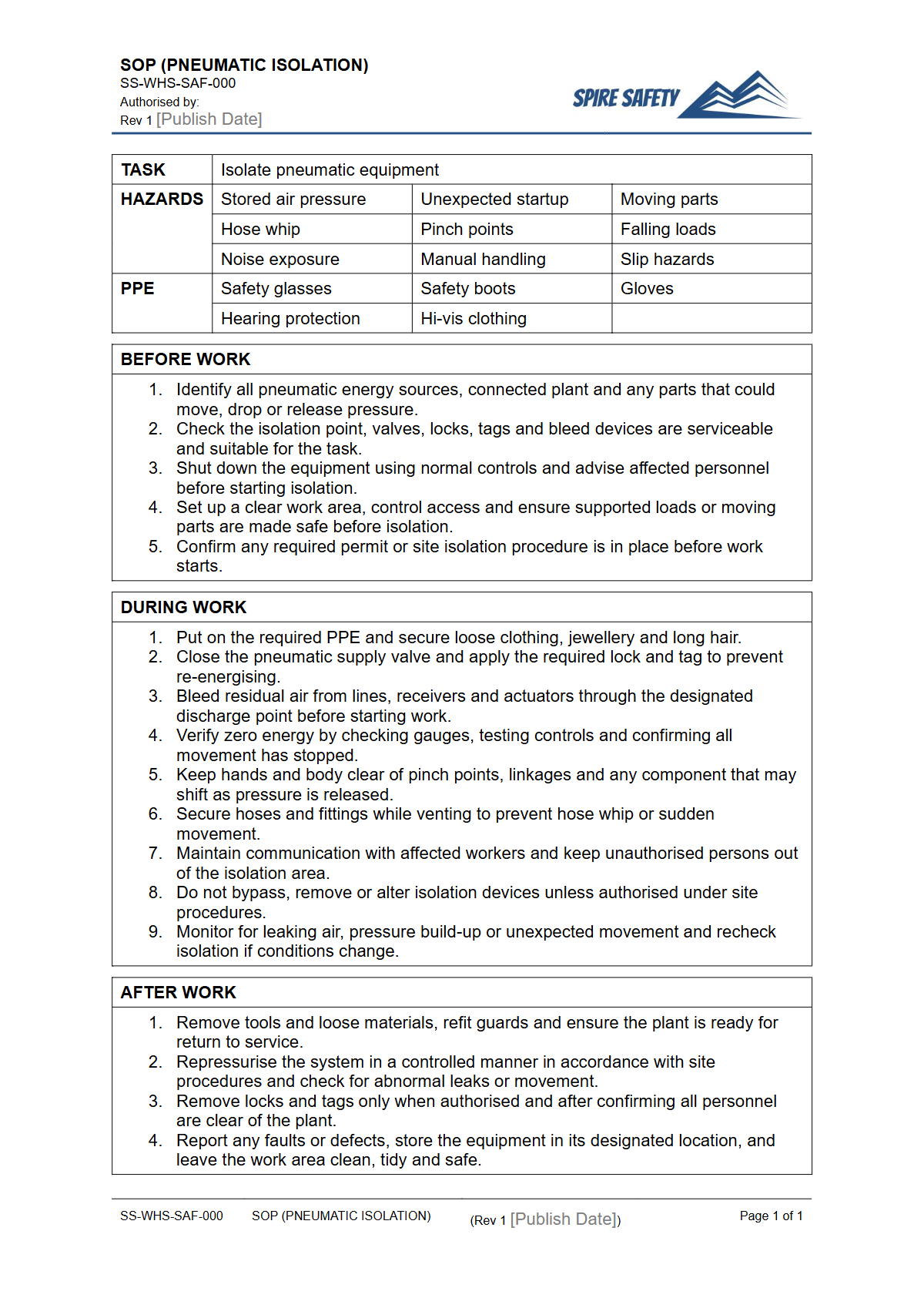
This Safe Operating Procedure template is available as a fully editable DOCX file and a print-ready PDF. To use it, download the file and systematically work through each section, filling in the details specific to your workplace and the equipment in question.
It includes fields for outlining responsibilities, required personal protective equipment (PPE), risk controls, and the sequential steps for isolation and re-energisation.
It is crucial to remember that this template is a starting point. You must customise it to reflect the specific pneumatic equipment, isolation points, and organisational procedures in your workplace.
We've included prompts and sections to guide you through this process. For example, your procedure will differ depending on whether you are isolating a simple pneumatic tool or a complex system powered by a central unit, which should have its own procedure documented in something like our free Air Compressor SOP.
When to use a Pneumatic Isolation Safe Operating Procedure
A documented pneumatic isolation procedure should be used whenever a worker needs to perform tasks on or near equipment where they could be exposed to the hazards of stored pneumatic energy. This includes, but is not limited to:
- Performing maintenance, repairs, or servicing on pneumatic machinery.
- Clearing jams or blockages from equipment with pneumatic actuators.
- Cleaning or inspecting parts of a machine that are normally in motion.
- Any task that requires a worker to place any part of their body into a danger zone where machine movement could cause injury.
Integrating these procedures is a key function of a robust WHS management system, demonstrating proactive risk management.
Who should use this Safe Operating Procedure
This template is designed for use by Persons Conducting a Business or Undertaking (PCBUs) to fulfil their duty of care. It should be developed by WHS managers, supervisors, and maintenance leaders in consultation with the workers who operate and service the equipment. The final, customised Safe Operating Procedure is intended for use by:
- Authorised and trained maintenance personnel and technicians.
- Machine operators trained in basic isolation procedures for cleaning or clearing tasks.
- Supervisors responsible for issuing work permits and overseeing high-risk tasks.
All individuals required to follow the SOP must be trained on its contents and deemed competent before performing any isolation tasks. This applies to a wide range of machinery, from simple presses to complex automated lines like those detailed in our Conveyer System SOP template.
Key Components of the Template
Our template guides you to document the critical elements of a compliant and effective isolation procedure. These include identifying all pneumatic energy sources, locating and labelling isolation valves, specifying the correct lockout devices and tags, and detailing the sequence for bleeding or venting stored pressure.
The procedure must also include a verification step, such as attempting to start the machine, to ensure the isolation has been successful before work commences. This level of procedural detail is essential for all powered equipment, including common tools like those covered in our free Circular Saw SOP.
The final section of the procedure should cover the steps for safely removing locks and re-energising the equipment, ensuring the area is clear and all personnel are accounted for. The effectiveness of these documented procedures is often a key focus of WHS compliance auditing.
By customising and implementing this template, you create a safer working environment and a clear, auditable record of your risk management process. Feel free to explore our free WHS resources library for more templates to support your safety management system.
Common mistakes
Common mistakes to avoid
- Assuming that turning off the machine's main power switch also de-pressurises the pneumatic system.
- Failing to verify isolation by attempting to operate the equipment after applying a lock.
- Using a generic procedure that doesn't account for the specific isolation points and stored energy risks of a particular machine.
- Forgetting to bleed residual pressure from pneumatic cylinders, accumulators, and air lines after closing the main valve.
Legal references
Legal considerations
The following legal requirements may be relevant to this type of work.
- Work Health and Safety Act (Harmonised) — Provides the primary duties for protecting workers and other people from work health and safety risks.
- Work Health and Safety Regulations (Harmonised) — Sets out requirements supporting the management of workplace hazards and risks.
The following codes may be relevant to this type of work.
- Managing WHS Risks Code of Practice — Provides practical guidance on identifying hazards, assessing risks and applying effective controls.
- Work Health and Safety Consultation, Cooperation and Coordination Code of Practice — Provides practical guidance on consulting workers and coordinating with other duty holders.
- Managing the Work Environment and Facilities Code of Practice — Provides practical guidance on safe work environments, workplace facilities and related controls.
Did you know
Hidden Force
Even after an air compressor is shut down, a standard pneumatic system can retain air at pressures over 100 psi. This stored energy is enough to cycle a machine or cause serious injury if not properly vented.
Verification is Vital
A significant portion of lockout/tagout incidents occur because the worker failed to verify that the system was truly de-energised. Always attempt to operate the equipment after isolation to confirm it has been successful.
FAQ
Frequently asked questions
01What is pneumatic isolation?
02Is a Safe Operating Procedure for pneumatic isolation a legal requirement in Australia?
03What's the difference between isolation and lockout?
04How often should we review our pneumatic isolation SOP?
Share this resource
Free Safe Operating Procedure (Pneumatic Isolation) Template
Browse Categories
How To Use It
- 1Download and open in Word or PDF.
- 2Replace the placeholders with your business details.
- 3Get it reviewed by a WHS specialist before rollout.
Need it customised?
Our WHS consultants can adapt this template to your site, run a gap analysis, or audit what you already have in place.
Book a Free Consultation WHS consulting servicesor call 1300 156 382
Related templates
- Free Safe Operating Procedure (Pole Climbing) Template
- Free Safe Operating Procedure (Pole Saw) Template
- Free Safe Operating Procedure (Pond Debris Removal) Template
- Free Safe Operating Procedure (Pond Edge Maintenance) Template
- Free Safe Operating Procedure (Pontoon Access) Template
- Free Safe Operating Procedure (Pool Backwashing) Template