
Free Safe Operating Procedure (Pontoon Access) Template
Formalise safety protocols for accessing and working on pontoons. Our free Safe Operating Procedure template provides a clear structure for your workplace safety. Download now.
Free Safe Operating Procedure (Pontoon Access) Template
DOCX • 126 KB + PDF
Updated Oct 2026
No signup required
Purpose of the Free Safe Operating Procedure (Pontoon Access) Template
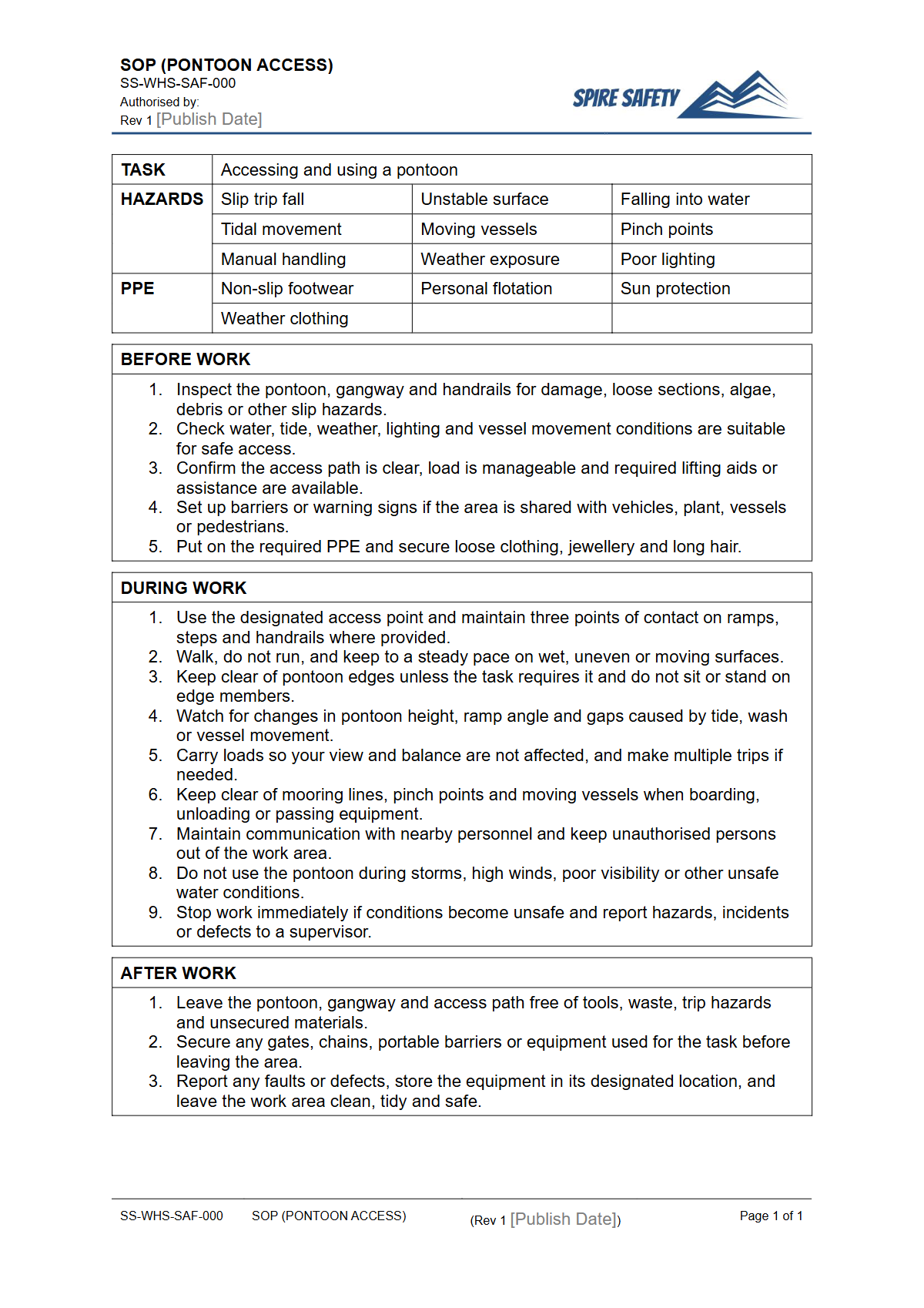
This free Safe Operating Procedure (Pontoon Access) template provides a framework for managing the unique risks associated with working on or near water. Accessing pontoons, whether for construction, maintenance, or events, introduces significant hazards such as falls into water, slips and trips, and structural instability.
A documented SOP is a critical administrative control to ensure all workers follow a consistent, safe method of work, reducing the risk of serious incidents. By using a structured template, you can systematically identify hazards and detail the control measures required for safe access and work.
It prompts you to consider factors like pontoon stability, gangway condition, environmental conditions, and emergency procedures.
Using a standardised SOP helps formalise operations, assists in training new staff, and demonstrates a commitment to proactive safety management as part of a robust WHS management system. It provides a clear, repeatable process that reduces ambiguity and improves safety outcomes on site.
Video walkthrough
How to use the Free Safe Operating Procedure (Pontoon Access) Template
To use this free Safe Operating Procedure (Pontoon Access) template, download the DOCX file and adapt it to your specific operational needs. Fill in the required fields with details relevant to your site, including the types of pontoons used, specific tasks performed, and site-specific emergency contacts.
It is crucial to conduct a site-specific risk assessment to inform the SOP's content, ensuring all identified hazards are adequately controlled.
Please note: This is a template, not a finished document. We strongly recommend you customise it to reflect the specific equipment, environment, and tasks at your worksite. For example, if heavy equipment is used for loading or access, you might need to cross-reference procedures from documents like our free Telehandler SOP template to ensure all related activities are covered.
When to use a Pontoon Access Safe Operating Procedure
A Pontoon Access SOP should be developed and implemented before any work begins on or from a pontoon structure. It is an essential document for tasks in marine construction, vessel maintenance, marina operations, public events near water, and environmental monitoring.
The SOP should be reviewed as part of a pre-start check before each use, especially if conditions change, such as during adverse weather, strong currents, or significant changes in water level.
The SOP forms a key part of applying the hierarchy of controls to the identified risks. If you are unsure how to effectively assess risks or implement controls for pontoon access tasks, our WHS consulting services can provide expert guidance.
The procedure should also outline the sequence of operations, from pre-use inspections of the pontoon and access gangways to the safe use of equipment on the structure. This may include portable tools powered by equipment that requires its own procedure, such as that detailed in our free Air Compressor SOP template.
Who should use this Safe Operating Procedure
This Safe Operating Procedure should be developed by a competent person, such as a Site Supervisor or WHS Manager, in consultation with the workers who will be performing the task. All workers and contractors required to access the pontoon must be trained in the SOP's contents before commencing work.
It serves as a vital training tool during inductions and a reference guide for toolbox talks, reinforcing safe work behaviour.
Supervisors can also use the document as an observational checklist to verify that procedures are being followed correctly. This practice is valuable for internal safety reviews and can provide important evidence during formal WHS compliance auditing. By implementing a comprehensive SOP for pontoon access, you create a safer working environment and help meet your duty of care obligations under WHS legislation.
Explore more templates and guides in our free WHS resources library to further enhance your safety systems.
Common mistakes
Common mistakes to avoid
- Failing to account for changing weather, tide, and water current conditions.
- Neglecting to inspect the pontoon, anchors, and access gangway for damage or wear before each use.
- Not providing, or workers failing to use, appropriate personal protective equipment (PPE) like a correctly fitted life jacket.
- Overloading the pontoon beyond its maximum rated capacity or with poorly distributed weight.
Legal references
Legal considerations
The following legal requirements may be relevant to this type of work.
- Work Health and Safety Act (Harmonised) — Provides the primary duties for protecting workers and other people from work health and safety risks.
- Work Health and Safety Regulations (Harmonised) — Sets out requirements supporting the management of workplace hazards and risks.
The following codes may be relevant to this type of work.
- Managing WHS Risks Code of Practice — Provides practical guidance on identifying hazards, assessing risks and applying effective controls.
- Work Health and Safety Consultation, Cooperation and Coordination Code of Practice — Provides practical guidance on consulting workers and coordinating with other duty holders.
- Managing the Work Environment and Facilities Code of Practice — Provides practical guidance on safe work environments, workplace facilities and related controls.
Did you know
Working Over Water Risks
According to Safe Work Australia, 51 workers drowned in work-related incidents between 2003 and 2021, with many of these tragedies occurring in the construction and transport industries.
Pontoon Stability
A pontoon's stability is critically affected by its centre of gravity. Placing heavy or unbalanced loads, especially high up or near the edge, can rapidly decrease stability and significantly increase the risk of capsizing.
FAQ
Frequently asked questions
01What is a Safe Operating Procedure for pontoon access?
02What hazards should be included in a pontoon access SOP?
03Is this pontoon access SOP template structured?
04Who is responsible for creating and updating the SOP?
Share this resource
Free Safe Operating Procedure (Pontoon Access) Template
Browse Categories
How To Use It
- 1Download and open in Word or PDF.
- 2Replace the placeholders with your business details.
- 3Get it reviewed by a WHS specialist before rollout.
Need it customised?
Our WHS consultants can adapt this template to your site, run a gap analysis, or audit what you already have in place.
Book a Free Consultation WHS consulting servicesor call 1300 156 382
Related templates
- Free Safe Operating Procedure (Pool Backwashing) Template
- Free Safe Operating Procedure (Pool Chemical Dosing System Operation) Template
- Free Safe Operating Procedure (Pool Cover Handling) Template
- Free Safe Operating Procedure (Pool Deck Cleaning) Template
- Free Safe Operating Procedure (Pool Deck Inspection) Template
- Free Safe Operating Procedure (Pool Fence Cleaning) Template