
Free Safe Operating Procedure (Pool Backwashing) Template
Document the correct process for cleaning your pool filter system to ensure safety and efficiency. Download our free Safe Operating Procedure template.
Free Safe Operating Procedure (Pool Backwashing) Template
DOCX • 126 KB + PDF
Updated Oct 2026
No signup required
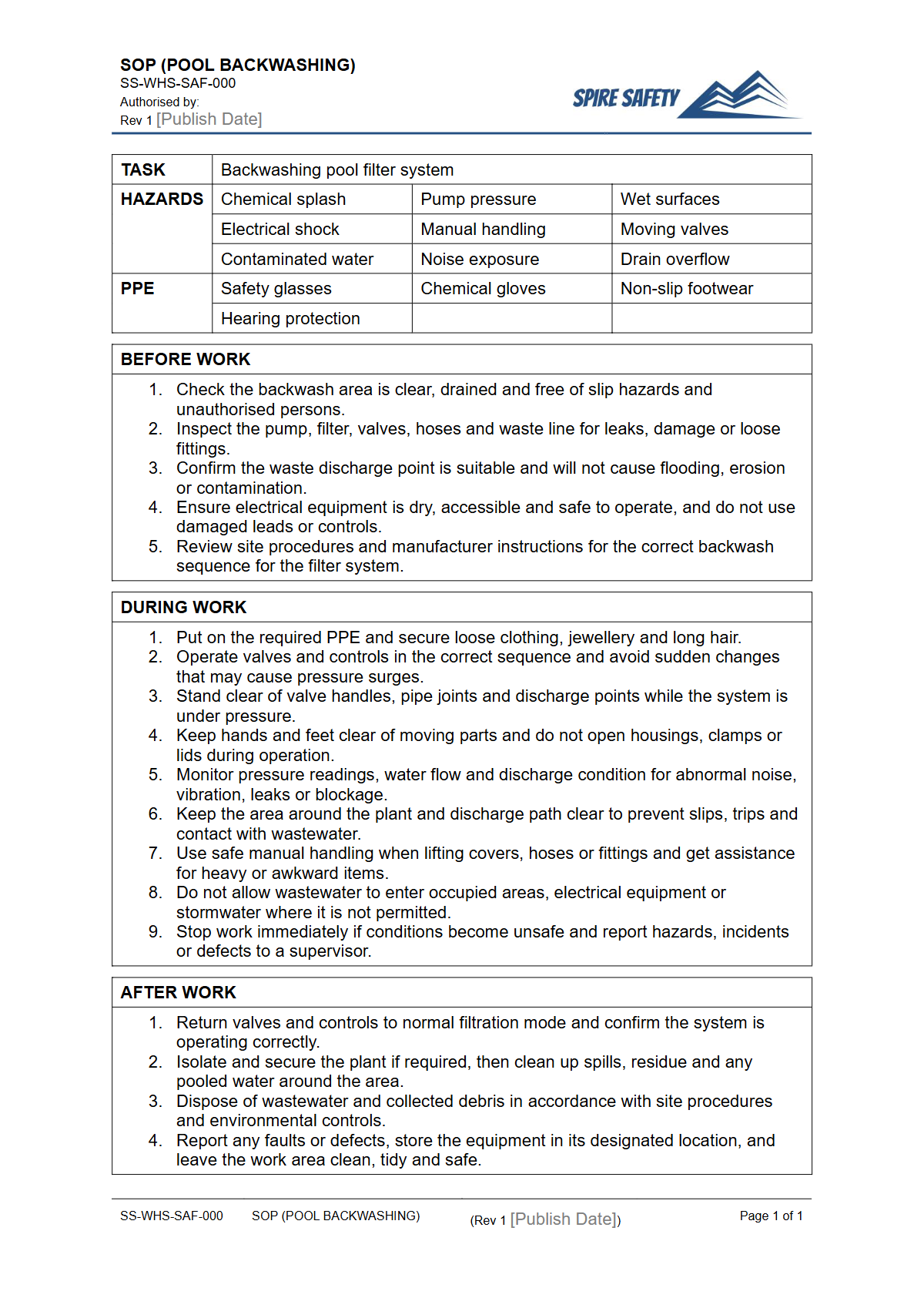
Purpose of the Free Safe Operating Procedure (Pool Backwashing) Template
Maintaining a commercial or public swimming pool requires strict adherence to safety protocols, especially for routine tasks like filter backwashing. This free Safe Operating Procedure (Pool Backwashing) Template provides a structured framework for documenting the step-by-step process, helping to ensure the task is performed safely and consistently every time.
Backwashing involves significant hazards, including exposure to hazardous chemicals, risks associated with pressurised equipment, manual handling, and potential for slips, trips, and falls on wet surfaces.
Using a standardised SOP helps any person conducting business or undertaking (PCBU) meet their primary duty of care by providing a clear, safe system of work. It forms a crucial part of a broader WHS management system, demonstrating a commitment to proactive risk management and operational safety.
Video walkthrough
How to use the Free Safe Operating Procedure (Pool Backwashing) Template
This template is provided as a fully editable DOCX file, with a PDF version also available for easy printing and distribution. It is designed as a starting point and must be adapted to the specific circumstances of your workplace.
A generic procedure cannot account for the unique layout, equipment, and chemical usage of your facility. A competent person should review and customise the document before implementation.
When customising this Safe Operating Procedure, you must include site-specific details such as the make and model of the pool pump and filter, locations of emergency shut-offs, specific chemicals used, required Personal Protective Equipment (PPE), and emergency contact information. Regular reviews and updates are also essential, particularly after WHS compliance audits or when new equipment is introduced.
Key Elements of a Pool Backwashing Safe Operating Procedure
A comprehensive SOP for this task should cover several key phases to ensure all risks are controlled. The template guides you to document each of these stages clearly.
It starts with pre-operational checks, which include inspecting the work area for slip hazards, ensuring adequate ventilation, checking the pressure gauge, and verifying that all necessary PPE is available and in good condition. This stage might also cover procedures for other associated plant, such as those detailed in our free Air Compressor SOP if pneumatic tools are used for maintenance.
The core of the document is the step-by-step procedure for backwashing. This section should detail the exact sequence for turning off the pump, changing the multiport valve settings (e.g., from 'FILTER' to 'BACKWASH'), running the backwash cycle for the correct duration, performing a 'RINSE' cycle, and finally returning the valve to the 'FILTER' position before restarting the pump.
Ambiguity at this stage can lead to equipment damage or injury.
Post-operational checks are just as important. This includes checking for leaks, ensuring the system pressure has returned to its normal operating range, and correctly cleaning and storing all equipment and PPE. For organisations like hotels or resorts with multiple operational hazards, this level of procedural detail is vital, similar to the process outlined in a Safe Operating Procedure for a deep fryer.
When to use it
This SOP should be used every time a pool filter backwash is required. The need for backwashing is typically indicated by the filter's pressure gauge, which shows an increase in pressure as the filter media becomes clogged with debris.
It should also be a key document for training new employees, providing a consistent and safe method of instruction. Furthermore, the SOP serves as a reference for periodic refresher training and as a critical piece of documentation during safety audits or incident investigations.
Who should use it
The primary users of this Safe Operating Procedure are the individuals responsible for pool maintenance, such as pool technicians, groundskeepers, and facility maintenance staff. It is also an essential tool for supervisors and managers who oversee these operations, allowing them to verify that correct procedures are being followed.
WHS managers and officers will use the SOP as evidence of a formalised risk control measure. For complex sites or those needing external guidance, our WHS consulting services can assist in developing and integrating these procedures effectively.
By implementing and enforcing this SOP, you create a safer environment for workers and ensure the pool remains a healthy and well-maintained asset for everyone to enjoy. You can explore our complete range of templates and guides in our free WHS resources library to support your organisation's safety culture.
Common mistakes
Common mistakes to avoid
- Forgetting to turn the pump off before turning the multiport valve handle.
- Backwashing for too long, which wastes excessive water and chemicals.
- Not backwashing long enough, resulting in a filter that is still dirty and inefficient.
- Incorrectly adding or handling diatomaceous earth (DE) or other filter media after the procedure.
Legal references
Legal considerations
The following legal requirements may be relevant to this type of work.
- Work Health and Safety Act (Harmonised) — Provides the primary duties for protecting workers and other people from work health and safety risks.
- Work Health and Safety Regulations (Harmonised) — Sets out requirements supporting the management of workplace hazards and risks.
The following codes may be relevant to this type of work.
- Managing WHS Risks Code of Practice — Provides practical guidance on identifying hazards, assessing risks and applying effective controls.
- Work Health and Safety Consultation, Cooperation and Coordination Code of Practice — Provides practical guidance on consulting workers and coordinating with other duty holders.
- Managing the Work Environment and Facilities Code of Practice — Provides practical guidance on safe work environments, workplace facilities and related controls.
Did you know
Pressure Gauge is Key
The pressure gauge on a pool filter is the most important indicator for when to backwash. Relying on a fixed schedule can be inefficient, as bather load and debris levels can vary significantly.
Rinse Cycle
Forgetting the 'Rinse' cycle after backwashing a sand or DE filter is a common error. This brief cycle resettles the filter media and flushes any remaining debris to waste, preventing it from being blown back into the pool.
FAQ
Frequently asked questions
01What are the main hazards involved in pool backwashing?
02Is a Safe Operating Procedure legally required for backwashing a pool in Australia?
03How often should a pool filter be backwashed?
04What PPE should be worn during pool backwashing?
Share this resource
Free Safe Operating Procedure (Pool Backwashing) Template
Browse Categories
How To Use It
- 1Download and open in Word or PDF.
- 2Replace the placeholders with your business details.
- 3Get it reviewed by a WHS specialist before rollout.
Need it customised?
Our WHS consultants can adapt this template to your site, run a gap analysis, or audit what you already have in place.
Book a Free Consultation WHS consulting servicesor call 1300 156 382
Related templates
- Free Safe Operating Procedure (Pool Chemical Dosing System Operation) Template
- Free Safe Operating Procedure (Pool Cover Handling) Template
- Free Safe Operating Procedure (Pool Deck Cleaning) Template
- Free Safe Operating Procedure (Pool Deck Inspection) Template
- Free Safe Operating Procedure (Pool Fence Cleaning) Template
- Free Safe Operating Procedure (Pool Filter Cleaning) Template