
Free Safe Operating Procedure (Pool Filter Cleaning) Template
Properly cleaning a pool filter involves significant hazards. Our free Safe Operating Procedure (Pool Filter Cleaning) Template helps you outline the risks and controls. Download the customisable template today.
Free Safe Operating Procedure (Pool Filter Cleaning) Template
DOCX • 126 KB + PDF
Updated Oct 2026
No signup required
Purpose of the Free Safe Operating Procedure (Pool Filter Cleaning) Template
Cleaning commercial or residential pool filters is a common maintenance task, but it carries significant risks if not performed correctly. This free Safe Operating Procedure (Pool Filter Cleaning) Template provides a structured framework for documenting the required steps to complete the task safely.
It helps organisations meet their duty of care by identifying hazards and implementing control measures. The procedure addresses risks such as chemical exposure, electrical shock, high-pressure equipment, and manual handling.
A well-defined SOP is a critical component of a business’s overall safety strategy. It forms a key part of broader WHS management systems, ensuring that all workers follow a consistent, safe, and effective process.
Using this template helps standardise your approach, reduce the likelihood of incidents, and provide clear instructions for training and supervision.
Video walkthrough
How to use the Free Safe Operating Procedure (Pool Filter Cleaning) Template
This template is available for download as a DOCX file for easy editing or as a PDF for straightforward printing. It is designed as a starting point, providing a comprehensive layout that aligns with Australian WHS expectations.
To make it effective for your specific circumstances, you must adapt the content to your unique workplace.
Important: This document must be customised. We have provided a general structure, but you need to consult with your workers and assess your specific equipment, chemicals, and work environment.
Identify the make and model of your filter system, the specific chemicals used (e.g., chlorine, hydrochloric acid, sodium bicarbonate), and any site-specific hazards. If you require expert assistance in tailoring safety documents, our WHS consulting services can provide tailored support.
What the Template Covers
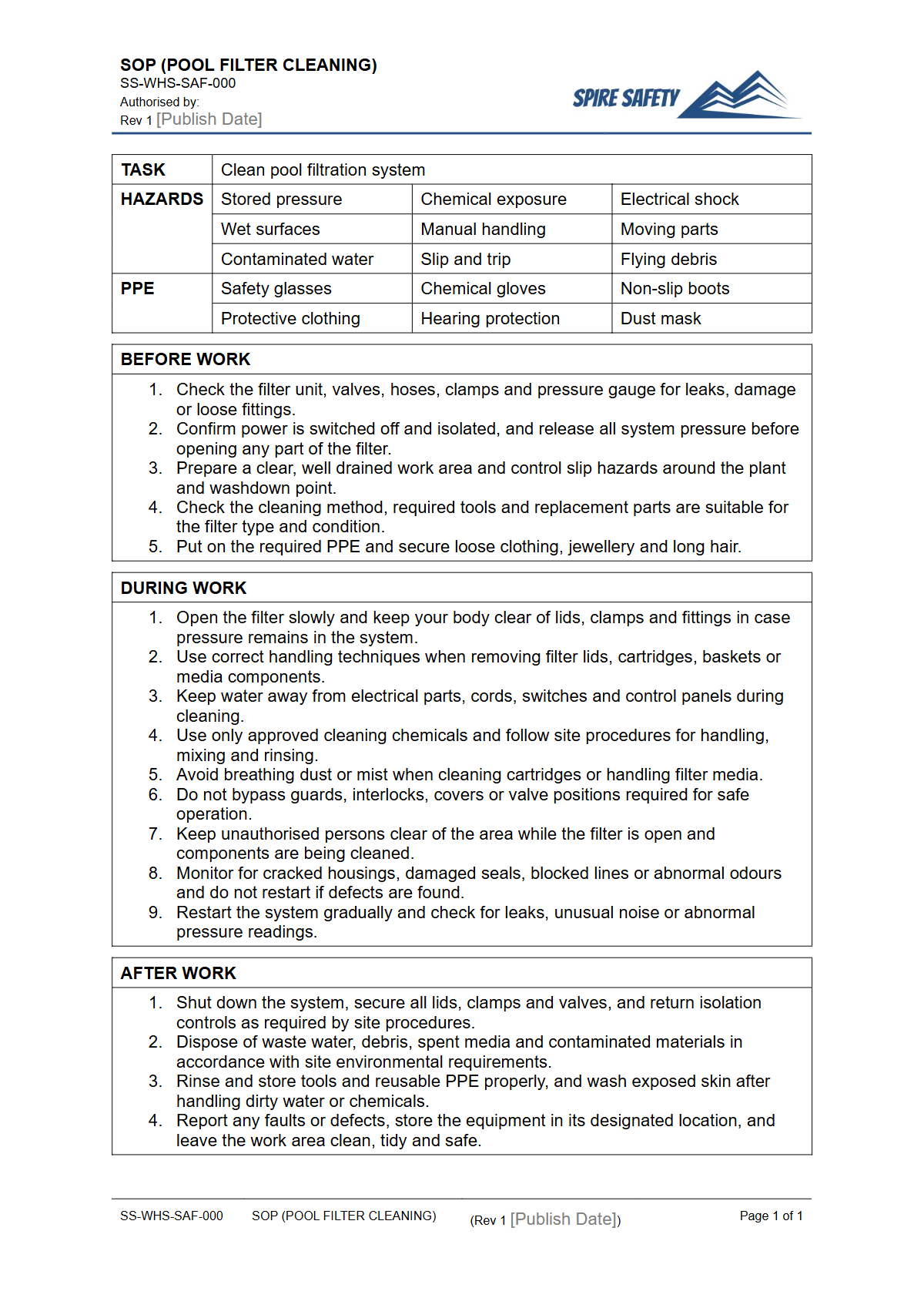
Our template guides you through documenting all necessary safety aspects of the cleaning process. Key sections included are:
- Associated Risks: A list of potential hazards like chemical burns, electric shock, slips and falls, and musculoskeletal injuries.
- Required Personal Protective Equipment (PPE): Specifies necessary PPE such as safety glasses, chemical-resistant gloves, and appropriate footwear.
- Pre-operational Checks: Outlines steps for isolating power (lockout-tagout), de-pressurising the filter tank, and preparing the work area.
- Step-by-step Procedure: A logical sequence for dismantling, cleaning, and reassembling the filter components (e.g., cartridges, D.E. grids, or sand).
- Post-operational Checks: Details procedures for restoring power, checking for leaks, and safely storing chemicals.
Documenting procedures for all high-risk equipment is essential for workplace safety. For example, tasks involving pressurised systems extend beyond pools, as seen in our free Air Compressor SOP template, which outlines similar principles of isolation and risk control.
When to Use This SOP
A Safe Operating Procedure for pool filter cleaning should be a living document, used consistently throughout your operations. It is essential for:
- Worker Training and Induction: Use it to train new employees or contractors, ensuring they understand the approved method before starting work.
- Pre-task Planning: Workers should review the SOP before commencing the cleaning task, especially if it is performed infrequently.
- Refresher Training: It serves as an excellent tool for periodic refresher sessions to prevent complacency and reinforce safe work habits.
- Incident Investigation: Following an incident or near-miss, the SOP can be reviewed and updated to prevent a recurrence. Regular reviews can also be triggered as part of scheduled WHS compliance auditing to ensure the procedure remains current and effective.
Who Should Use This SOP
This procedure is designed for anyone involved in or responsible for the maintenance of swimming pool filtration systems. This includes:
- Pool Technicians and Maintenance Staff: The primary users who perform the cleaning task.
- Supervisors and Managers: Responsible for ensuring workers are trained on and adhere to the SOP.
- Persons Conducting a Business or Undertaking (PCBUs): Business owners and operators who hold the primary duty of care for worker safety.
By implementing and enforcing this SOP, PCBUs can demonstrate a proactive approach to managing health and safety risks. You can find more templates and checklists to support your safety goals in our free WHS resources library.
Common mistakes
Common mistakes to avoid
- Forgetting to turn off the power and isolate the pump before starting work.
- Failing to release the air pressure from the filter tank before opening the lid.
- Using incorrect manual handling techniques when lifting heavy filter cartridges or grids.
- Handling cleaning chemicals like muriatic acid without wearing appropriate PPE, such as gloves and eye protection.
Legal references
Legal considerations
The following legal requirements may be relevant to this type of work.
- Work Health and Safety Act (Harmonised) — Provides the primary duties for protecting workers and other people from work health and safety risks.
- Work Health and Safety Regulations (Harmonised) — Sets out requirements supporting the management of workplace hazards and risks.
The following codes may be relevant to this type of work.
- Managing WHS Risks Code of Practice — Provides practical guidance on identifying hazards, assessing risks and applying effective controls.
- Work Health and Safety Consultation, Cooperation and Coordination Code of Practice — Provides practical guidance on consulting workers and coordinating with other duty holders.
- Managing the Work Environment and Facilities Code of Practice — Provides practical guidance on safe work environments, workplace facilities and related controls.
Did you know
A Dangerous Mix
Mixing chlorine with acid, a common mistake during pool maintenance, creates toxic chlorine gas. Even brief exposure can cause severe respiratory damage, highlighting the need for strict chemical handling procedures.
Filter Pressure
A pool filter tank can operate under significant pressure. Failing to properly release this pressure before opening the housing can cause the lid and components to be ejected with explosive force, posing a serious risk of injury.
FAQ
Frequently asked questions
01What is a Safe Operating Procedure (SOP)?
02Why do I need an SOP for cleaning a pool filter?
03What are the main hazards when cleaning a pool filter?
04Is this template enough to be WHS-aligned?
Share this resource
Free Safe Operating Procedure (Pool Filter Cleaning) Template
Browse Categories
How To Use It
- 1Download and open in Word or PDF.
- 2Replace the placeholders with your business details.
- 3Get it reviewed by a WHS specialist before rollout.
Need it customised?
Our WHS consultants can adapt this template to your site, run a gap analysis, or audit what you already have in place.
Book a Free Consultation WHS consulting servicesor call 1300 156 382
Related templates
- Free Safe Operating Procedure (Pool Furniture Setup) Template
- Free Safe Operating Procedure (Pool Gate Inspection) Template
- Free Safe Operating Procedure (Pool Lane Rope Handling) Template
- Free Safe Operating Procedure (Pool Lane Setup) Template
- Free Safe Operating Procedure (Pool Leaf Skimming) Template
- Free Safe Operating Procedure (Pool Rescue Gear Check) Template