
Free Safe Operating Procedure (Pool Furniture Setup) Template
Streamline your safety processes for hospitality and recreation areas with our structured template. Download this free Safe Operating Procedure to get started.
Free Safe Operating Procedure (Pool Furniture Setup) Template
DOCX • 126 KB + PDF
Updated Oct 2026
No signup required
Purpose of the Free Safe Operating Procedure (Pool Furniture Setup) Template
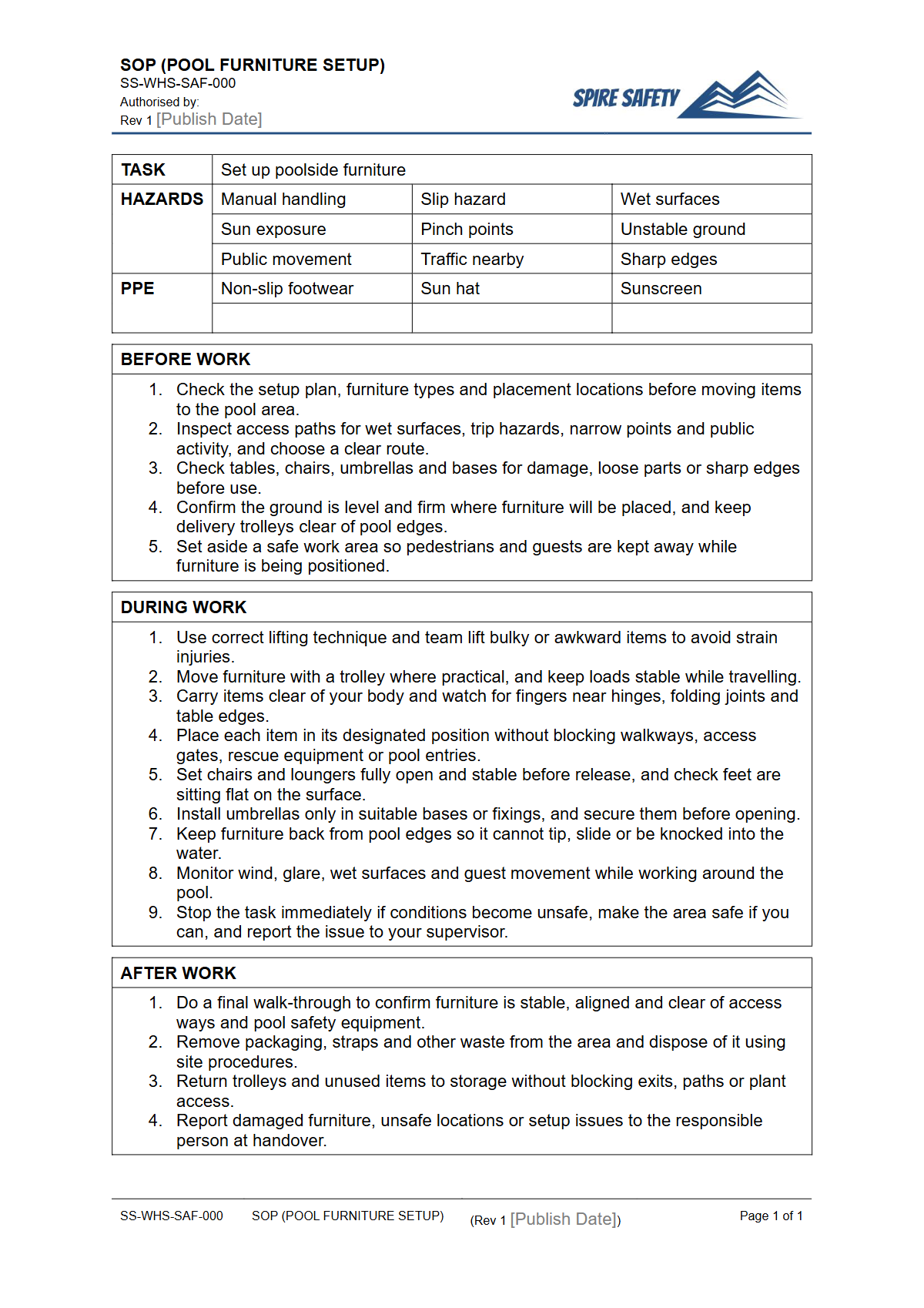
Setting up pool furniture may seem like a straightforward task, but it carries inherent risks that can lead to workplace injuries. This Free Safe Operating Procedure (Pool Furniture Setup) Template provides a structured framework to help you formalise a safe system of work for this common activity.
By documenting the process, you can effectively manage hazards, ensure consistency in how the task is performed, and provide a clear training tool for your workers.
The primary purpose of this SOP is to outline the step-by-step process for safely moving, positioning, and storing pool furniture such as sun loungers, chairs, tables, and umbrellas. It prompts consideration of key hazards, including musculoskeletal injuries from hazardous manual tasks, pinch and crush points, and slip, trip, and fall hazards on wet or uneven surfaces.
Implementing documented procedures is a fundamental part of building robust WHS management systems that protect both your employees and the public.
Key Hazards Addressed
A comprehensive SOP for this task should identify and control risks including:
- Manual Handling: Lifting, carrying, pushing, and pulling heavy or awkward furniture can lead to sprains and strains.
- Slips, Trips & Falls: Wet surfaces, hoses, and poorly placed items create significant trip hazards around pool areas.
- Pinch Points: Folding chairs, adjustable loungers, and cantilever umbrellas have mechanisms that can pinch or crush fingers.
- Environmental Factors: Working in direct sun can lead to heat stress, while sudden wind gusts can make large umbrellas unstable and dangerous to handle.
- Damaged Equipment: Broken or unstable furniture can collapse during movement or use, creating a risk of injury.
Video walkthrough
How to use the Free Safe Operating Procedure (Pool Furniture Setup) Template
This template is available for download in both DOCX and PDF formats. We recommend using the DOCX version to customise the document to your specific operational needs.
A generic procedure is not sufficient; you must adapt it to reflect the realities of your workplace. Review each section and add or remove information based on the exact type of furniture you use, the layout of your pool area, the staff who perform the task, and the specific control measures you have in place.
Please note: This document is a starting-point template designed to align with Australian WHS principles. It is not a complete, ready-to-use legal document.
We strongly recommend you conduct your own risk assessment and customise this SOP to reflect the unique hazards and controls of your specific site and equipment. If you require assistance in tailoring safety documentation to your business, engaging professional WHS consulting services can provide expert guidance.
When to use the Safe Operating Procedure
This SOP should be the go-to reference document whenever pool furniture is handled. This includes daily setup routines at the start of the day, packing down at closing time, rearranging furniture for cleaning or special events, and moving items to or from storage.
The procedure should be integrated into your training program for all new employees assigned to these duties and used for regular refresher training to prevent complacency. It also serves as an excellent resource for toolbox talks, especially at the beginning of peak season when seasonal staff are onboarded. For more templates and checklists to support your safety program, browse our complete free WHS resources library.
Who should use it
This Safe Operating Procedure is intended for all persons conducting a business or undertaking (PCBUs) in environments with poolside furniture, such as hotels, resorts, motels, holiday parks, and public swimming facilities. It should be actively used by workers who perform the task, including grounds staff, pool attendants, maintenance teams, and event personnel.
Supervisors and managers are responsible for ensuring the procedure is understood, followed, and periodically reviewed for relevance. The structured format also makes it useful for safety officers and management when developing broader safety systems that cover various operational tasks, similar to how one might customise a deep fryer standard operation SOP for a commercial kitchen.
Integrating the SOP into Your Safety System
A document is only effective when it is put into practice. Ensure the finalised SOP is readily accessible to all relevant workers, either as a laminated copy in a staff area or digitally on company devices.
Supervisors should periodically observe the task being performed to verify it aligns with the written procedure. Any deviations or newly identified hazards should prompt a review and potential update of the SOP.
This process of documentation, implementation, and review is critical for maintaining a safe workplace and demonstrating due-diligence.
Many facilities have multiple pieces of equipment that require documented procedures. Just as you need an SOP for furniture setup, you might also require others like a Free Air Compressor SOP for your maintenance workshop.
A program of regular WHS compliance auditing can help ensure these documented procedures are being implemented effectively across all areas of your operation and that they remain current with regulatory requirements and best practices.
Common mistakes
Common mistakes to avoid
- Assuming the task is "common sense" and requires no formal procedure or training.
- Failing to inspect furniture for damage like sharp edges, cracks, or instability before moving it.
- Not clearing pathways or checking for trip hazards (e.g., hoses, bags) before starting.
- Using incorrect manual handling techniques, such as twisting the back while carrying a heavy item.
Legal references
Legal considerations
The following legal requirements may be relevant to this type of work.
- Work Health and Safety Act (Harmonised) — Provides the primary duties for protecting workers and other people from work health and safety risks.
- Work Health and Safety Regulations (Harmonised) — Sets out requirements supporting the management of workplace hazards and risks.
The following codes may be relevant to this type of work.
- Managing WHS Risks Code of Practice — Provides practical guidance on identifying hazards, assessing risks and applying effective controls.
- Work Health and Safety Consultation, Cooperation and Coordination Code of Practice — Provides practical guidance on consulting workers and coordinating with other duty holders.
- Managing the Work Environment and Facilities Code of Practice — Provides practical guidance on safe work environments, workplace facilities and related controls.
Did you know
Manual Handling Risk
Musculoskeletal disorders from hazardous manual tasks are the most common mechanism of workplace injury in Australia, highlighting the need for procedures even for seemingly simple tasks like moving furniture.
Slip Hazards
Slips, trips, and falls are a leading cause of injury in the hospitality industry. Wet surfaces around pools significantly increase this risk during activities like furniture setup and pack-down.
FAQ
Frequently asked questions
01What hazards are involved in setting up pool furniture?
02Is a Safe Operating Procedure legally required for setting up pool furniture in Australia?
03How often should we review our Pool Furniture Setup SOP?
04Can this template be used for other types of furniture?
Share this resource
Free Safe Operating Procedure (Pool Furniture Setup) Template
Browse Categories
How To Use It
- 1Download and open in Word or PDF.
- 2Replace the placeholders with your business details.
- 3Get it reviewed by a WHS specialist before rollout.
Need it customised?
Our WHS consultants can adapt this template to your site, run a gap analysis, or audit what you already have in place.
Book a Free Consultation WHS consulting servicesor call 1300 156 382
Related templates
- Free Safe Operating Procedure (Pool Gate Inspection) Template
- Free Safe Operating Procedure (Pool Lane Rope Handling) Template
- Free Safe Operating Procedure (Pool Lane Setup) Template
- Free Safe Operating Procedure (Pool Leaf Skimming) Template
- Free Safe Operating Procedure (Pool Rescue Gear Check) Template
- Free Safe Operating Procedure (Pool Safety Sign Check) Template