
Free Safe Operating Procedure (Pool Rescue Gear Check) Template
Ensure your aquatic facility is prepared for emergencies with our free Safe Operating Procedure (Pool Rescue Gear Check) template.
Free Safe Operating Procedure (Pool Rescue Gear Check) Template
DOCX • 126 KB + PDF
Updated Oct 2026
No signup required
Purpose of the Free Safe Operating Procedure (Pool Rescue Gear Check) Template
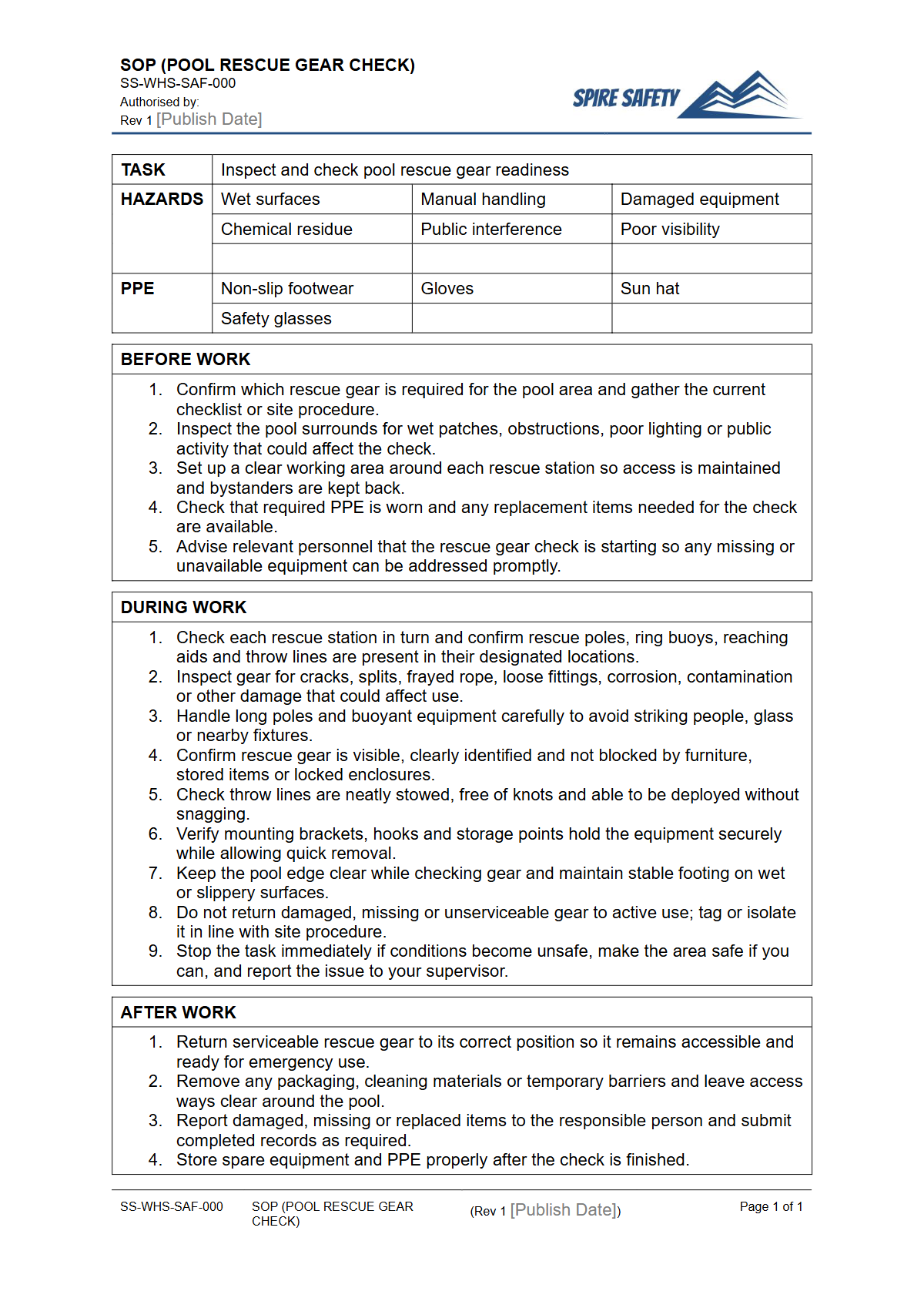
This Free Safe Operating Procedure (Pool Rescue Gear Check) Template provides a structured framework for aquatic facility operators to ensure all rescue equipment is present, functional, and ready for immediate use. Regularly inspecting items like reach poles, throw ropes, lifebuoys, and spinal boards is a critical safety control measure.
A documented SOP standardises this process, creating a clear record of checks and promoting accountability among staff. Using this template helps organisations systematically manage the risks associated with aquatic emergencies by verifying the integrity of life-saving equipment.
It forms a key component of your broader WHS management systems, demonstrating a proactive approach to safety.
What this Safe Operating Procedure covers:
- Essential pre-operational safety checks for a range of pool rescue equipment.
- Step-by-step instructions for conducting the inspection.
- A checklist format to record the condition of each item.
- Procedures for reporting and rectifying faults or missing equipment.
Video walkthrough
How to use the Free Safe Operating Procedure (Pool Rescue Gear Check) Template
This template is designed as a starting point. You must adapt it to the specific equipment, layout, and operational realities of your facility.
A large public pool will have different requirements compared to a small hotel or school pool.
Important: We have developed this document as a general guide. It is the responsibility of the Person Conducting a Business or Undertaking (PCBU) to ensure it is customised to reflect the specific hazards and control measures relevant to their workplace.
You may need to seek expert advice to ensure your safety procedures are robust and effective. Spire Safety offers professional WHS consulting to help businesses refine their safety documentation and practices.
Customisation steps:
- Download: Choose either the DOCX or PDF format.
- Review and Edit: Go through each section and add or remove equipment specific to your location. Adjust the checklist items to match the manufacturer's recommendations for each piece of gear.
- Consult: Involve your lifeguards, duty managers, and other relevant staff in the review process. Their hands-on experience is invaluable for creating a practical and effective procedure.
- Approve and Implement: Once finalised, formally approve the SOP and integrate it into your operational routines. Ensure all relevant personnel are trained on how to use it correctly. Scheduled checks are fundamental to safety, much like the pre-start checks outlined in a Free Air Compressor SOP Template are vital for machinery operation.
When to use it
This SOP should be used as part of your daily, weekly, and monthly safety inspection schedule. The frequency of checks for specific items may vary based on manufacturer guidelines, facility usage levels, and environmental factors (e.g., outdoor pools may require more frequent checks due to UV exposure).
It should also be used:
- Before the start of each operating day or shift.
- After any incident where rescue equipment was used.
- During routine safety audits to verify compliance with internal procedures.
- As a training tool for new staff members responsible for facility safety.
Integrating this SOP into your regular processes helps prepare your organisation for a WHS compliance auditing program, where documented evidence of safety checks is often reviewed. In large facilities, ensuring all equipment is accounted for and functional is a major logistical task; for example, if a telehandler SOP is used for high-reach maintenance, this pool rescue SOP manages the critical life-saving gear at ground level.
Who should use it
This document is intended for anyone responsible for safety and operations at an aquatic facility. This includes:
- Pool Managers and Duty Managers: For overseeing and ensuring the checks are completed.
- Lifeguards and Pool Attendants: As the primary users who conduct the day-to-day inspections.
- WHS/OHS Officers: For integrating the SOP into the overall safety management system and using it during audits.
- Facility Owners (PCBUs): To fulfil their primary duty of care by ensuring safe systems of work are in place.
By providing a clear and consistent procedure, this SOP helps ensure that every person with a safety responsibility understands their role in maintaining the readiness of critical rescue equipment. You can find many other useful documents in our free WHS resources library to support your safety goals.
Common mistakes
Common mistakes to avoid
- Failing to inspect equipment daily, leading to surprise failures during an emergency.
- Storing rescue equipment in locked or inaccessible locations.
- Continuing to use equipment that is damaged, faded, or past its expiry date.
- Incomplete documentation, or 'pencil-whipping' checklists without actually performing the checks.
Legal references
Legal considerations
The following legal requirements may be relevant to this type of work.
- Work Health and Safety Act (Harmonised) — Provides the primary duties for protecting workers and other people from work health and safety risks.
- Work Health and Safety Regulations (Harmonised) — Sets out requirements supporting the management of workplace hazards and risks.
The following codes may be relevant to this type of work.
- Managing WHS Risks Code of Practice — Provides practical guidance on identifying hazards, assessing risks and applying effective controls.
- Work Health and Safety Consultation, Cooperation and Coordination Code of Practice — Provides practical guidance on consulting workers and coordinating with other duty holders.
- Managing the Work Environment and Facilities Code of Practice — Provides practical guidance on safe work environments, workplace facilities and related controls.
Did you know
Drowning Statistics
According to the Royal Life Saving Society Australia, on average, 281 people die from drowning in Australia each year. Many of these incidents occur in locations where timely access to functional rescue equipment could have made a difference.
The Importance of Reach
Reach poles and throw ropes are among the most critical pieces of rescue equipment, allowing a rescuer to assist a person in distress without entering the water themselves. This significantly reduces the risk of a simple rescue escalating into a more dangerous double-drowning situation.
FAQ
Frequently asked questions
01What should be included in a pool rescue gear checklist?
02How often should pool rescue equipment be inspected?
03Who is responsible for checking pool rescue equipment?
04Why is a documented SOP better than an informal checklist?
Share this resource
Free Safe Operating Procedure (Pool Rescue Gear Check) Template
Browse Categories
How To Use It
- 1Download and open in Word or PDF.
- 2Replace the placeholders with your business details.
- 3Get it reviewed by a WHS specialist before rollout.
Need it customised?
Our WHS consultants can adapt this template to your site, run a gap analysis, or audit what you already have in place.
Book a Free Consultation WHS consulting servicesor call 1300 156 382
Related templates
- Free Safe Operating Procedure (Pool Safety Sign Check) Template
- Free Safe Operating Procedure (Pool Test Kit Handling) Template
- Free Safe Operating Procedure (Pool Tile Cleaning) Template
- Free Safe Operating Procedure (Pool Vacuuming) Template
- Free Safe Operating Procedure (Pool Water Log Check) Template
- Free Safe Operating Procedure (Poolside Furniture Move) Template