
Free Safe Operating Procedure (Pool Test Kit Handling) Template
Properly handling pool test kits is crucial for preventing chemical exposure and ensuring accurate results.
Free Safe Operating Procedure (Pool Test Kit Handling) Template
DOCX • 126 KB + PDF
Updated Oct 2026
No signup required
Purpose of the Free Safe Operating Procedure (Pool Test Kit Handling) Template
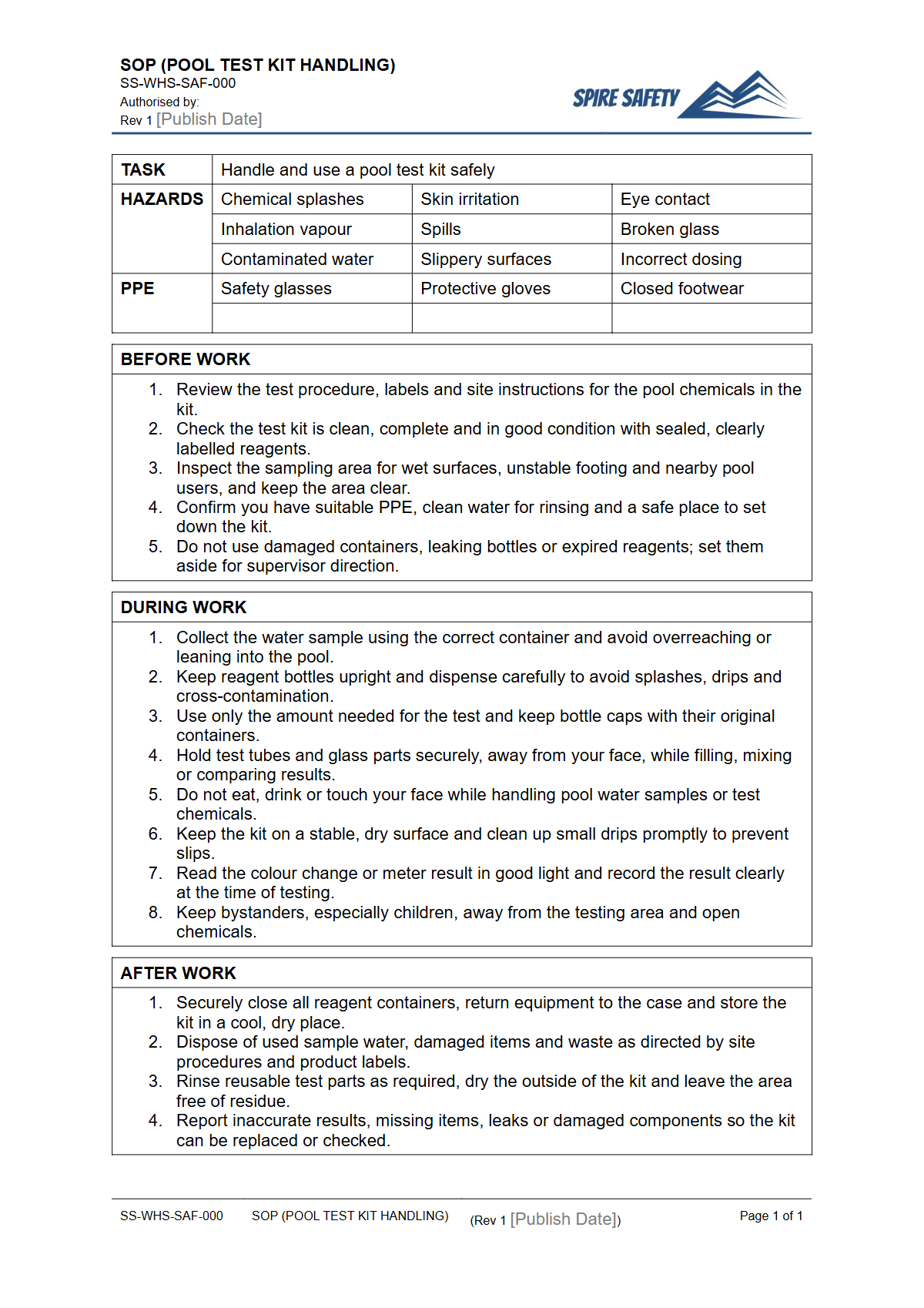
Handling the reagents in pool test kits involves working with hazardous chemicals that can cause skin irritation, eye damage, or other health effects if managed improperly. This Free Safe Operating Procedure (Pool Test Kit Handling) Template provides a structured framework for documenting the risks and control measures associated with this common task.
Using a standardised procedure helps ensure workers follow a consistent, safe process every time they test pool water, minimising the risk of chemical exposure and ensuring accurate water quality readings. Developing clear, documented procedures is a fundamental part of effective WHS management systems, demonstrating a commitment to workplace health and safety.
Video walkthrough
How to use the Free Safe Operating Procedure (Pool Test Kit Handling) Template
This template is provided as a fully editable DOCX file, allowing you to tailor it to your specific operational needs, and a PDF for easy printing and distribution. To use this Safe Operating Procedure for Pool Test Kit Handling, download the file and populate the sections with information specific to your site.
This includes the exact names of the reagents used, the brand of test kit, step-by-step instructions, and emergency procedures. It is critical to consult the Safety Data Sheets (SDS) for each chemical reagent to ensure your control measures, PPE requirements, and first aid information are accurate.
Documented procedures are vital for a wide range of tasks; for instance, a commercial kitchen would use a specific deep fryer SOP to manage its unique hazards.
Important: This is a template and must be customised to your workplace. We cannot guarantee that this document will be suitable for your circumstances.
You must adapt the SOP to the specific equipment, chemicals, context, and personnel at your site. A competent person should review and approve the final document before implementation to ensure all site-specific risks are controlled.
When to use this Safe Operating Procedure
A Safe Operating Procedure (SOP) for handling pool test kits should be used as a primary reference document for several key activities. It forms the basis of initial training and induction for any new staff member tasked with water testing duties.
It should also be readily available at the point of work for quick reference. The SOP is an essential tool during periodic refresher training to reinforce safe work practices and is a key piece of evidence reviewed during internal or external safety audits. Regular reviews of such procedures are a core component of proactive WHS compliance auditing.
Who should use this SOP
This procedure is intended for use by all personnel involved in the testing and maintenance of swimming pools, spas, and other treated water bodies. This includes, but is not limited to: pool technicians, facility maintenance staff, lifeguards with water testing responsibilities, and resort or hotel groundskeepers.
Supervisors and managers should also use the SOP to ensure they are providing correct instruction, monitoring work, and enforcing the established safety standards. It helps Persons Conducting a Business or Undertaking (PCBUs) fulfil their primary duty of care under Australian WHS legislation.
In a large facility, this SOP might sit alongside procedures for other equipment, such as an Air Compressor SOP used by the same maintenance team.
Key Information to Include in Your Customised SOP
To make this template effective, you must populate it with precise details relevant to your operation. Vague instructions can lead to confusion and incidents. Your customised SOP should clearly define:
- Hazardous Chemicals: List the specific names of all reagents used (e.g., Phenol Red, DPD tablets, acid/base demand reagents).
- Personal Protective Equipment (PPE): Specify the exact type of PPE required, such as nitrile gloves and chemical splash-proof safety glasses.
- Step-by-Step Guide: Provide clear, sequential instructions for collecting a water sample, adding reagents, reading the results, and cleaning the equipment. Include details like how long to wait after adding a reagent and how to hold the comparator to the light.
- Emergency Procedures: Detail first aid measures for chemical splashes to skin or eyes and procedures for cleaning up small spills of reagents.
- Storage and Disposal: Outline where to store the test kit (e.g., cool, dry, dark location away from other chemicals) and how to safely dispose of used samples and expired reagents according to local regulations.
Your overarching safety framework may cover everything from chemical handling to the operation of mobile plant, detailed in documents like a Telehandler SOP. You can find more templates to build out your safety system in our free WHS resources library.
Common mistakes
Common mistakes to avoid
- Using reagents that are past their expiry date or have been contaminated.
- Failing to thoroughly rinse vials with pool water before and sample water after each test.
- Testing water immediately after adding balancing chemicals, which leads to inaccurate readings.
- Touching reagent tablets with bare hands, as oils and moisture can affect the test results.
Legal references
Legal considerations
The following legal requirements may be relevant to this type of work.
- Work Health and Safety Act (Harmonised) — Provides the primary duties for protecting workers and other people from work health and safety risks.
- Work Health and Safety Regulations (Harmonised) — Sets out requirements supporting the management of workplace hazards and risks.
The following codes may be relevant to this type of work.
- Managing WHS Risks Code of Practice — Provides practical guidance on identifying hazards, assessing risks and applying effective controls.
- Work Health and Safety Consultation, Cooperation and Coordination Code of Practice — Provides practical guidance on consulting workers and coordinating with other duty holders.
- Managing the Work Environment and Facilities Code of Practice — Provides practical guidance on safe work environments, workplace facilities and related controls.
Did you know
Reagents Expire
Most chemical reagents used in pool test kits have an expiry date. Using expired reagents can lead to highly inaccurate test results, potentially causing you to mismanage your pool's chemical balance.
Tablet vs. Liquid
DPD tablets are generally considered more stable and less prone to degradation than their liquid reagent counterparts, often providing more consistent and reliable chlorine readings over time.
FAQ
Frequently asked questions
01What Personal Protective Equipment (PPE) is needed for handling pool test kits?
02How should I store chemicals from a pool test kit?
03Are Safe Operating Procedures a legal requirement in Australia?
04How often should a pool test kit handling SOP be reviewed?
Share this resource
Free Safe Operating Procedure (Pool Test Kit Handling) Template
Browse Categories
How To Use It
- 1Download and open in Word or PDF.
- 2Replace the placeholders with your business details.
- 3Get it reviewed by a WHS specialist before rollout.
Need it customised?
Our WHS consultants can adapt this template to your site, run a gap analysis, or audit what you already have in place.
Book a Free Consultation WHS consulting servicesor call 1300 156 382
Related templates
- Free Safe Operating Procedure (Pool Tile Cleaning) Template
- Free Safe Operating Procedure (Pool Vacuuming) Template
- Free Safe Operating Procedure (Pool Water Log Check) Template
- Free Safe Operating Procedure (Poolside Furniture Move) Template
- Free Safe Operating Procedure (Port Gate Check) Template
- Free Safe Operating Procedure (Port Litter Cleanup) Template