
Free Safe Operating Procedure (Port Litter Cleanup) Template
Effectively manage waste in maritime environments with our free Safe Operating Procedure for port litter cleanup. Download the customisable template today.
Free Safe Operating Procedure (Port Litter Cleanup) Template
DOCX • 126 KB + PDF
Updated Oct 2026
No signup required
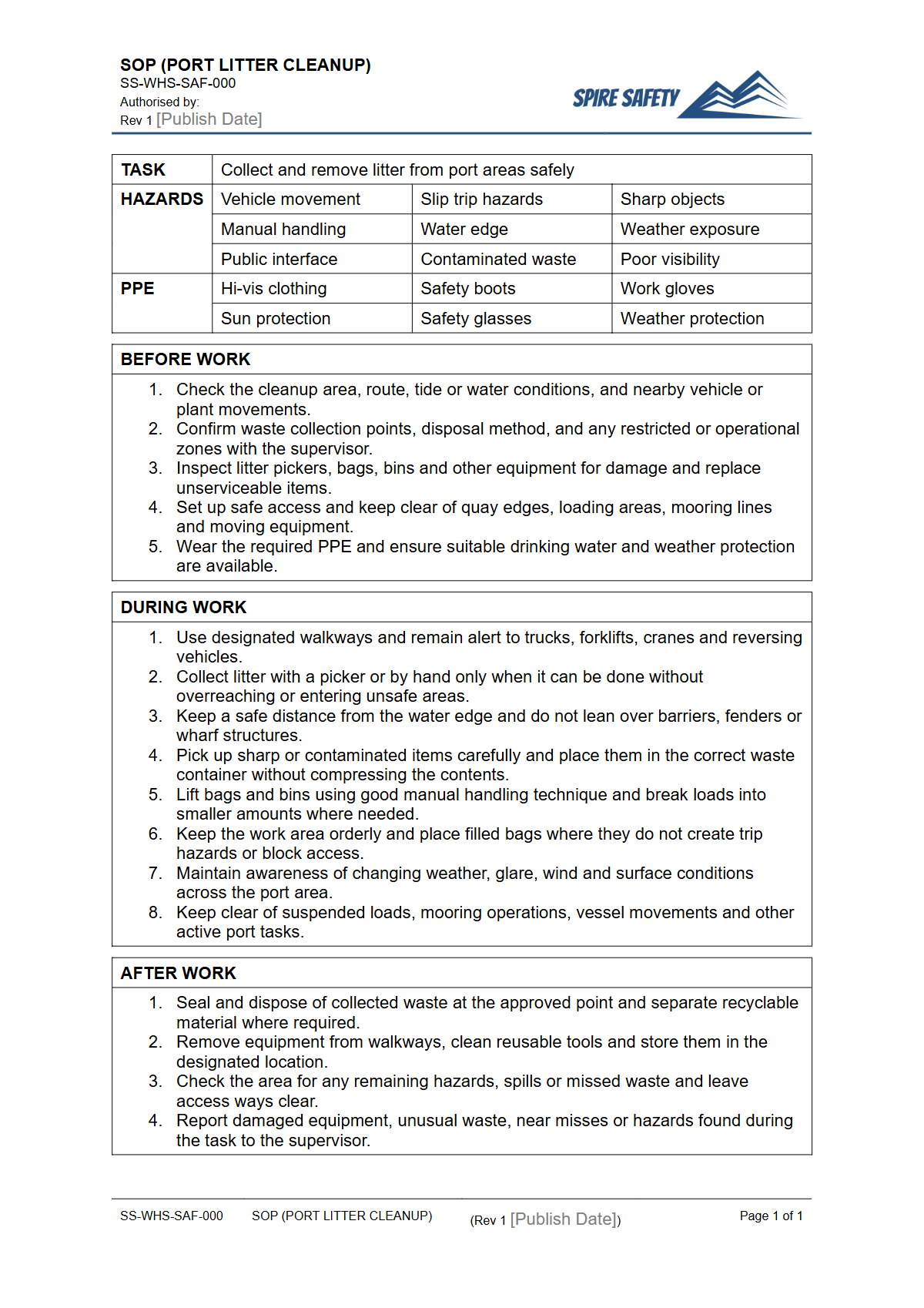
Purpose of the Free Safe Operating Procedure (Port Litter Cleanup) Template
This Free Safe Operating Procedure (Port Litter Cleanup) Template serves as a critical tool for systematically managing health and safety risks associated with waste collection in maritime settings. A port is a dynamic environment with unique hazards, including moving vehicles, heavy machinery, proximity to water, tidal movements, and potential exposure to unidentified substances.
This SOP provides a structured format to document step-by-step instructions, define responsibilities, and specify safety controls. By formalising these protocols, you create a clear, repeatable process that reduces the likelihood of incidents and demonstrates a commitment to worker safety.
It also ensures safety protocols are integrated into your broader comprehensive WHS management systems, strengthening your overall safety culture.
Video walkthrough
How to use the Free Safe Operating Procedure (Port Litter Cleanup) Template
To get the most value from this Free Safe Operating Procedure (Port Litter Cleanup) Template, it must be adapted to your specific operational context and site conditions. Simply downloading and printing the document is not enough.
The Word (DOCX) version is designed for easy editing, allowing you to add, remove, and modify sections to reflect your unique environment and equipment. Regular reviews are also essential, often forming part of a scheduled WHS compliance auditing program to ensure ongoing effectiveness.
A Note on Customisation
We have drafted this template as a helpful starting point, but it is not a complete, out-of-the-box solution. You MUST customise it by conducting your own site-specific risk assessments and consulting directly with the workers who will be performing the task.
Their direct experience is invaluable for identifying practical hazards and effective controls. Key sections you will need to adapt include:
- Personal Protective Equipment (PPE) requirements based on a risk assessment.
- Site-specific hazard identification (e.g., tides, vehicle traffic routes, uneven surfaces, public access areas).
- Waste segregation, handling, and disposal procedures specific to your port.
- Emergency procedures for scenarios like man overboard, injuries, or hazardous material spills.
- Worker training and competency requirements.
When to use this Safe Operating Procedure
This SOP is not just for formal training sessions. It should be a live document, actively used to guide day-to-day operations and reinforce safe work practices. It is intended for use during:
- Initial worker induction and task-specific training.
- Pre-start briefings before commencing each cleanup shift.
- Refresher training sessions to maintain competency.
- Planning for non-routine cleanup tasks, such as after a storm or an event.
- Incident investigations to review whether procedures were followed.
Who should use it
The responsibility for safety is shared, and this SOP is relevant to several roles within a port or maritime organisation. Port managers, WHS professionals, and supervisors can use this template to develop and implement formal safety processes.
Workers performing the cleanup are the primary end-users and should be able to refer to the SOP to understand the expected safe work method. Involving them in the customisation process is not just good practice; it's essential for creating a procedure that is practical and effective.
Sometimes, bringing in external WHS consulting support can help facilitate this consultation process efficiently.
Integrating the SOP into your WHS Framework
A Safe Operating Procedure is most effective when it's part of a connected safety framework; it should not exist in isolation. Consider how the port litter cleanup task interacts with other activities on site and ensure procedures are aligned.
For example, the movement of heavy machinery is a common hazard in ports, and your safety system must account for the interaction between pedestrians and mobile plant. Your safety system should include procedures for all high-risk equipment, similar to how you would document processes in our FREE Telehandler SOP Template. This integrated approach ensures that risks are managed holistically across the entire operation.
A well-developed SOP is a cornerstone of a safe workplace, providing clarity and consistency for high-risk tasks. By downloading and adapting this template to your specific needs, you take a proactive step towards protecting your workers and meeting your WHS obligations.
Be sure to explore our complete free WHS resources library for more tools to support your safety goals.
Common mistakes
Common mistakes to avoid
- Using the template without performing a site-specific risk assessment.
- Failing to identify and address all hazards, such as tidal movements or vehicle traffic patterns.
- Neglecting to train workers on the finalised SOP and verify their understanding before they start work.
- Not reviewing and updating the procedure after an incident, near-miss, or change in operations.
Legal references
Legal considerations
The following legal requirements may be relevant to this type of work.
- Work Health and Safety Act (Harmonised) — Provides the primary duties for protecting workers and other people from work health and safety risks.
- Work Health and Safety Regulations (Harmonised) — Sets out requirements supporting the management of workplace hazards and risks.
The following codes may be relevant to this type of work.
- Managing WHS Risks Code of Practice — Provides practical guidance on identifying hazards, assessing risks and applying effective controls.
- Work Health and Safety Consultation, Cooperation and Coordination Code of Practice — Provides practical guidance on consulting workers and coordinating with other duty holders.
- Managing the Work Environment and Facilities Code of Practice — Provides practical guidance on safe work environments, workplace facilities and related controls.
Did you know
Marine Debris
The CSIRO estimates that around 11 million tonnes of plastic waste enter the ocean every year, much of which accumulates in coastal and port areas, posing significant environmental and safety risks during cleanup.
Consultation is Key
Under Australian WHS law, employers have a duty to consult with workers on matters that directly affect their health and safety. This includes the development and review of Safe Operating Procedures.
FAQ
Frequently asked questions
01What are the main hazards in port litter cleanup?
02How often should a Safe Operating Procedure for port litter cleanup be reviewed?
03Does this SOP cover hazardous material spills?
04Who is responsible for ensuring the SOP is followed?
Share this resource
Free Safe Operating Procedure (Port Litter Cleanup) Template
Browse Categories
How To Use It
- 1Download and open in Word or PDF.
- 2Replace the placeholders with your business details.
- 3Get it reviewed by a WHS specialist before rollout.
Need it customised?
Our WHS consultants can adapt this template to your site, run a gap analysis, or audit what you already have in place.
Book a Free Consultation WHS consulting servicesor call 1300 156 382
Related templates
- Free Safe Operating Procedure (Port Shed Cleaning) Template
- Free Safe Operating Procedure (Port Waste Handling) Template
- Free Safe Operating Procedure (Portable Appliance Test) Template
- Free Safe Operating Procedure (Portable Bandsaw) Template
- Free Safe Operating Procedure (Portable Heater) Template
- Free Safe Operating Procedure (Portable Hoist Check) Template